
The (No B.S.) Guide to AI (AEO) Search for Small Local Service Businesses
(Date of last guide edit: Sept 10, 2026)
An AI Overview is an automated summary — or a direct answer to a question — that appears at the top of a search.
It works by evaluating multiple sources across the internet and generating the best answer it can find for the searcher.
To get your business mentioned in an AI Overview, you need to become a trusted source: that means creating helpful content that answers real questions, keeping your Google Business Profile and website accurate and current, and building credibility across the web.
AI doesn't choose a business at random — and unlike traditional SEO, you can't trigger AEO visibility with keywords alone.
That's what an AI Overview is in a nutshell.
Now, let's get into a real education - everything AI for a local service business.
First, Let's Talk About "The Call Pool" - What is it?
You'll see this term throughout the guide, so let's define it up front: the Call Pool is the small handful of businesses a customer sees first when they search for a service online.
Think about the last time you searched for a plumber, a spa, or a roofer. You probably didn't scroll through fifty options — you looked at whoever showed up in the first few results and chose from there.
That short list at the top of the scroll is the Call Pool.
Everyone outside of the Call Pool is not very visbible to the searcher.
Keep the Call Pool in mind as you read — it will come up a lot.
The 3 Variables of Being Visible in (AI) Search
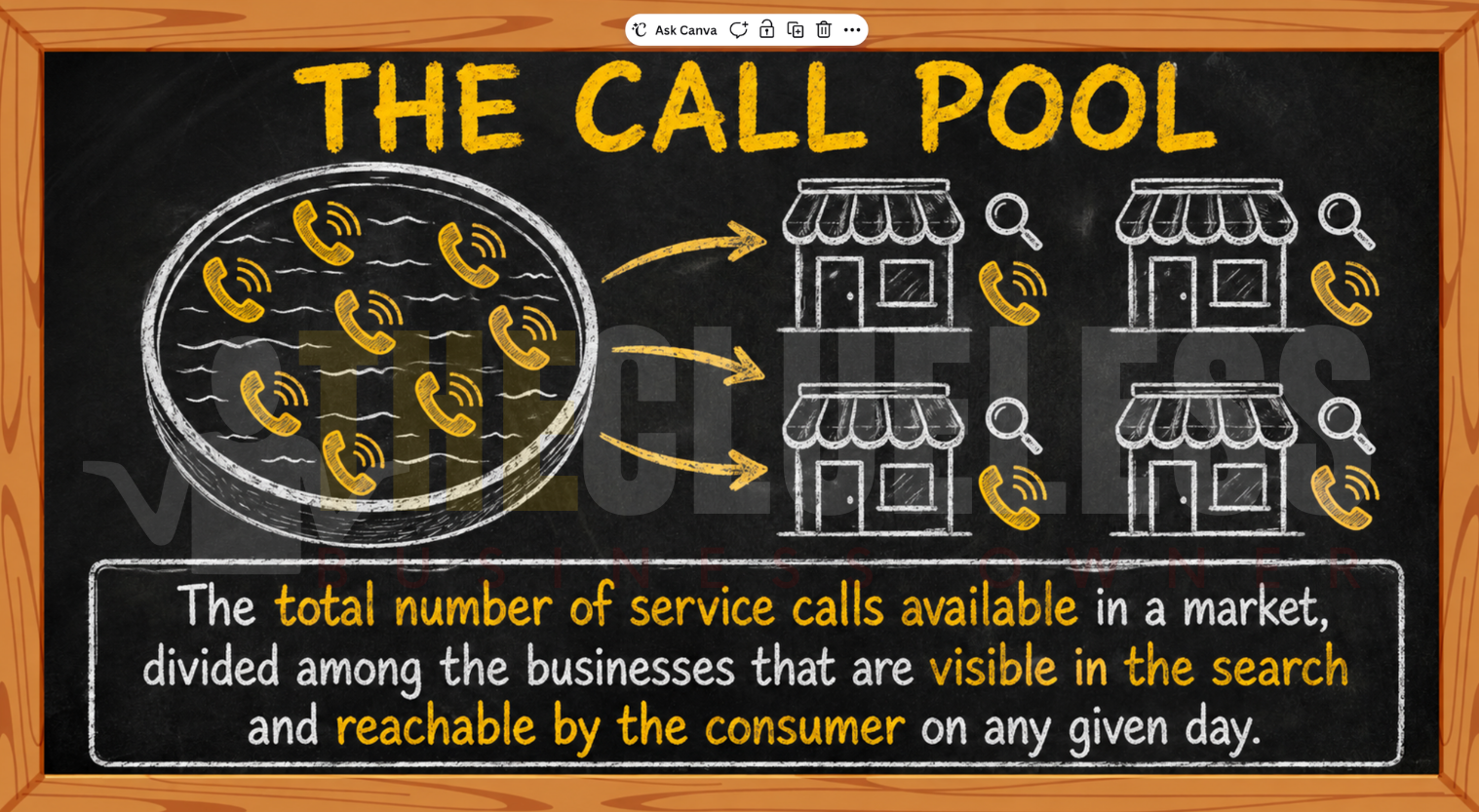
1. The Trust Trail
Your business needs a consistent, credible presence across the internet. Your website, Google Business Profile, directories (Yellow Pages, Yelp etc..), review platforms, social profiles, and other reputable sources should all reinforce the same basic story: who you are, what you do, where you do it, and why people should trust you.
I call this your Trust Trail.
Think of it as the information AI and search engines can find across the internet that helps confirm what your own website says about your business. The stronger and more consistent those signals are, the easier it is for search engines and AI platforms to understand your business — and trust what they find.
2. Recent Content
Freshness has always mattered for SEO, but it appears to matter even more for AI search.
Ahrefs analyzed 17 million AI citations and found that content cited by AI assistants was, on average, 25.7% fresher than the content showing up in traditional Google search results.
That doesn't mean you need to publish constantly just to look active, and it definitely doesn't mean changing the date on an old article and calling it new.
The content still has to be genuinely relevant, useful, and accurate. Focus on answering the questions your customers are actually asking, and revisit your existing content to make sure it's still accurate.
When you have something meaningful to add, update it. Freshness alone won't make AI choose your content — but when AI is choosing between several credible sources, useful and current information gives you an edge.
3. A Top Source
This is where traditional SEO becomes especially important.
Google has said that traditional SEO best practices remain foundational for visibility in its AI experiences — but that doesn't mean you need to rank #1, or even land in the top organic results, to get cited in an AI Overview.
Google can and does surface supporting sources beyond the highest-ranking results.
That said, if your website already performs well in traditional search, you have a real advantage.
Google already knows about you, can crawl and index your content, and has signals showing your pages are relevant to what people search for that is related to what you sell.
Additionally, ranking at the top of Google doesn't guarantee you'll be selected for an AI Overview — but strong traditional search visibility gives you a head start.
Bottom line: AI search isn't replacing good SEO. It's creating another opportunity for good SEO to pay off.
Local Search Adds Another Layer
The three variables above apply whether you're building visibility locally or nationally. But when someone searches for a local service provider — a plumber, dentist, chiropractor, spa, window company — Google adds another consideration: local relevance.
Google has long said that local search results are primarily based on relevance, distance, and prominence.
In simpler terms:
- Does your business offer what the person is looking for? (Relevance)
- Is it relevant to the location they searched? (Distance)
- How established does your business appear to be? (Prominence)
That means local businesses have a few extra things to get right.
Your Google Business Profile needs to be complete and accurate, your service area needs to make sense for the market you're targeting, and your business information needs to be consistent across your website, your GBP, and every other credible place you appear.
This is exactly where your Trust Trail matters most — reviews, local directories, backlinks, community mentions, and industry websites all reinforce what your website and GBP already say about you.
Reviews Tell AI More Than "This Is a Good Business"
Reviews are more interesting than they used to be, because they contain more information than a star rating.
Compare these two reviews for a window replacement company:
- "Great company. Highly recommend!"
- "The Window Guyz did an amazing job replacing the windows in our home."
Both are great reviews, but the second gives AI far more to work with — it doesn't just say the customer had a good experience, it says exactly what the company does - and that they are good at it.
I want to be careful here: Google hasn't said that getting customers to mention a specific service in their review automatically boosts your rankings.
But detailed, authentic reviews create a much richer body of information about your business, and for a local service business, that's genuinely valuable.
Instead of telling customers exactly what to write, just encourage them to describe their actual experience — what service they had done, what problem you solved, what they appreciated.
Over time, those reviews become a real body of customer-generated content that reinforces what your business says about itself.
So stop thinking only about how many reviews you have or how many stars you've earned. Start thinking about the information inside those reviews.
People Don't Often Click Into AI Overviews
One more thing worth knowing here: research consistently shows people rarely click through to the sources cited inside an AI Overview.
DemandSage's search analytics put it at under 8% of users following the links AI Overviews provide, and Seer Interactive's tracking found organic click-through drops as much as 61% on the same query once an AI Overview appears (a dip that's been slowly recovering through 2026, per their most recent data).
The exact number moves depending on who's measuring and how, but the direction is consistent: it's a small fraction of visits. That doesn't mean people aren't using AI Overviews.
Most local service business searchers click into the Google Business Profiles.
In the next section we will talk about zero-click searches. When it comes to local business search there's a lot of fear-based nonsense floating around.
Zero-Click Searches, Demystified
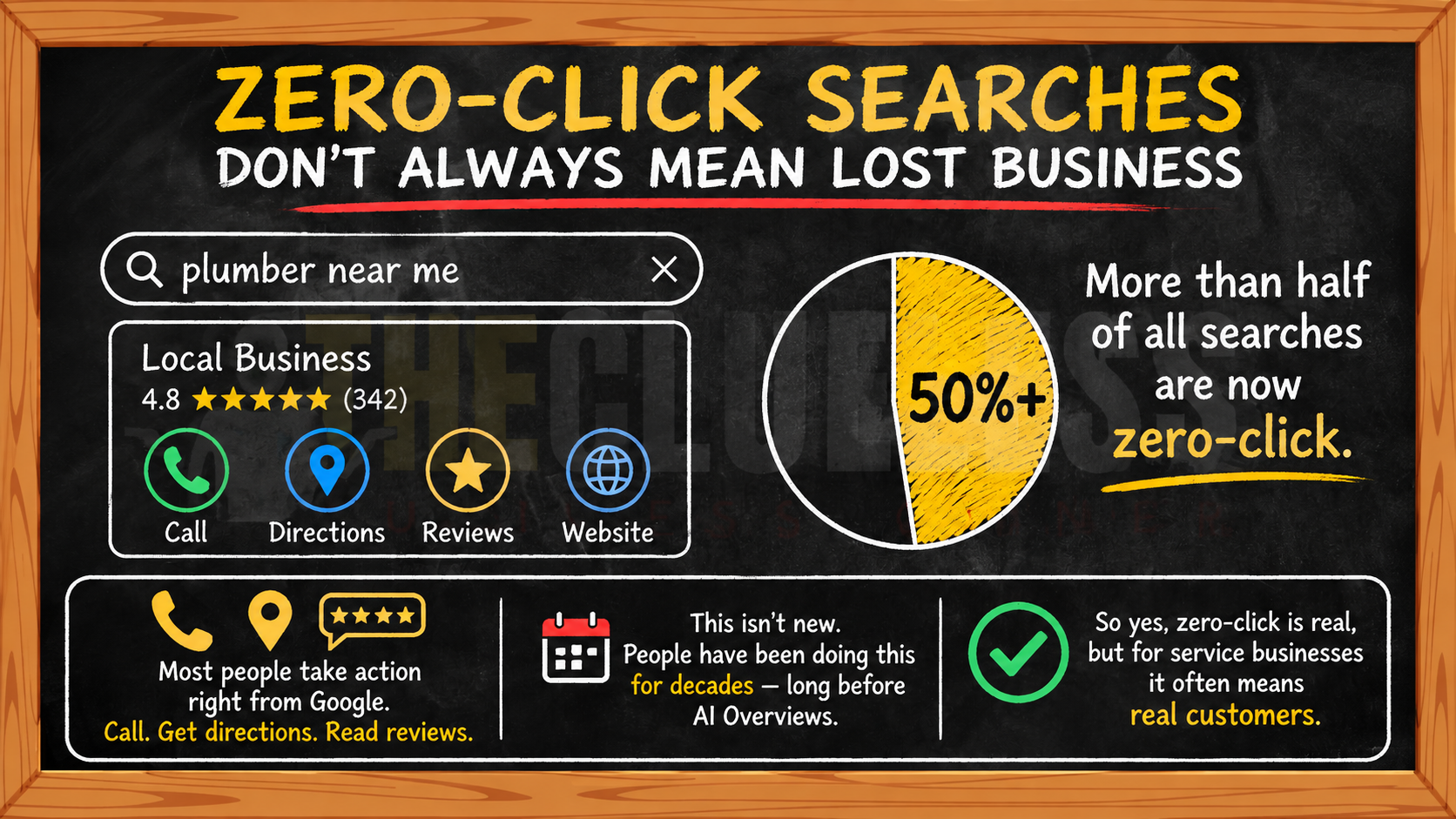
You've probably heard some version of "more than half of all searches are now zero-click." It's a real statistic.
But here is my personal problem with it - this statistic is often a misused piece of information a marketing company uses for fear-based selling of their services.
So let's actually walk through what it means.
A zero-click search happens when someone types a question into Google, gets an answer, and creates an action that is outside of clicking through to a website.
Think about how often you look things up like:
- Local weather or flight statuses
- Driving directions or business hours
- "What time does the hardware store close?"
- "How much does a 50-gallon water heater cost?"
- "Who has the best reviews for a roofer near me?"
You can achieve answers to questions like those without clicking through to a website.
That is a zero-click search.
For over twenty years, the internet worked on a simple model: search, click a website, decide who to contact.
Today, Google and AI systems increasingly try to answer those questions directly inside the search experience, thus eliminating some steps before the searcher gets the information they asked for.
Here's the part the fear-based marketers leave out: most transactional searches for a service business click on Google Business Profiles — and Google counts that as a zero-click search too, because the person never visited an actual website.
This isn't new search behavior.
Searchers have been tapping "Call Business," getting directions, or reading reviews straight off Google Business Profiles for decades, long before AI Overviews EVER existed. (Zero-click searches have literally been happening for two decades!)
This is why it matters to understand informational searches from transactional ones:
- Informational (zero-click): learning a fact or getting an answer that doesn't require action. Example: "Why is my hot water heater leaking?"
- Transactional (High Intent Search): taking immediate action — buy, hire, call, request a quote. Example: "plumber near me" or "hot water heater repair near me."
Transactional searches can also be zero-click — again, because most of them end with the searcher clicking on what is the most popular real estate on the Internet, which is Google Business Profiles. (This still means a call is going to happen - a lead.)
You cannot compare the data from these two search types; they behave completely differently, and they impact your business in completely different ways.
So why do so many marketers push the "over 50% zero-click" stat with no context?
Partly because business owners, for the most part, aren't educated on what it actually means. And partly because fear generates clicks.
Imagine a homeowner searches "How much does it cost to install a ceiling fan?"
Google might show a quick AI Overview summarizing the typical price range and the factors that affect cost — pulled directly from information it gathered from websites like yours.
That doesn't mean websites no longer matter. It means Google is answering basic questions on the screen itself.
However, the answers to those questions, that Google uses, COMES FROM WEBSITES.
Although many claim websites are becoming irrelevant.
Because of this shift, your website now has two jobs:
- Job #1: Help Google understand and trust your information, so it uses your business data to fuel those quick answers.
- Job #2: Give the customer a compelling reason to click your link when they're actually ready to hire someone.
The real threat to your business is not AI.
The REAL threat to your business is invisibility.
And by the way — this has been true since long before AI ever entered the picture.
So really, what has changed?
Before you even thought about AI search - was your business visible in search in the first place?
SEO Isn't Dead — It's the Foundation Everything Is Built On
You'll hear plenty of marketers proclaim that "SEO is dead." It isn't. SEO is the foundation of AEO.
Google uses the same quality framework it's used for MANY years: E-E-A-T.
It sounds like tech jargon, but it represents four simple, real-world questions:
- Experience: Have you physically done the work the searcher needs?
- Expertise: Do you actually know what you're talking about?
- Authoritativeness: Are you recognized as a credible, go-to local source?
- Trustworthiness: Can a searcher trust your business not to rip them off?
Modern AI search models look for these exact same trust signals. If your digital footprint proves you have high E-E-A-T, you'll rank higher - bottom line.
At the same time, Google is actively burying low-quality, robotic content written purely to game the algorithm. You can't cheat the system anymore — you just have to prove you're a great local business.
If your business already has a well-optimized website, strong traditional search visibility, and an established online presence, you're not starting from scratch. You've already built much of the foundation you need.
The fundamentals are still remarkably familiar: a great website that clearly explains what you do, great reviews, an accurate Google Business Profile, and a strong Trust Trail.
What's new is one more consideration layered on top — keeping all of that digital information useful, accurate, and current.
AI Didn't Create This Shift. It Just Sped It Up.
The core fundamentals of online visibility have stayed remarkably consistent for over a decade.
To win clients online, businesses still need a strong, fast website; accurate, matching business information (NAP); consistent, detailed reviews; helpful content; and real-world trust signals.
The platforms are evolving, but Google's obsession with trust, expertise, and authority is nothing new - and it is NOT going away.
Remember the Voice Search Craze around 2017–2019?
Amazon Alexa exploded, Google Assistant expanded rapidly, Siri became a household name — and tech gurus predicted more than 50% of all searches would be voice-based by 2020.
Marketers said you needed a whole new, expensive strategy to be visible through smart speakers.
What actually happened?
Voice search assistants used the exact same information ecosystem as typed search. The businesses that were already visible on Google Maps and their own websites were the same businesses showing up in Alexa and Siri results.
Voice search changed how people asked a question — it never changed where the answers came from.
AI search is the same story wearing a new hat.
The businesses that demonstrate real expertise, build genuine trust, and maintain a clean online presence are still the ones sitting at the top of the scroll.
Google has publicly said traditional SEO best practices remain completely relevant, because its AI features are built directly on top of the same core ranking and quality systems it's always used.
As Brendon Kraham of Google says, "The best formula for success remains foundational SEO."
When there's a disagreement between a marketer's hype and what Google says about its own systems, I listen to Google — and I'd suggest you do the same.
The Digital Real Estate Landscape
Think of search results like physical real estate.
The various spots where your business can show up are just different types of real estate — and just like land real estate, not all of it has the same value.
I consider the Google Business Profile section of search beachfront property.
For a local service business, the "3-pack" (the first three map results a customer sees before clicking "more") is the most valuable land on the screen.
Using that same comparison: Google didn't bulldoze the old neighborhood.
It simply built a new condominium next door called AI Overviews.
AI search doesn't invent new facts out of thin air, and there's no secret system for listing your business.
It uses the exact same Google information ecosystem you're already familiar with.
What's different is that AI Overviews now show up on roughly 48% of tracked U.S. search queries, per BrightEdge's tracking as of early 2026 — up from around 31% just a year earlier.
That's a fast-moving number and it'll keep climbing, so don't hold me to the exact figure by the time you're reading this.
But here's the piece that actually matters for you: AI Overviews still show up far less often on local, transactional searches — the "plumber near me" type of query you actually care about — than on general informational ones.
Don't let a headline stat about search overall convince you the sky is falling on your specific corner of it. Searchers still mostly click on Google Business Profiles for local business services just like they have for 2 decades.
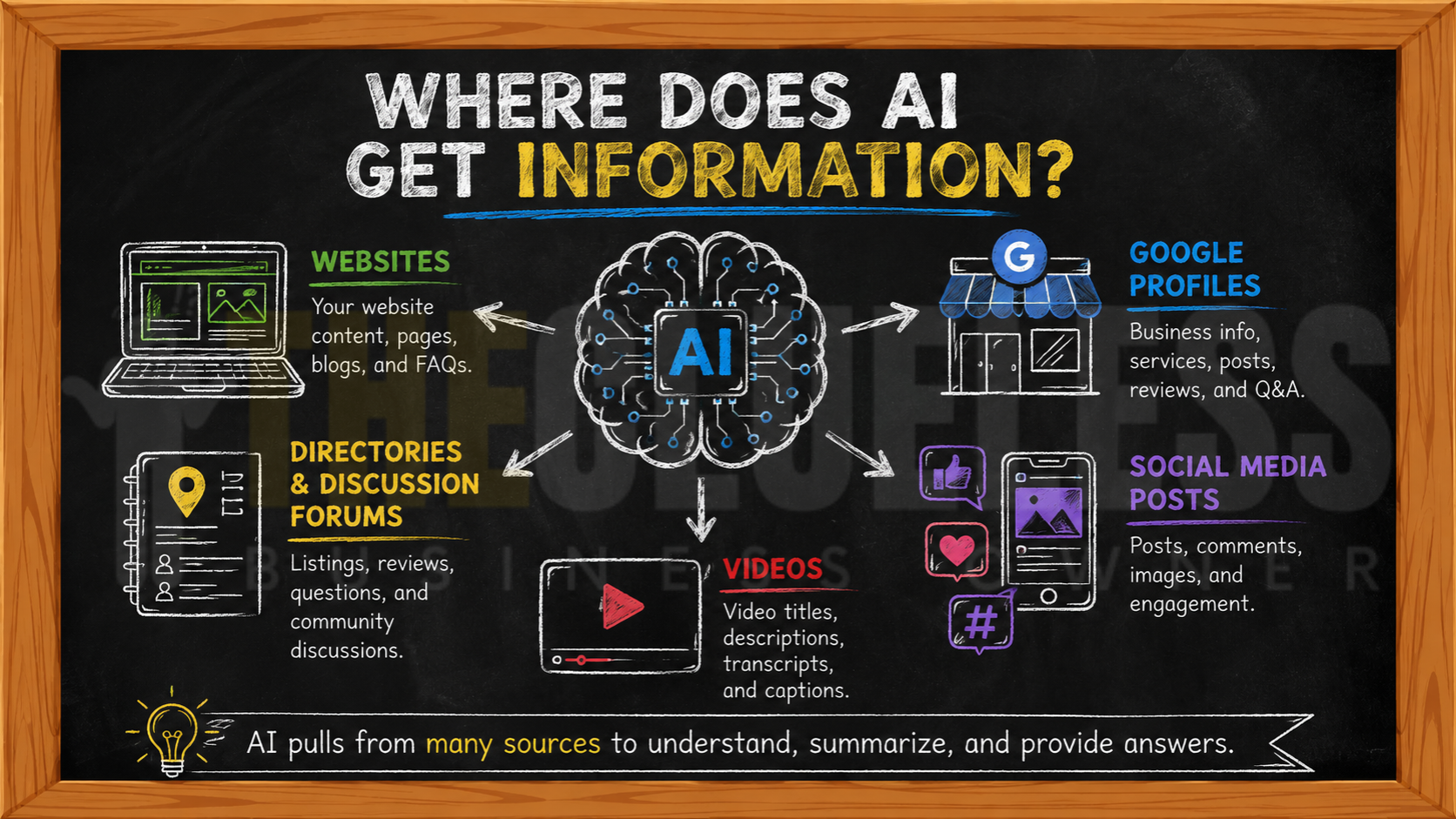
Where Does AI Actually Get Its Information?
AI platforms don't guess or play favorites — they pull from a broad spectrum of sources, and which ones matter most depends on the type of query.
For local service providers, five sources matter most:
1. Your company website
AI crawls your entire site to understand the scope of your services — not just the main text, but meta titles, service pages, blog posts, and your FAQ section.
It also reads hidden technical data like schema markup, page titles, and image alt text to verify you're a legitimate operation. This is exactly why building strong Answer Zones (more on that below) matters so much — it gives AI a quick, clear window into what your site and what a particular page is about.
2. Your Google Business Profile
This is often the single biggest source for local AI search. AI reads your business categories, photos, and description — and it heavily reads your customer reviews and your replies to them.
One trick I use with my own clients: strategically weaving important service keywords into review replies gives the AI engine more data to work with. It also scrapes your Google Posts, a feature most local businesses completely ignore.
Also, most business owners assume landing in the Top 3 comes down to reviews and proximity — it doesn't.
Did you know that your website is a ranking signal too? And ignoring it means leaving one of your best levers sitting completely untouched.
3. Directory listings and discussion forums
AI engines reference major directories like Yelp, Houzz, and Yellow Pages to verify your phone number and address.
Just as important, they pull real-world sentiment from places like Reddit and Quora — seeing what actual humans recommend when they think no one official is watching.
4. Social media
Social content is starting to show up inside AI search results more than ever. A highly relevant, localized post on Instagram or Facebook can get pulled straight into an AI response.
AI can even scan and analyze the text and objects inside your photos — one more reason to ditch generic graphics for real, helpful content.
5. Video content
AI loves video, and prefers raw, human-generated footage over polished corporate commercials. A simple YouTube channel with short, straightforward smartphone videos answering basic customer questions is a genuine goldmine for AI search data.
For a local business, your website and Google Profile still function as the master sources of truth — but your online presence is no longer evaluated in one isolated corner of the internet. AI is actively looking for consistency, credibility, and supporting information across the entire web.
This is exactly why a business can no longer rely on a single, isolated marketing tactic.
The 4 Major AI Platforms
When most business owners think about AI, they only think of ChatGPT.
In reality, there are four major platforms local consumers are using right now to research services and make buying decisions:
- ChatGPT (roughly 1 billion weekly users) — created by OpenAI, currently the most widely used conversational AI assistant on the planet.
- Gemini (roughly 1 billion weekly users) — Google's native AI platform, baked directly into Google Search and Android.
- Copilot (roughly 420 million monthly users) — Microsoft's assistant, built into Windows, Microsoft 365, and Bing.
- Claude (surging past 900 million monthly visits, up well over 800% year-over-year) — created by Anthropic, popular for its conversational and analytical strength.
(A heads-up on these numbers: this is one of the fastest-moving corners of tech, and every one of these figures will be out of date within a few months of whenever you're reading this. Treat the relative order — and the fact that all four keep growing fast — as the lasting takeaway, not the exact counts.)
You don't need to master the technical inner workings of all four. What matters is one simple truth: your customers are no longer looking for information in just one place.
Traditional Google search still dominates total search volume by a wide margin, but AI assistants are carving out a real and rapidly growing share of it — Google itself is still the undisputed king, but that lead is shrinking every quarter, not holding steady.
ChatGPT vs. Google AI (Gemini) — What's the Difference?
Think of it like an apple and an orange — both fruit, designed for different purposes.
Gemini was built to help people search the web; it analyzes Google's search index and summarizes what it finds.
ChatGPT was built to have conversations and answer questions directly; when it needs current information, it can search the web and combine multiple trusted sources.
Or think of it this way: Google AI is a librarian. You ask a question, and the librarian pulls the best books off the shelf and summarizes them.
ChatGPT is a knowledgeable consultant. You ask a question, and the consultant answers from everything they know, checking sources when appropriate.
Google AI asks, "Which websites should I summarize?" ChatGPT asks, "What's the best answer to this question?"
How to Get Your Business Listed on ChatGPT
Despite what some marketers would have you believe, you don't submit your business to ChatGPT.
There's no form, no directory, no button to push, and it's not something you can buy (outside of running ads, which is a separate thing entirely).
ChatGPT discovers and evaluates businesses using publicly available information across the web. When someone asks for a recommendation, it looks for enough trustworthy evidence to confidently mention you.
Here's what actually helps: a professional website with helpful, original content; accurate and consistent business information across the web; positive reviews; a complete Google Business Profile; mentions on reputable websites; and content that demonstrates real expertise.
Notice this isn't much different from what improves your odds in Google's AI Overviews.
The mistake most business owners make is trying to optimize for one AI platform specifically — instead, build a strong digital presence that any AI can trust.
Worth knowing: OpenAI announced a partnership that lets ChatGPT use Yelp's reviews, ratings, photos, and business information when answering local search questions.
That's one more reason to claim your free Yelp Business Profile and keep it accurate.
You do not need to buy Yelp advertising in order for ChatGPT to have access to the information.
(Sidenote: Yelp has faced thousands of FTC complaints and multiple lawsuits from small business owners who say their sales tactics cross a line -
which I have personally experienced
on more than one occasion in my 15 year career.
And while courts have continually sided with Yelp on these legal battles, the sheer volume of complaints tells you something about their tactics.
The ChatGPT partnership runs on Yelp's underlying business data, not on whether you're a paying advertiser. Claim the free profile, fill it out completely, and you're done. Don't let anyone bully you into thinking otherwise.)
Making Your Website Feed the AI Engine
In the past, you wrote website content for two audiences: search engines and human visitors. Now there's a third audience at the table: AI.
AI search systems don't read your website like a human does — they crawl it looking for structured data, heading hierarchy, and clear Q&A formats.
If your content is thin or vague, AI will simply move on to a competitor's site.
This is exactly why I moved away from thinking purely in "keywords" and started thinking in terms of searcher intent — what specific questions are your customers asking, and what problems are they trying to solve?
Your Google Business Profile may be what a customer sees first, but your website gives Google far more information about who you are, what you do, and where you operate.
Google has said explicitly that information in Business Profiles can come from publicly crawled information — including your own website. Your website and your GBP don't exist in separate worlds; they work together.
To be clear about what a great website doesn't guarantee: having a great website does not guarantee your Business Profile lands in the Map Pack.
Google has never published its exact ranking formula, and distance alone can mean a business ranks prominently for one searcher and not another.
Nobody can legitimately promise you the Top 3. What we can say is that Google crawls your site, uses information from across the web to understand your business, and explicitly names relevance, distance, and prominence as the primary local ranking factors.
So despite the fact that many people believe review and proximity alone determine what businesses land in the 3-pack - that could not be further from the truth.
Your website isn't irrelevant in AI search... NOT EVEN CLOSE. In fact, its job is just getting bigger.
Create an Answer Zone
Here's the single most useful framework I can hand you for structuring your content, and I know it works: I call it the Answer Zone.
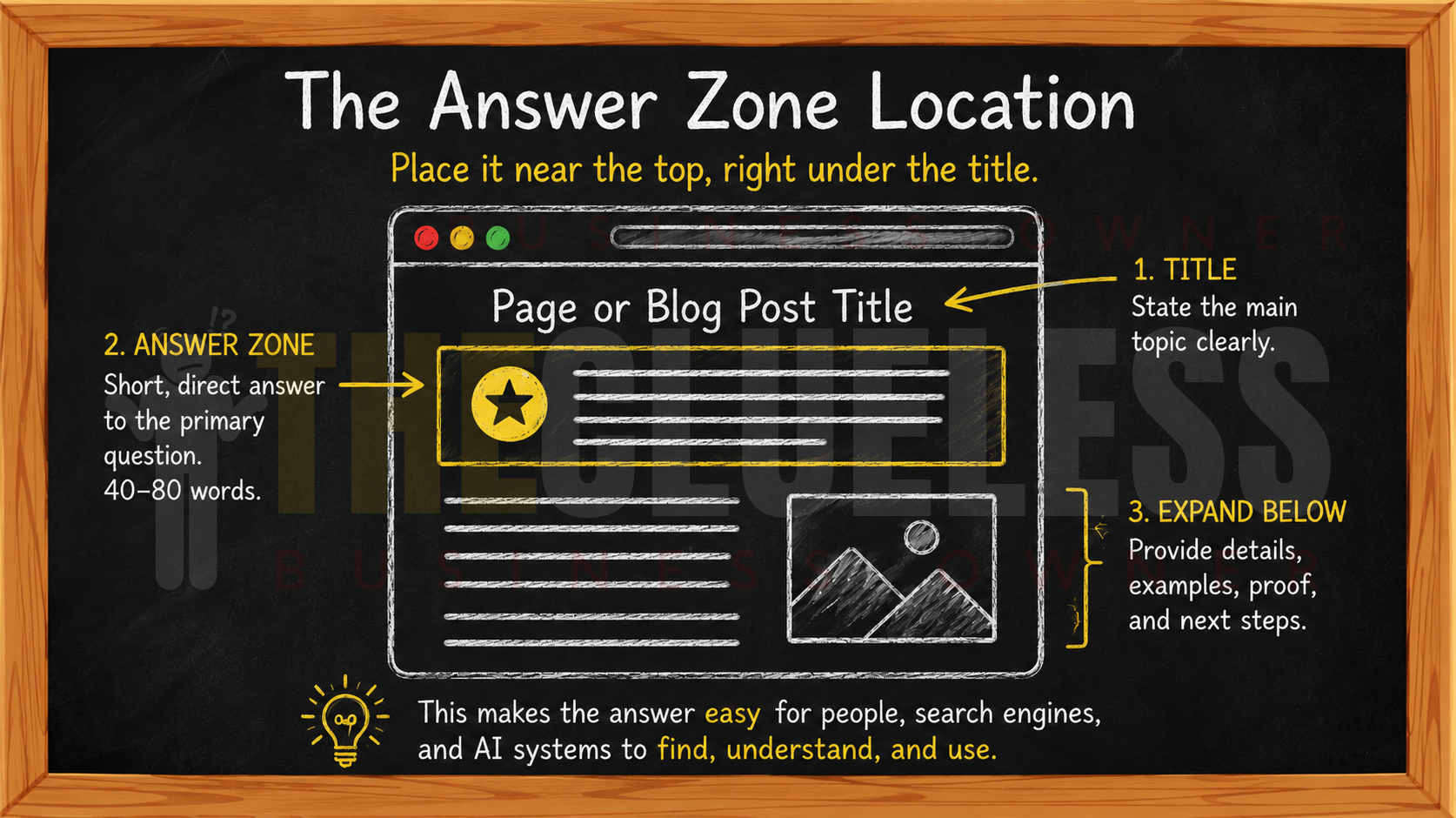
The Answer Zone is a short section placed at the top of an important page or blog post that clearly answers the primary question or search intent of that page — before you spend the rest of the page explaining, educating, and demonstrating expertise.
How to build one:
- Identify the main question. What's the one thing someone landing on this page actually wants to know?
- Answer it immediately. Aim for roughly 40–80 words — no magic number, but the goal is a clear, direct answer with no long intro, company history, or sales pitch first.
- Make it stand on its own. Someone should be able to read only the Answer Zone and walk away understanding the basic answer.
- Include specifics when useful. Names, services, locations, numbers — anything that makes it more precise, without keyword-stuffing.
- Expand below it. The rest of the page supports and expands the answer with explanations, examples, FAQs, and photos.
The test: read your Answer Zone alone and ask, "If this were the only paragraph an AI system saw, would it understand the answer?" If yes, you've built a strong one.
One important caveat: the Answer Zone isn't a magic ticket into an AI Overview. You still need to have a great overall online ecosystem built around your business.
There's no special format, word count, or markup that guarantees Google or any AI platform will cite your site — Google has said you don't need special AI-specific tricks to be eligible.
The Answer Zone is simply a framework for making your most important information clear, useful, and easy to find. That's good for AI, good for search engines, and — most importantly — good for the human who came to your site looking for an answer.
And by the way we have been very successful getting our clients into many AI Overviews using this strategy. Given of course the ecosystem around the client's business is very strong - you must first have this in place.
Example Answer Zone: Let's say you're a window company with a page titled "How Do You Know It's Time to Replace Your Windows?"
Instead of opening with several paragraphs of introduction, place your Answer Zone directly below the H1 title:
You may need to replace your windows if you're noticing drafts, condensation between the panes, difficulty opening or closing them, visible frame damage, or increasing heating and cooling costs. Older windows may also lack the energy-efficiency features available in newer models. A professional inspection can help determine whether replacement or repair is the right call.
Then continue with sections like Signs Your Windows May Need Replacing, Drafts and Air Leaks, Condensation Between the Glass, and so on — each expanding on a piece of the answer, with internal links back to related pages.
The reader doesn't have to dig for the basic answer, and the rest of the content gives you room to demonstrate
real expertise.
Answer first, expand second — that's what makes it accessible to both humans and AI.
Real-World Examples of AI Search in Action
This is something that changes literally every day, so take these as illustrations rather than permanent screenshots of how things work.
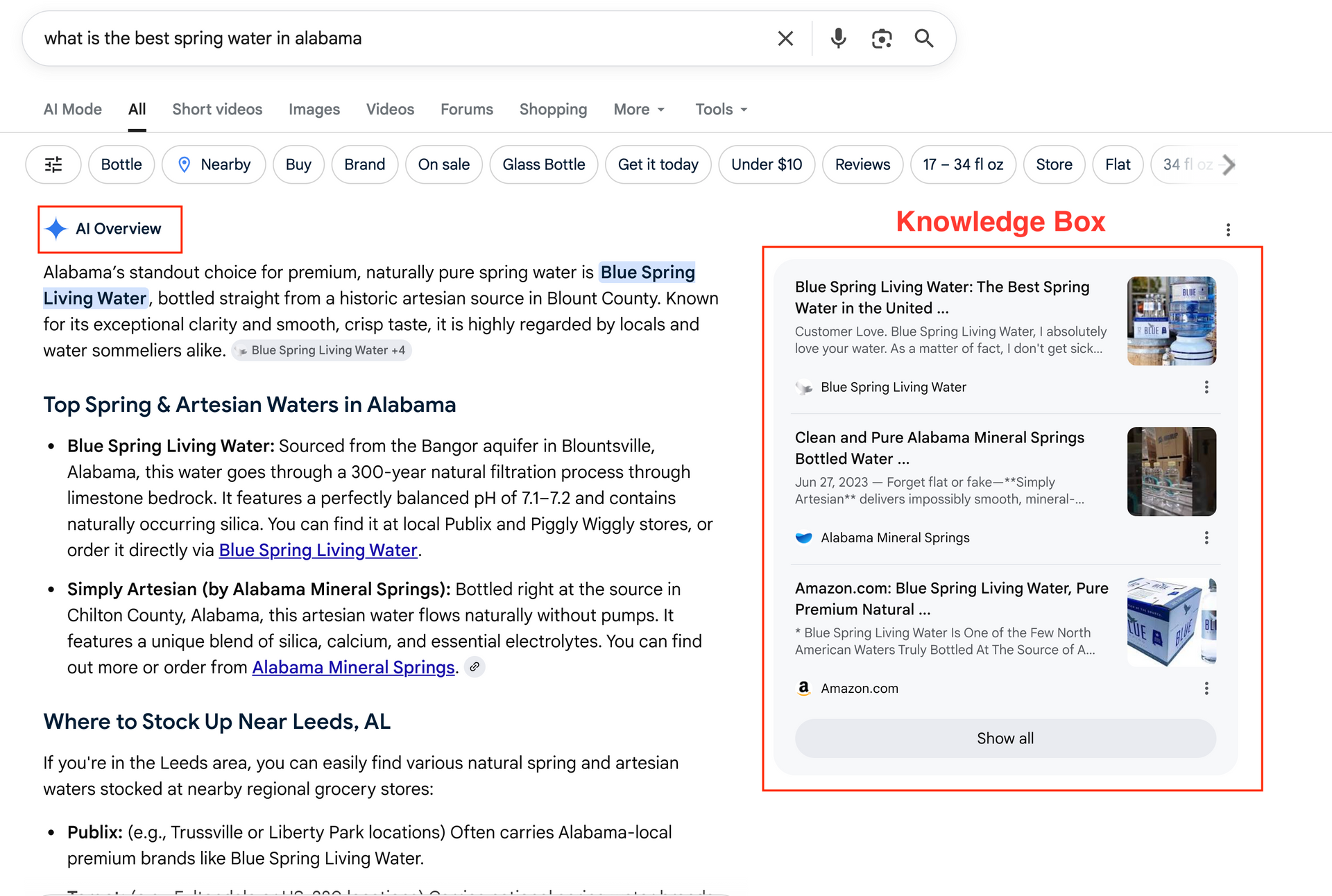
When I searched "what is the best spring water in Alabama," Google returned an AI Overview with a Knowledge Box beside it — more information to click through to. Asking a follow-up question inside that same search populated even more detail instantly. The exact layout varies by query and browser, but the pattern holds: AI is increasingly trying to finish the customer's research inside the search results themselves.
(This is a client of mine Blue Spring Living Water.)
That's the broader shift happening here — Google is becoming less of a search engine and more of a decision engine. Instead of handing a customer a long list of websites to click through, Google is filtering data, comparing local businesses, and highlighting trusted providers directly on the screen, often letting the customer tap "call" without visiting a single website.
When a homeowner types something like "help me find an affordable but trustworthy plumber," the AI is effectively filtering your local market against six questions: who's the best match, who talks about this issue the most online, who has the highest proof of trustworthy service, who's closest, who best answers the exact question, and who offers the most fair rates.
It's super important to know what the questions are when people look for your business. Make sure your digital footprint doesn't give clear answers to those questions - if you don't you will likely not appear in the Call Pool.
This connects to a bigger behavioral shift: searches are getting far more specific.
In the old days, a typical search was "Plumber Birmingham."
Today it's "Who is the best emergency plumber near me who works weekends and has great reviews?"
I call this the Black Dress Principle — a woman doesn't usually walk into a store looking for "any dress," she's usually looking for something highly specific (a formal black dress for a cocktail party, a wedding dress, a casual summer dress).
The internet works the same way: the more specific the search, the more relevant the results will be. Searchers are learning this and it is impacting the way search works.
Businesses with rich, deeply detailed information online are in the best position to win, because they can actually answer the specific question(s) being asked.
BTW - No, Google Search Ads Aren't Going Away
If you've heard that AI ads are replacing traditional Google Search Ads, you can relax — that's simply not true.
You need to understand - advertising is Google's primary source of revenue (upwards of $230 BILLION per year, YES you read that number right). So, while Google continues investing heavily in AI, they are not going to take away a very lucrative tool that so many businesses spend money on and rely on for leads.
Also just FYI, I have tested Performance Max for my service based clients and it has never produced the results search ads do.
AI isn't replacing Google Ads, it's being integrated into them — helping write headlines, suggest keywords, and optimize campaigns. Those are tools, not requirements; you still control your keywords, your copy, your budget.
Google Search Ads are a very important part of The Call Pool and search in general.
Reason being, SEO, your website, your Google Business Profile, reviews, and helpful content help you EARN visibility.
However, Google Search Ads help you BUY visibility.
The strongest marketing strategies use both.
What AI Still Can't Do
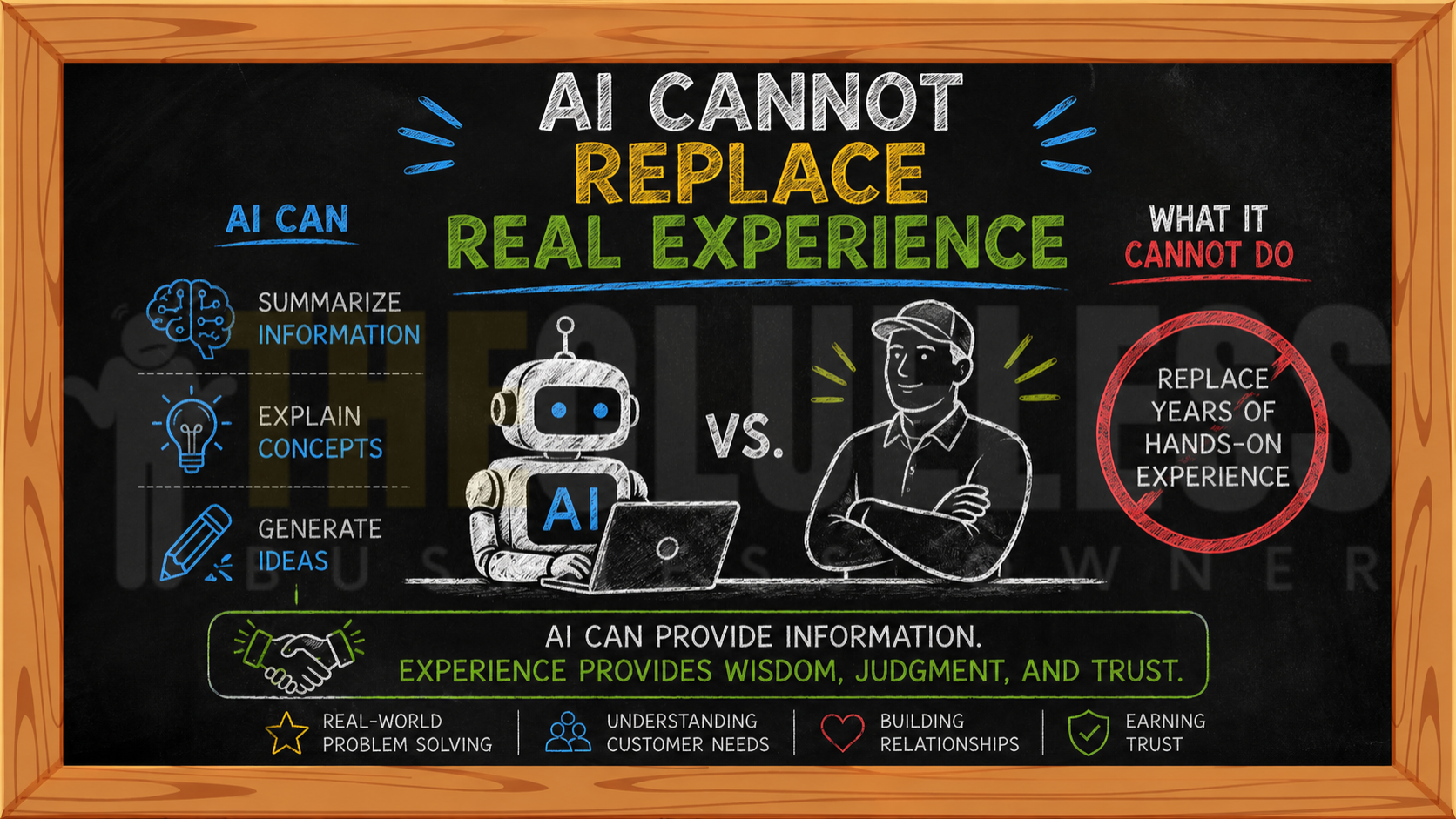
With all the hype, it's easy to believe AI can do everything. It can't — and if you rely on it blindly, it can genuinely damage your credibility. Here are the hard boundaries.
AI cannot replace real-world experience. A plumber who's physically repaired thousands of water heaters knows things an algorithm simply can't comprehend.
Here is a hard example of AI limits: I use ChatGPT constantly for brainstorming Facebook ad ideas and organizing campaigns — but it hasn't managed hundreds of campaigns, and it hasn't watched real money succeed or fail in the real world. It can't replace judgment or real experience.
I have never ONCE gotten a good Facebook ad strategy from AI that actually worked.
You want to know why? Because THE ONLY way you can learn to build successful Facebook ad campaigns is through hands on learning and expertise. AI does NOT have that. It only understands theories. Theories don't create great Facebook ad campaigns, only experience can.
AI can't build an AI-ready website (despite what some marketers would have you believe). AI can generate service pages and basic copy in minutes, but it doesn't know what makes your company different unless you tell it.
It doesn't know which services are most profitable, it doesn't have any real information on your customers, or why customers choose you over a competitor, or the years of experience behind your work.
Think of AI as the builder, not the architect — it can help construct the house, but only you can provide the blueprint.
AI cannot build trust for you. Genuine trust comes from real, unedited reviews, authentic testimonials, consistent honest communication, and delivering exactly what you promise.
It's earned one customer at a time — software can help you communicate value, but your business still has to create it.
AI cannot guarantee accuracy. It hallucinates, and sometimes attaches incorrect information to real businesses.
I learned this firsthand: I looked up my husband's business — fifteen-plus years in operation, nothing but 5-star reviews — and the AI Overview had incorrectly attached unrelated links and falsely claimed his company was "often accused of doing shoddy work." I was mortified.
The links pointed to a completely different business. I reported it through Google Gemini and it was corrected, but it's a real reminder: always review, verify, and double-check any AI-generated information before publishing or acting on it. It's not a perfect system.
AI cannot replace human relationships. When a homeowner's basement is flooding, they don't want to talk to a sterile algorithm — they want someone they trust.
AI can answer common questions, but it can't provide genuine empathy or real connection. Local business has always been built on people serving people, and I believe one of the biggest competitive advantages in the years ahead will simply be a real human answering the phone.
I believe with all my heart in the future you will see advertisements that say - "Call Us! A REAL human will answer the phone!"
AI cannot fix a broken business. It can't fix poor customer service, a string of bad reviews, slow response times, or weak back-office operations.
Technology amplifies what's already there — if your processes are excellent, AI helps you move faster; if they're broken, AI just helps you make mistakes faster.
AI cannot create something from nothing. It draws entirely from the digital footprint your business has already built.
If your website is thin, your GBP is incomplete, and your reviews are sparse, AI has very little evidence you're an authority worth recommending.
AI doesn't invent your reputation — it reflects the reputation you've already earned. It doesn't create authority — it recognizes authority that already exists.
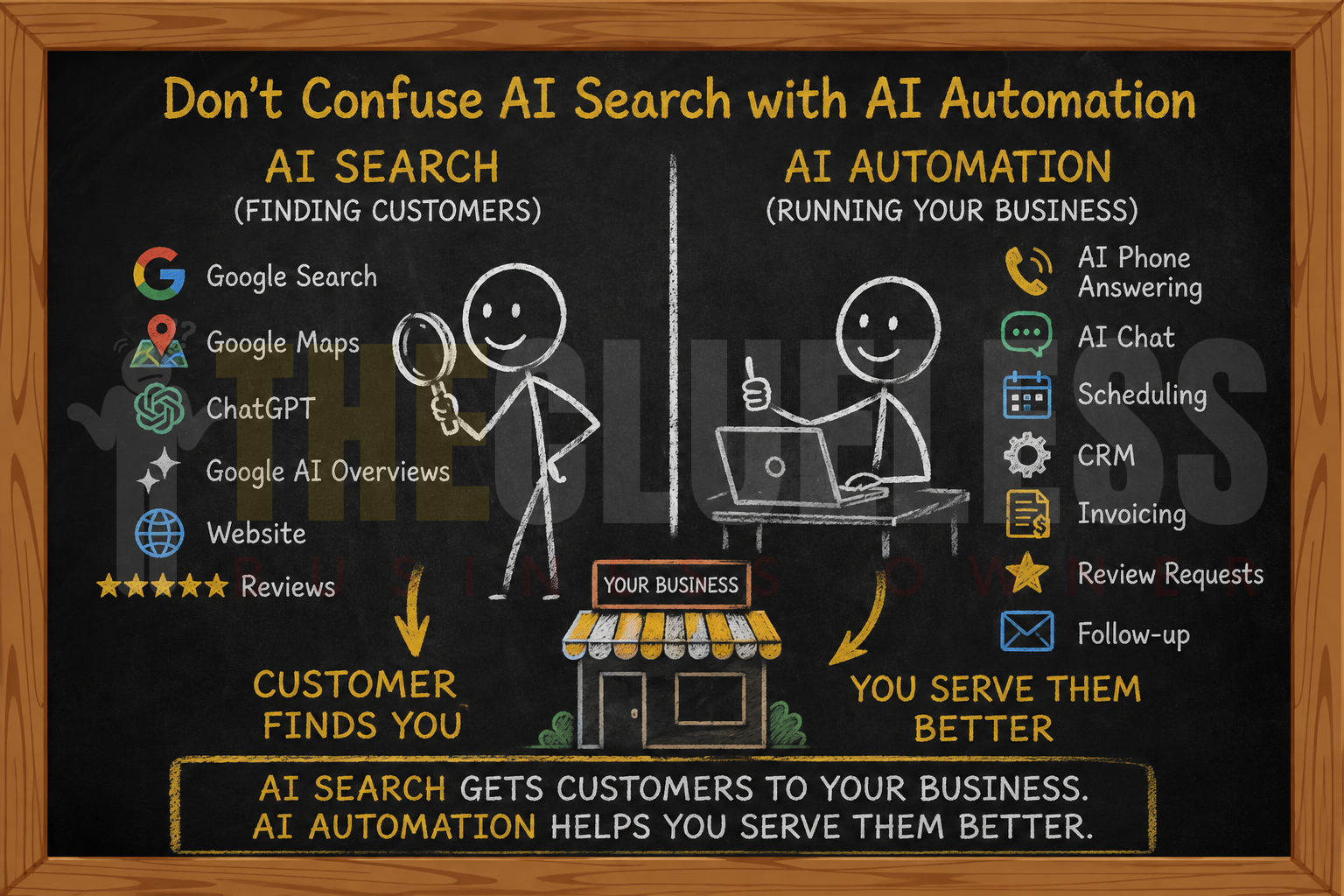
Don't Confuse AI Search with AI Automation
One of the biggest misconceptions today is that using AI software automatically makes your business more visible online. It doesn't.
There's an important difference between the two:
- AI search is how customers discover your business — ChatGPT, AI Overviews, Google Maps, and similar platforms.
- AI automation is what happens after a customer finds you — answering your phone, scheduling appointments, following up with leads.
Installing an AI receptionist will not suddenly cause ChatGPT to recommend your business. Automating your review responses will not automatically move you up in Google.
These tools make your business run more efficiently — they don't replace the work required to become a business that AI trusts enough to recommend in the first place.
First you earn the visibility. Then you use AI to make the most of every opportunity that visibility creates.
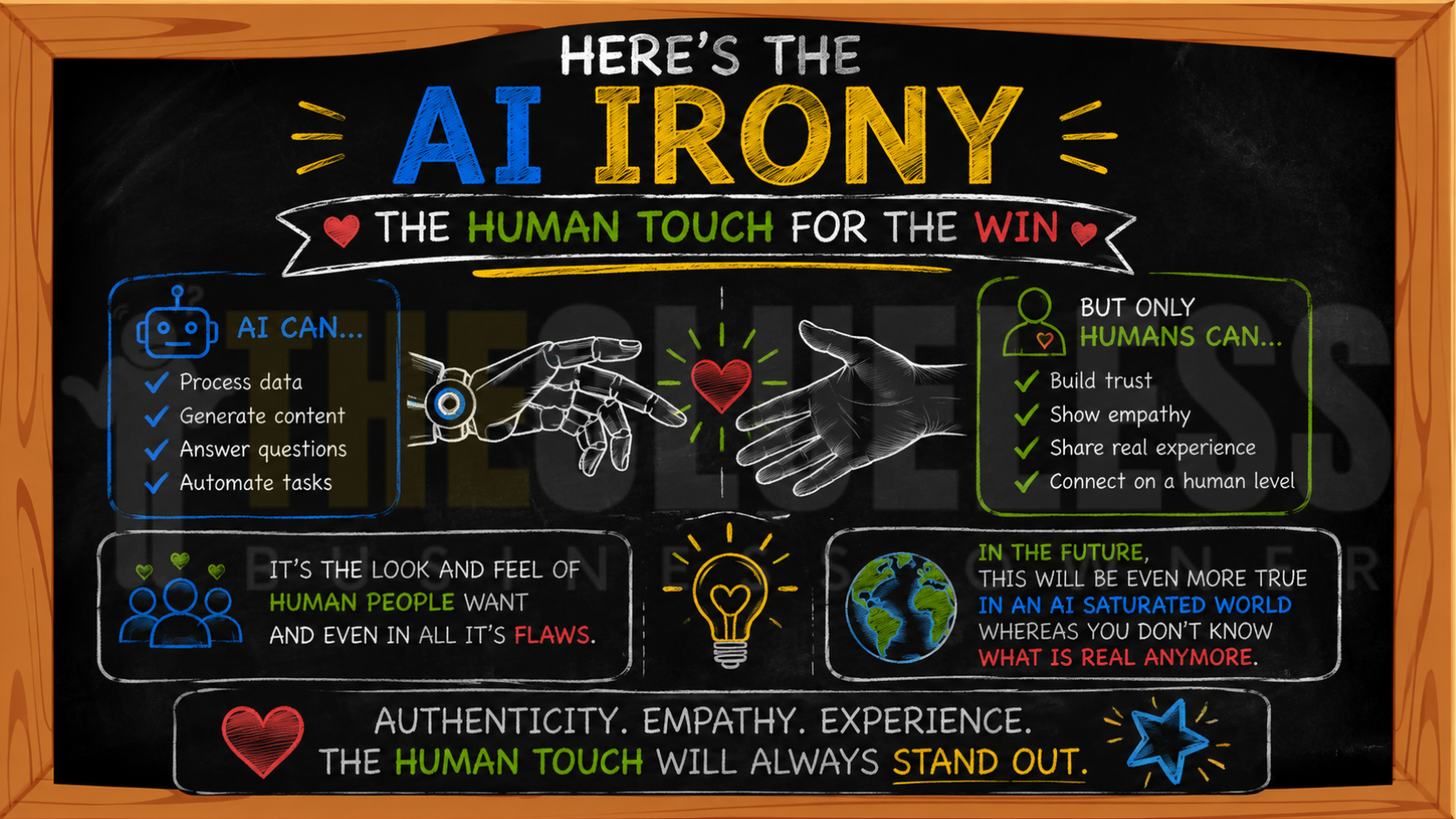
The Ultimate AI Irony: The Human Touch Wins
At the end of the day, people want the raw, real look of an actual human being — flaws and all.
As the internet gets more saturated with AI-generated content, consumers will increasingly struggle to tell what's real, and authenticity becomes your highest-value currency.
As I said above in an earlier section, I truly believe a popular marketing tactic in the future is going to be phones being answered by REAL humans.
Raw, unpolished smartphone photos and videos consistently outperform stock photography and polished agency ads — I manage Facebook ads for several retail clients, and a raw, imperfect photo of a real product beats a flawless stock image nearly every time.
Showing your real team, your messy workspace, your actual trucks, and your real customers builds instant credibility.
As AI floods the internet with cheap, generic content, the businesses that lean hardest into their own humanity — real personality, real flaws, authentic reviews, unedited photos and video — are the ones that stand out.
Beware the Sharks: The Scammers and Doomsday Sellers
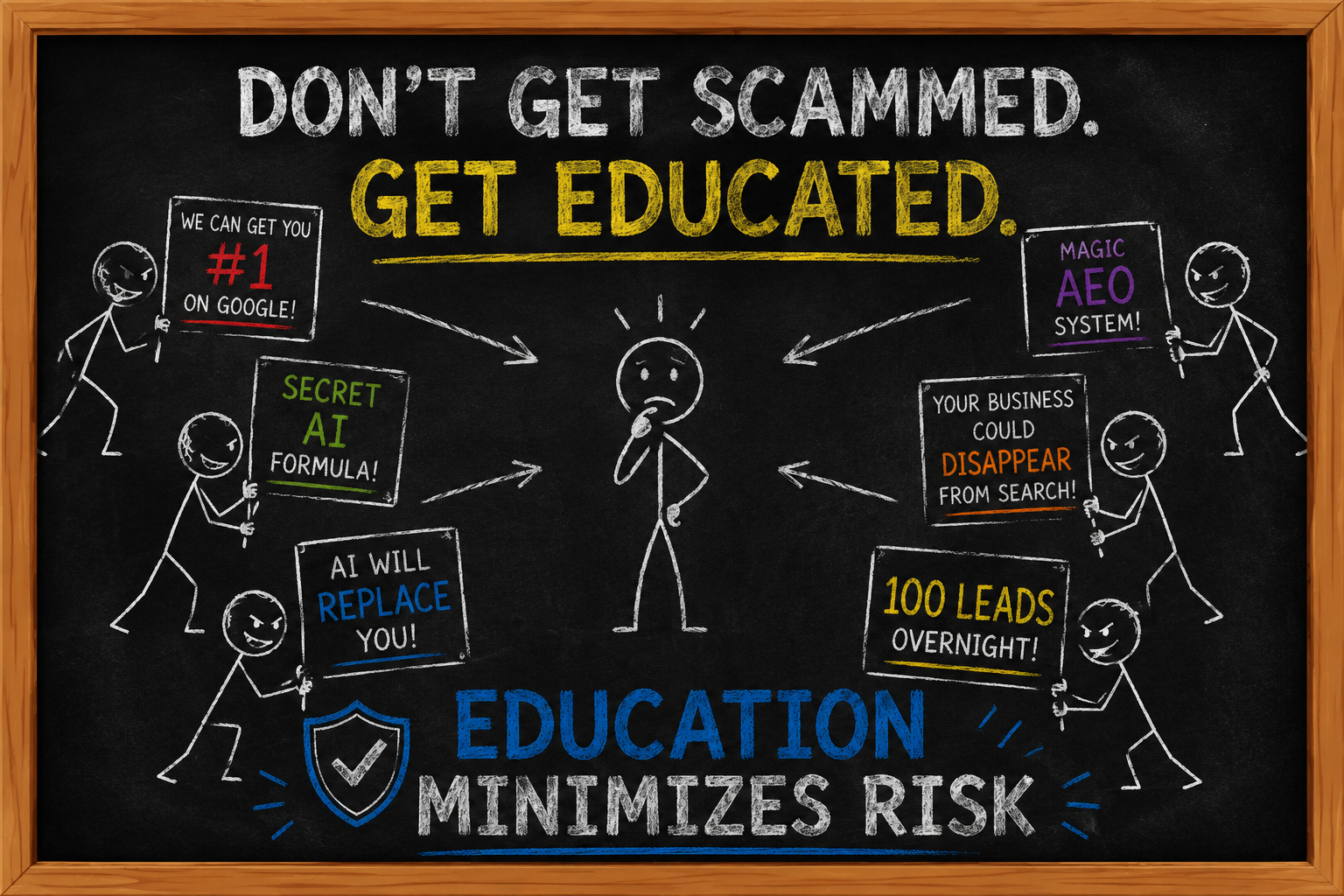
Whenever a new technology emerges, two groups show up: the innovators building real solutions, and the opportunists building fear so they can sell you something.
It has been that way since the beginning of the Internet. That will never change.
Scammers know business owners don't have time to track every algorithm update, they KNOW you don't understand it and heck don't want to understand it.
So they exploit that fact and take advantage of it. They use fear-based marketing to sell products you don't understand and often don't need.
You've probably already gotten some version of these calls:
- "We can guarantee first page rankings."
- "Your Google profile has critical errors costing you leads right now."
- "Your business is missing out on voice searches."
Now that AI is the new hot buzzword, the pitches sound like: "You're invisible to ChatGPT — buy our optimization package."
"SEO is dead, you need our proprietary AEO system." "More than 50% of searches are zero-click!" No one is visiting your website!
The technology changes. The sales tactics don't.
A quick note on that last one, since we already covered it in detail above: the "50%+ zero-click" stat is real, but it's almost always presented with zero context about what it actually means for a local service business (a lot of those "zero clicks" are just customers calling straight from Google Maps, which has been happening for over a decade).
Leaving out that context and letting fear do the rest is, in my book is the same as lying. Never EVER buy anything from a company that begins the relationship with a LIE.
Here's the full rundown of the tricks to watch for:
1. The "Secret AI Code" Scam
Agencies charge thousands claiming they need to add a secret AI code or proprietary schema formula so AI engines can "finally recognize" your business.
The reality: there's no secret code. AI relies on clear, human-readable content. Schema can add helpful context, but it isn't a hidden formula. AI can't be tricked. Scammers are just dressing up standard web best practices as wizardry.
2. The "ChatGPT Business Listing" Scam
Marketers promise to get you the guaranteed "#1 recommended answer" inside ChatGPT or Google AI Overviews.
There's no such thing as a business directory for ChatGPT, and you cannot buy a listing inside an AI model's actual generated answer. (OpenAI does sell clearly labeled "Sponsored" ads that can appear at the bottom of a ChatGPT response — a real, transparent product, open to any U.S. business. This is an entirely different thing than being the AI's organic recommendation.) If someone guarantees they can do this, run, don't walk away.
3. The "Guaranteed AI Recommendation" Scam
No one — not Google, OpenAI, Anthropic, or Microsoft — offers a legitimate way to buy or guarantee an organic AI recommendation. (Google will sell you a labeled "Sponsored" ad that shows up near or inside an AI Overview — that's a real, transparent product. It is not the same thing as being recommended as an actual AI-generated answer.)
You can absolutely improve your visibility. The only way you can buy that? Either with an investment of your time making sure your entire digital footprint ROCKS, or you hire an HONEST marketing person to do it.
4. The "Schema on Every Page" Scam
Agencies repackage standard schema markup as a "revolutionary AI ranking breakthrough" and charge thousands to add it everywhere.
Schema is a helpful, standard SEO practice — it's not a revolutionary breakthrough worth premium fees, and it certainly isn't the magic key to AI visibility on its own.
5. The "LLMs.txt Requirement" Panic
Urgent warnings claim your business will be invisible to AI unless you add an llms.txt file immediately.
Here's the reality behind the hype: Ahrefs analyzed 137,000 domains and found that 97% of published llms.txt files get zero requests.
Google's own John Mueller has publicly stated that AI services don't even request the file.
Multiple 2026 industry sources describe the panic around it as a "self-fulfilling cycle built on hope, not data" — SEO tools flag it as a "site issue," anxious business owners scramble to add it, and that scramble is what makes it feel important, not any actual evidence it works.
If you want one, it takes a few minutes and costs nothing — don't pay an agency hundreds or thousands for it.
6. The "Automated AI Bot" Lead Promise
Scammers promise a fully autonomous AI sales system that floods your calendar while you do nothing. Some AI tools genuinely help with scheduling and answering common questions — I use AI daily.
But many of these systems are just robocallers or poorly configured chatbots wearing an AI label. AI should enhance your customer experience. It shouldn't become your customer experience.
7. The "Proprietary AI Content" Trap
Agencies charge massive retainers for a "revolutionary AI content engine" that's often just the same publicly available AI tools everyone has access to, with a few minor edits and a premium price tag.
If an agency can't explain the actual strategy behind their content, you're probably paying for prompts, not marketing.
8. The "AI Google Maps Verification" Scam
An urgent call claims your Google profile is at risk of suspension unless you complete "AI verification" — for a fee.
This one is real enough that Google itself has taken legal action over it: Google sued a company called G Verifier in Ohio, alleging it made unsolicited calls to business owners falsely claiming their listing would be marked "permanently closed" unless they paid a "verification" fee.
It's not a rare, isolated con either — Hiya's spam-call tracker logs over 2,000 reports of this exact scam every single month.
Google never charges you to verify your business and never hires third parties to call demanding payment on their behalf.
If your profile needs verification, you'll see it directly in your GBP dashboard. This is always a scam.
9. The "AI Directory Sync" Extortion
An agency shows you a flashy "AI scan" listing your business across dozens of obscure directories, then offers to keep you "AI synchronized" for a monthly fee.
Consistent business information does matter — but Google weights authoritative, trusted sources far more heavily than hundreds of obscure directories nobody uses.
10. The Fake "AI Negative Review Removal" Promise
A company promises a "proprietary AI legal bot" that can force removal of negative reviews for a hefty fee.
No software or agency can force a platform to remove a legitimate review that doesn't violate its terms of service. If the review doesn't violate policy, it isn't coming down — no matter how much you paid.
Whenever someone tells you they have a secret system, an exclusive AI relationship, or a guaranteed shortcut, ask yourself one question: is this solving a real business problem, or are they simply selling my fear?
The more you understand how this actually works, the harder you become to manipulate. That's exactly why this guide exists — not to make you an AI expert, but to make sure you're never an easy target.
Ready to Take Action on What You've Learned?
Everything above explains how AI search works. If you've read this far, you understand more about AEO than the vast majority of your competitors — and probably more than most of the agencies calling to sell fear.
So here's what I don't want to do: hand you a list of acronyms and call it a strategy.
Every time the internet shifts, a new one shows up — SEO, VSO, AEO, GEO — and suddenly business owners are told they need an expensive new "expert" to keep up.
Instead, I want you focused on the thing that never changes: building a sustainable, trustworthy online presence that pays you back year after year, regardless of what acronym is trending.
That's exactly why I built The Call Pool Blueprint™ — a straightforward marketing philosophy, not a chase for the next acronym.
Your goal never changes: you want your business to be one of the first they see, no matter which platform they're searching on.
Consumers decide fast, and they choose from the top of the scroll.
The platforms will keep changing. That target won't.
Before you get worked up about AI, ask yourself one honest question: was your business even visible in standard search to begin with?
Now that you understand why all of this matters, here's exactly what to do about it: Click here to get your AI Readiness to Do List
Keep Learning

Growth Mindset
Give a group of people the same business to run and access to all the same resources. Some will succeed and some will fail. What is the deciding factor? Their mindset. This is what divides.

Marketing Strategy
Want to blow your competitors out of the water? It really isn't that complicated. Just HAVING a strategy can do the trick! (Pssst they don't usually have one.)