
The Scams, Pitfalls, and Marketing Traps
This 15-minute read is going to save you
THOUSANDS of dollars over the life of your business.
Seriously.
One of the biggest challenges local business owners face today isn't their local competition, changing Google algorithms, or the rise of AI.
It is making financial decisions without good information.
Very often business owners waste hard-earned money on things they don’t need, sign long-term contracts for marketing services they don't understand, and fall victim to predatory marketing scams.
In fact this is one of the very things that inspired me to create
The Clueless Business Owner.
My mission here is not to make you paranoid or deeply suspicious of every little thing you experience on the Internet.
The goal is to educate you so you can make good decisions based on the RIGHT information.
Education doesn’t completely eliminate risk, but it drastically
minimizes
it. The deeper your understanding of how the digital ecosystem actually functions, the easier it becomes to make good investments for your business.
Let's pull back the curtain on the most common traps draining local business bank accounts today.
Scams
The New Frontier: The "AI Fear-Mongering" Scam
Let's start with exactly what is happening in the market right now: predatory marketing companies using weaponized fear around artificial intelligence to bully business owners into buying their services.
They use fear statements to create panic:
"Your business is about to completely disappear from Google!"
"Your website is outdated and invisible to ChatGPT—buy our magic solution to fix it!"
"AI is replacing every business that isn't fully automated by next month."
"SEO is dead! You have to buy our proprietary AEO/GEO optimization packages right now!"
They throw around acronyms and catch phrases to intimidate and sound smart. They claim they have a "secret, proprietary AI algorithm," and back it up with shady, fake websites using AI-generated testimonials and fabricated case studies.
These shadey marketers do not have a secret algorithm. They are selling you magic beans.
The Truth: SEO is Not Dead
Who are you going to believe? A super-aggressive individual trying to scare you into opening your wallet, or the
actual multi-billion-dollar tech giants who built the search engines in the first place?
Google has explicitly stated:
"The best practices for SEO continue to be relevant because our generative AI features on Google Search are rooted in our core Search ranking and quality systems."
In plain English: AI search did not make traditional SEO obsolete. Google's generative AI features are rooted in its core Search ranking and quality systems, so the same strong SEO foundation still matters.
The Shift to "Integrity-Driven Marketing"
There is no legitimate secret trick or overnight shortcut that guarantees your business a place in Google's AI Overviews.
There are no more secrets, black-hat tricks, or overnight quick fixes to land your business in Google's AI Overviews. The systems reward real, authentic, CONSISTENT, high-quality digital assets.
Click here to read a thorough guide on how AI impacts local business search.
Beware of "Black Hat" GEO (Generative Engine Optimization): Deceptive AI Visibility Tactics
In the marketing world,
"Black Hat" refers to unethical, deceptive tactics used to trick search engines into ranking a website higher.
As AI search becomes the standard, a new wave of shady agencies is popping up, promising to "guarantee your company is recommended by ChatGPT" or "force Gemini to mention your brand."
Be extremely cautious. Just like the black hat SEO tactics of the past that manipulated traditional Google results, dangerous shortcuts are now appearing for AI Search—often referred to as Black Hat GEO (Generative Engine Optimization).
Beware of “Guaranteed Ask Maps Rankings”
Ask Maps creates another opportunity for marketers to sell business owners a magic shortcut.
Be skeptical of anyone promising to “rank you #1 in Ask Maps,” guarantee that Google will recommend your business for conversational searches, or claiming they have a proprietary way to force your business into AI-generated recommendations.
There is no separate magic Ask Maps optimization button.
The fundamentals still matter: a complete and accurate Google Business Profile, a strong website, genuine reviews, useful content, consistent business information and a trustworthy digital footprint.
Definitions:
GEO is optimizing your online presence so AI can find, trust, and recommend your business.
Black Hat GEO refers to unethical tactics designed to manipulate AI-generated search results rather than providing genuine value and trustworthy information.
The Anatomy of an AI Search Trap
These shortcuts usually involve digital sleight-of-hand that breaks the rules of major AI platforms.
They use:
- Manufactured Authority:
Using automated software to create thousands of fake web pages linking to you to fake popularity.
- AI-Generated Content/Link Bait Farms:
Churning out thousands of cheap, scraped articles to trick searchers.
- Fake Online Conversations:
Deploying networks of automated bots to drop fake mentions of your business on discussion forums and social media.
While these deceptive tactics might produce a tiny, short-term spike in visibility,
they will not survive regular algorithm updates.
Google has extensive spam-detection systems designed to identify manipulative behavior and content that violates its search policies.
Investing in cheap, black hat tactics might seem affordable today, but it becomes
VERY expensive
when Google completely blacklists your domain or deletes your Google Business Profile, cutting off your lead flow overnight. (And I have seen this happen, please don't do it, it is NOT worth it!!)
How to Spot a Scammy "Marketer"
The scariest part? You could hire one of these companies without even realizing they are breaking the rules.
Many shady agencies use polished pitches and claim to be "integrity-driven" because they know you don’t understand the underlying technology.
Here is how to spot them before you sign a contract:
- The Price Tag is Cheap:
High-quality, manual digital asset building takes time and expertise. If an agency promises to fully optimize your website, content, backlinks, Google Business Profile and entire digital footprint for $199 a month, ask exactly what work is being performed. At that price point, there simply isn't enough budget for the amount of skilled manual work a comprehensive SEO strategy requires.
- They Lack a Real Reputation: Search for the agency's name online. Look for complaints, read their reviews, and explicitly ask to speak with real, active clients in your industry. If they can't put you on the phone with a happy reference, walk away.
The Bulletproof Alternative: The safest long-term strategy for AI search is also the simplest. Build an authentic digital footprint. Answer your customers' real questions, earn genuine reviews from real clients, and become the most trusted, definitive online source of information in your local market.
Google Profile Verification Scams: The Scum of Local Marketing
This is a trap I absolutely despise.
These automated, predatory robo-calls cost local business owners a tremendous amount of time, money, and mental stress every single day. Scammers use automated software bots to harvest phone numbers directly from Google Business Profiles and feed them into relentless robocall programs.
In my agency, we constantly have to swap out CallRail tracking numbers on our clients' websites, ads, and digital assets just to escape the sheer volume of these calls.
The Pitch: Fabricated Urgency
Typically, your phone will ring and you'll hear an urgent recorded message claiming there is a critical problem with your Google listing, that your profile is "unverified," or that your business is no longer showing up properly, costing you thousands in lost revenue.
I am honestly shocked this scam is still as prevalent as it is, but unfortunately, I guess people are still falling for it.
The Reality Check: Know the Difference Between Google and a Scammer
Google can legitimately contact businesses in certain situations, including automated calls to confirm business information or assist customers. (BUT it is EXTREMELY rare!)
Google will never call demanding payment to keep your Business Profile active, keep your pin on Google Maps, or prevent your listing from being deleted. Google will also never ask for your password or payment information during these calls.
In fact, you have a greater chance of winning the lottery than EVER getting a human on the phone at Google to discuss an issue with your Free Google Profile listing.
I have personally answered so many of these robo calls. The absolute second these terrible ASSHOLES realize you understand what they are doing and that they cannot fool you, they will slam the phone down.
I vividly remember one instance where I really laid into one of these callers. I asked him point-blank: "Don't you care that you are scamming independent business owners? People who are working their butts off just to provide for their families?"
His response? He told me to go "F" myself and hung up the phone.
That is exactly who is on the other end of those urgent "Google Verification" alerts. They make a living preying on your lack of information.
If you get a call, an email, or a text claiming your Google listing is expiring, or that you need to pay a fee to keep your pin on the map, hang up immediately. It is a 100% a SCAM.
The "Overnight Success" Trap: Beware of Guaranteed, Super-Fast Results
Whenever a marketing agency or salesperson promises that they can put your business at the very top of Google or AI search results "in just a matter of days," don't walk—run away. And definitely do not write them a check.
Let's establish an absolute rule for your business: No one—not a mega-agency, an high-priced marketing consultant, or an AI tech company—can legitimately guarantee top organic rankings overnight that lasts.
NO ONE.
Why? Because search results and AI recommendation systems are entirely controlled by the algorithms of tech giants, not by the marketers selling you services.
Marketing is a Process, Not Magic
While some digital improvements can happen quickly—such as launching a targeted Google Ads campaign or fixing a technical error on your website—building a dominant, sustainable organic presence takes time.
A strong, sustainable search presence cannot legitimately be manufactured overnight.
They require real momentum:
- A clean, long-term domain and website history.
- Deep, authoritative content that actually answers user questions.
- A steady velocity of genuine customer reviews.
- A clean network of trusted local and industry backlinks.
These are assets that must improve and evolve over a period of months, not days.
Why the Shortcut Pitch is So Dangerous
Predatory marketers know exactly what they are doing. They look for stressed, hardworking business owners who might not fully understand digital infrastructure but desperately need quick revenue.
They exploit that vulnerability with buzzwords like "secret formulas," "guaranteed map rankings," or "instant SEO success."
These promises are designed to close sales, not deliver real business growth.
Anyone promising overnight success for an asset that takes time to build is telling you a blatant lie. Good marketing is a disciplined, step-by-step process.
Do not let your desire for speed trick you into paying for a shortcut that doesn't exist.
The "Cheap SEO" Trap: Building Your Business on a House of Cards
Let me tell you the absolute truth about ranking your business at the top of search and AI results: it is a long game. It is exactly like building a high-performing stock portfolio.
Investing in your digital visibility is a core, long-term growth strategy. As long as that investment is properly built and maintained, it is an asset that will pay massive dividends and compound over time.
Achieving and maintaining those top positions takes an immense amount of skilled work, strategy, and time. It is not cheap to achieve, and it is certainly not fast.
Historically, there were "tricks" that slimeball marketers could use to gain fast traction in search results through what we call Black Hat SEO.
They would find a loophole in the system, exploit it for a quick ranking boost, and show you a fancy monthly report that made you think they were doing a great job.
Thank goodness those days are over.
Google's spam-detection and machine-learning systems have made manipulative SEO tactics increasingly risky and far less sustainable. Building a website around shortcuts today is the exact equivalent of building a house of cards. One tiny algorithmic wind, and your entire digital presence comes crashing down.
The 2012 Penguin Update Bloodbath: A Cautionary Tale
I remember one specific Google algorithm update very vividly: the Penguin Update of 2012.
It was an absolute bloodbath for businesses using shortcuts. This update specifically targeted low-quality paid backlinks, link schemes, and manipulative tricks.
When Penguin rolled out, websites that had relied heavily on manipulative link-building practices saw devastating ranking and traffic losses.
Companies that relied entirely on Google for customers saw their sales disappear instantly. Some never recovered and were forced to permanently close their doors.
During that chaotic time, the owner of an online gift company contacted me desperately needing help. Unfortunately, I had to tell her it was a hard no for me.
The systemic damage the previous agency had done to her website's reputation was far beyond what anyone could realistically fix quickly.
The worst part of this disaster?
These business owners had no idea their websites were violating Google's guidelines. They simply trusted a cheap SEO company that promised fast results using deceptive tactics the owners didn't understand. They thought they were just getting a cheap SEO person.
And what did they ultimately end up paying for it?
The Louis Vuitton Reality Check: You Don't Know What You're Buying
Most business owners have no idea what they are actually paying for when they buy digital marketing. This information gap is exactly what scam artists exploit.
When you get a random, unsolicited email from an agency telling you your website isn't ranking and that they have a proprietary solution for a very low monthly investment, I want you to step back and apply some common sense.
If someone walked up to you on the street and offered to sell you a brand-new, 5-piece set of genuine Louis Vuitton luggage for $100, would you buy it? Of course not.
You’d be incredibly skeptical. You know it’s impossible to get buy something that costs over $10,000 for a hundred bucks. You know for a fact that it’s a fake.
It is no different with local SEO and AI optimization.
Do the actual math in your head right now considering the following variables:
- The actual financial value of ranking permanently above your biggest local competitor.
- Your phone calls increasing by 40% or more every single month.
- Multiply that call volume by your average job size. What is that hard number?
What is a new, lifelong customer actually worth to your company? Do you honestly believe that kind of massive, life-changing business value can be delivered properly for a few hundred dollars a month?
Come on! You know it can't.
Inside the Cheap SEO Sales Pitch
Let me pull back the curtain on how a cheap, few-hundred-dollars-a-month SEO package actually works under the hood.
One common cheap-SEO model is to throw generic keywords onto website pages and then build large numbers of low-quality links from questionable websites and link networks. (Such as link farms.)
Link farms are groups of thousands of low-quality, spam-heavy websites created solely for the purpose of selling outbound links to trick search engines.
They exist entirely on gambling sites, questionable foreign directories, and completely unrelated domains.
This is a direct, severe violation of Google’s terms of service. Furthermore, because these link networks are incredibly unstable, the spam links they build to your site usually disappear in 90 days or less—meaning you have absolutely nothing to show for the money you spent.
What Real, Integrity-Driven SEO Actually Requires
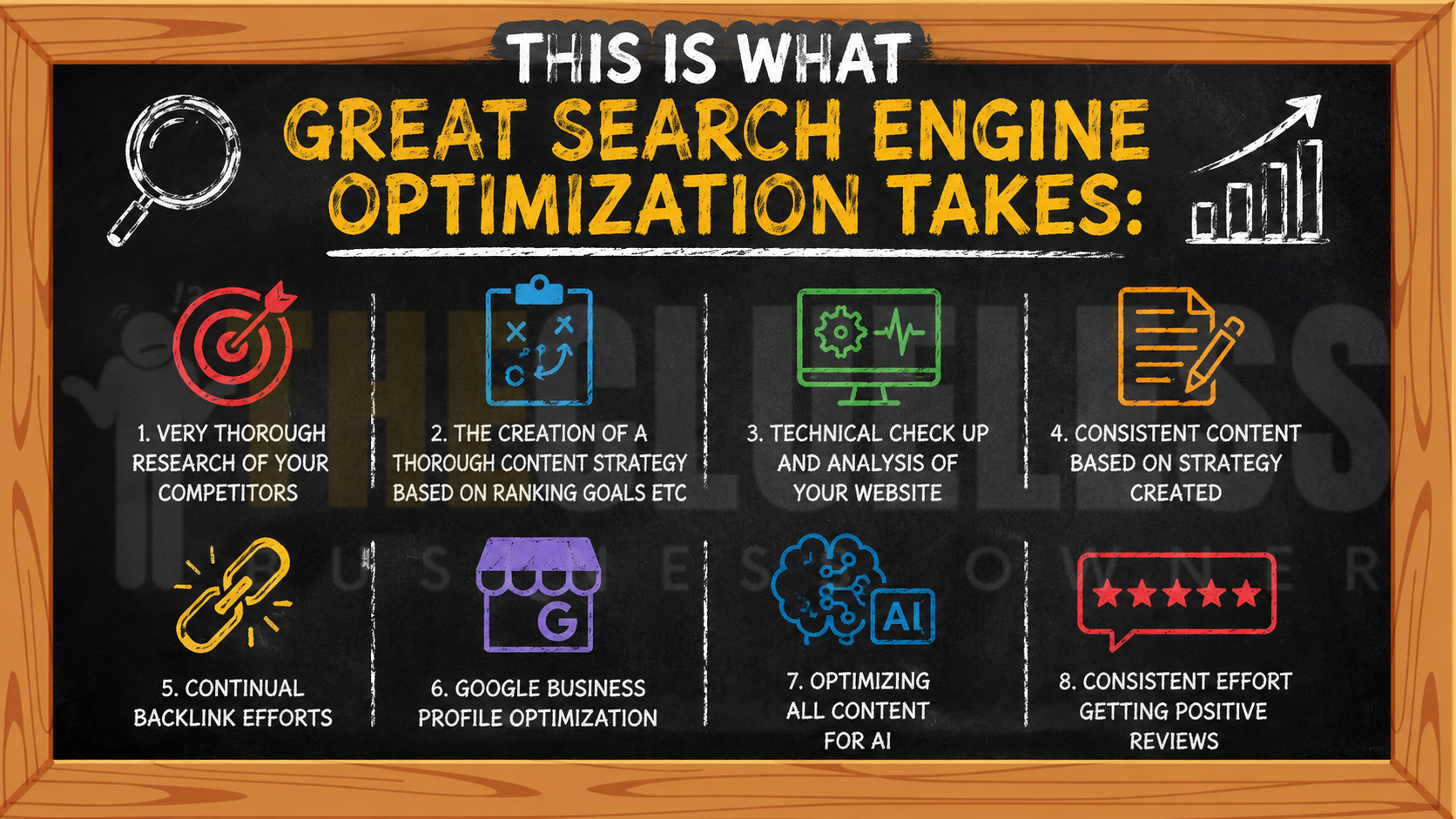
If you want real, compounding revenue growth that survives algorithm updates, here is what a legitimate professional has to execute for your business:
- Competitor Investigation: A thorough research of your local market competitors.
- Content Strategy: A thorough content strategy must be designed that is based on your services and the value of someone choosing you over your competitors. Every page must be gone through with a fine tooth comb. All meta titles and descriptions. All services need to be broken out into their own pages. Your geography content needs to be mapped out. Specific geographically pages for all target areas need to be written out.
- Technical: Making sure your website pages are loading properly and all parts are functioning.
- Foundational AI: Writing high-quality, authoritative answers to your industry's biggest questions.
- Backlinking: Earning real, high-trust backlinks from legitimate local directories, news outlets, and industry associations.
- Google Business Profile &
AI Optimization: Constantly updating and syncing your real-world business data across the entire digital ecosystem.
- Review Strategy :
There needs to be a huge focus on getting continual good reviews for your business - this is the glue that holds everything together.
This requires an immense amount of manual hours, high-level marketing expertise, and continuous effort.
Does this sound like work that can be done for $199 a month?
You will never find a REAL marketing strategist to do this work properly for a cheap monthly fee. If you fall for that pitch after reading this—sorry, but that loss is completely on you.
The Bottom Line
In the past, search engines would release major updates once or twice a year. Today, because of machine learning and AI, the search ecosystem updates and calibrates constantly.
The algorithms are smarter than they have ever been, and they have zero tolerance for shortcuts. Great marketing is built exclusively on high-quality content, clean data, and solid, integrity-driven backlinks.
It takes time to build, but it is the single best investment you can make for your business. When done with total integrity, it builds a massive digital moat around your business, generating compounding revenue year after year.
Fake Reviews
If you run a local service business, you already know that 5-star customer reviews are pure gold. A steady stream of great feedback has a massive, direct impact on your incoming lead volume, your conversion rates, and your bottom-line revenue.
But you also know what earning those real reviews takes:
Time, exceptional service, and consistent effort.
When a shady marketing company slides into your inbox promising to drop "20 new 5-star reviews onto your profile in just 48 hours," it can be incredibly tempting. In fact, major industry studies estimate that anywhere from 10% to 30% of all online reviews are fake.
Let me give you some serious advice: buying fake reviews is a shortcut that will create a catastrophic problem for your business down the road. Just don't do it.
The Enforcement: Google’s AI Anti-Spam Crackdown
Major search and map platforms are deploying advanced machine-learning models designed specifically to detect unnatural review velocity, suspicious IP addresses, and non-local user behavior.
If their automated system flags your profile for review manipulation, the consequences are swift and severe:
- They will instantly wipe out your entire review history.
- They will completely suspend or permanently delete your Google Business Profile.
- They will trigger warning labels on your listing that completely destroy consumer trust.
Just how serious is this crackdown? Google reported that in May 2026 it removed more than 292 million policy-violating reviews and placed strict restrictions on more than 782 million policy-violating accounts.
The Risk Isn't Worth the Short-Lived Reward
Think about the math. Is a quick injection of 20 fake reviews worth losing one of the most valuable digital assets you have?
Is it worth being completely blacklisted from local map results?
When you buy fake reviews you are putting one of your most valuable online assets in the hands of shady marketers. The moment Google's daily algorithm update catches up to them, everything you built vanishes.
My Advice: Just do it the right way. Implement a strict, manual system within your business to ask every single happy customer for an authentic review.
It takes longer, but it creates a bulletproof digital asset. Your business will be rewarded with sustained visibility, and you will never have to wake up stressing that your digital success will be stripped away overnight.
Smoke and Mirrors: The "Vanity Metric" Report Trap
If there is one thing in the digital marketing industry that I absolutely cannot stand, it is vanity metrics. 🤮
I am talking about those 15-page monthly reports filled to the brim with colorful pie charts, complex line graphs, and heavy technical jargon that most business owners have absolutely no idea how to interpret.
Let me let you in on a little secret: the confusion it creates is intentional.
Unscrupulous marketing agencies know that the more complicated and overwhelming a report looks, the more likely a stressed business owner is to throw their hands up and assume something incredibly important must be happening behind the scenes.
Even if your phone isn't ringing and you've seen zero actual revenue growth from the service, these bloated reports trigger a psychological trap. They make you reluctant to cancel because of the money you’ve already invested and the "progress" you think you might lose that you consider will eventually come.
The Vanity Matrix vs. The Bottom Line
When an agency cannot deliver
the super FAST results they promised, they will intentionally redirect your attention toward easy, automated data points:
- Impressions: How many times a digital bot or human scrolled past your link.
- Reach: The theoretical number of people who might have seen a post.
- Click-Through Rates (CTR): The percentage of clicks vs. impressions.
- Proprietary "Trust Scores": Arbitrary authority numbers made up by third-party software.
Why do they focus so heavily on these numbers?
Because vanity metrics are incredibly easy to inflate, buy, or automate, while actual business results take real work. (This also buys them time.)
Impressions Don't Pay The Bills
Over the years, I’ve had dozens of clients show me their smoke-and-mirrors data dumps out of pure frustration.
They tell me, "Our agency says our impressions are up 400%, but our jobs are down 40%."
This is the exact reason my own client reporting is very simple.
When you invest your hard-earned capital into advertising and digital asset building, you should only care about two definitive metrics:
- What did I spend?
- What did I get for it?
The Hard Truth: Impressions do not pay your bills or pay for college tuition for your kids. Leads do. New customers do.
If your marketing agency spends more time explaining their charts than tracking your lead phone calls, they are selling you smoke and mirrors.
If the only thing that is growing is THEIR bank account - there is a HUGE problem.
Warnings
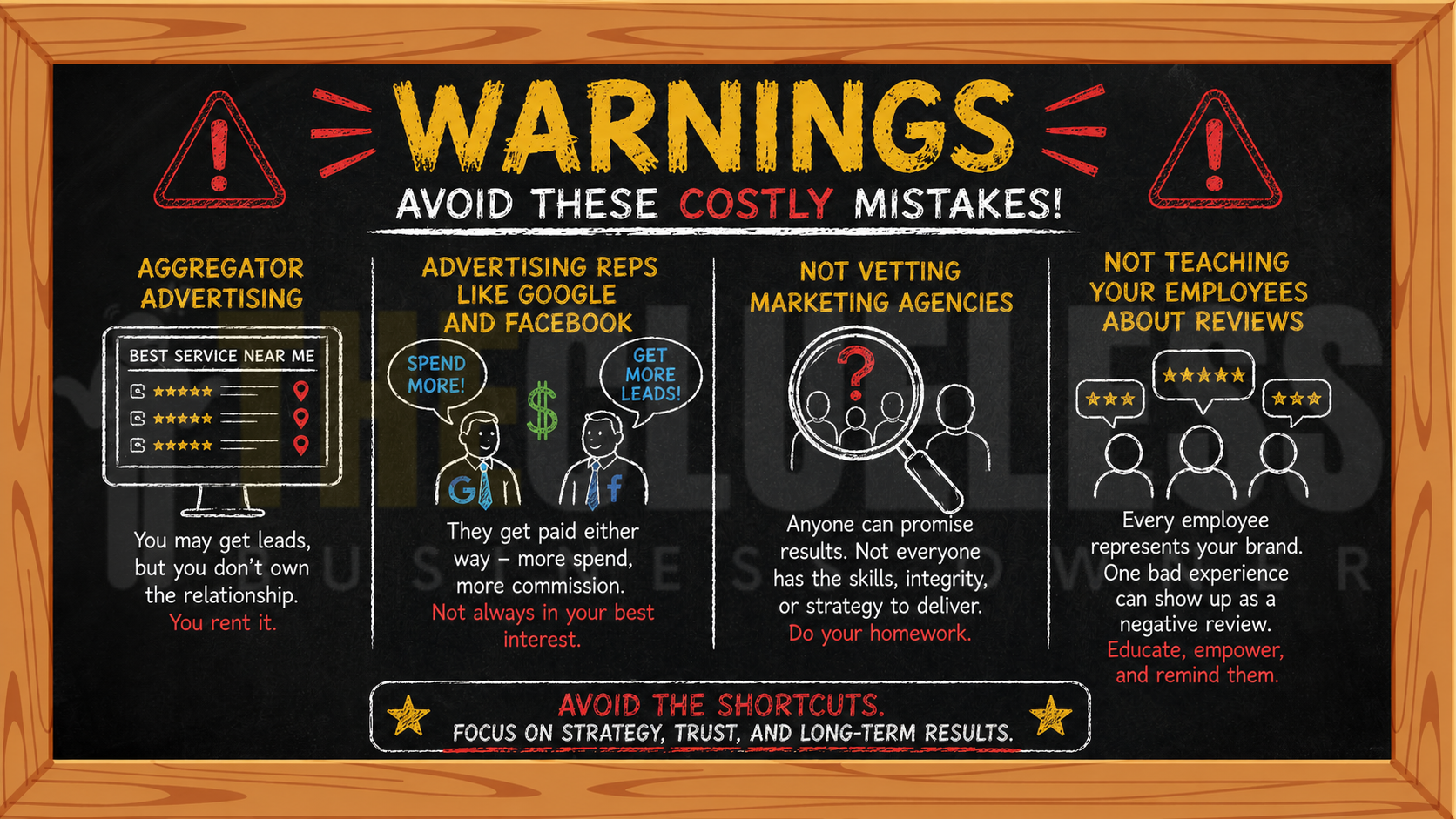
Aggregator Advertising: Don't Rent Your Visibility
I completely understand the initial appeal of platforms like Angi when you're running a local service business.
If you're just starting out, they can seem like a shortcut to getting the phone to ring.
Instead of spending months building a website, earning reviews, improving your Google Business Profile, and creating helpful content, an aggregator promises to put your business in front of homeowners who are already looking for your services.
I understand why that's attractive.
Aggregator websites are essentially large online directories that collect hundreds—or sometimes thousands—of businesses into one place.
When someone searches Google for something like "plumber near me," they may come across a page listing multiple contractors in the same area.
For a brand-new business with very little online presence, appearing on one of those platforms can help get your foot in the door.
There's nothing wrong with that.
Where I think businesses get into trouble is when they build their entire marketing strategy around someone else's platform.
Think about it.
- You don't own that website.
- You don't control how your business is displayed.
- You don't control which competitors appear next to you.
- You don't control the rules.
And you certainly don't control what happens if the platform changes its pricing, changes its policies, or decides to feature another contractor instead.
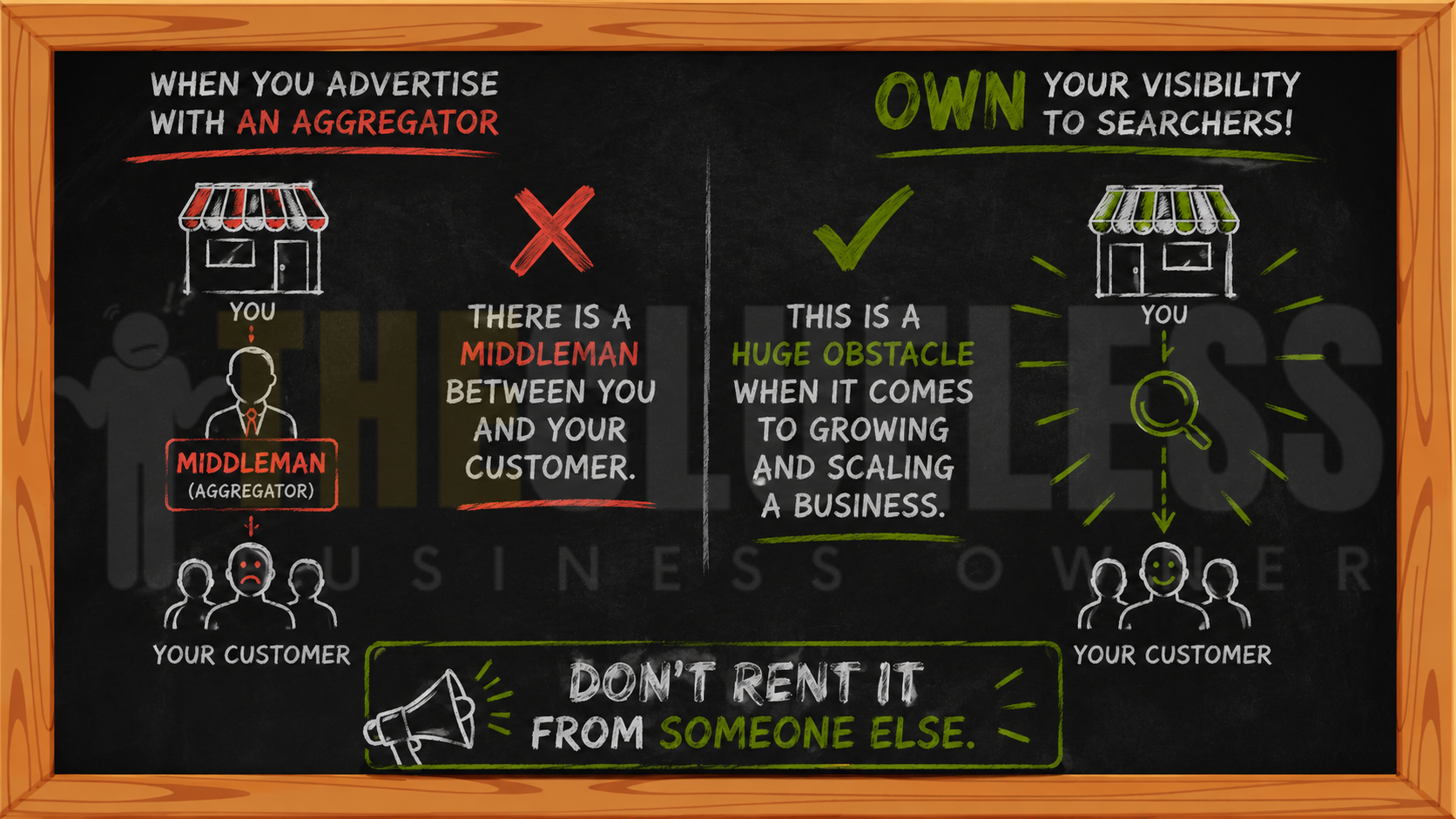
You're renting visibility. Not owning it.
That's a huge difference.
I would much rather see you invest your time and money into assets that belong to you.
- Your website.
- Your Google Business Profile.
- Your customer reviews.
- Your email list.
- Your videos.
- Your helpful content.
Those are assets that continue working for your business long after you've paid for them.
An aggregator can be a useful stepping stone while you're building your own online presence.
It should never become the foundation of your business and your ONLY source of leads.
Because the moment you stop paying for rented visibility, the leads often stop too. When you invest in your own digital ecosystem, you're building something that becomes more valuable over time.
Every new review strengthens your reputation. Every helpful blog post builds authority. Every completed project creates another opportunity to earn trust. Every improvement to your website gives both customers and AI another reason to recommend your business.
That's an investment.
Not a rental.
My goal has always been simple: Use other platforms when they make sense. But spend the majority of your time building digital assets that you own and control.
Those assets will continue serving your business long after the next marketing platform comes and goes.
Are Aggregator Leads the Best Investment?
There's another important difference that many business owners don't think about.
On many lead-generation platforms, the customer isn't contacting your business.
They're submitting a request to the platform.
That platform may then distribute or sell the same lead to multiple service providers at the same time.
Now you're not just trying to win a customer.
You're racing against several competitors who received the exact same opportunity.
Instead of having the customer choose you, you're competing to respond the fastest, offer the lowest price, or simply answer the phone before someone else does.
Compare that to a customer who finds your website, your Google Business Profile, or calls your business directly.
That customer has already chosen to contact you.
You're starting the conversation from a position of trust—not from the middle of a bidding war.
That's one more reason I encourage businesses to invest in building their own digital presence.
When customers come directly to you, you're building your business—not someone else's.
Marketing Platform "Reps": The Budget-Draining Advisory Trap
If you run paid advertising on platforms like Google or Facebook, chances are you've received messages from someone claiming to be your "dedicated account representative," offering a free session to help improve your campaign results.
Many well-meaning business owners assume these representatives are elite, highly skilled marketing experts who are acting as consultants with your best financial interests in mind.
Neither assumption is true.
Let’s pull back the curtain on how these platform reps are actually measured, how they are compensated, and why blindly following their advice is one of the fastest ways to burn through your marketing budget.
Google Ads Representatives: The Budget-Expansion Agents
The people who call or email you claiming to be your "Google Ads Account Manager" almost never work directly for Google.
Some Google Ads representatives are Google employees, while others work for authorized third-party companies operating on Google's behalf.
Guess how these representatives are incentivized and evaluated? By their ability to get advertisers to adopt automated settings and increase their daily ad spend.
They know absolutely nothing about your local business, your obstacles, your profit margins, or what a new customer is actually worth to your bottom line.
Their automated playbooks almost always revolve around a few predictable scripts:
- Bumping Your Daily Budgets: Convincing you that your campaigns are "budget-limited" and need more cash.
- Broadening Your Targeting: Expanding your keyword match types so your ads show up for completely irrelevant, low-intent searches.
- Pushing New Campaign Types: Forcing you into broad networks (like Performance Max) even when it makes no strategic sense for a local service business.
- ⚠️ Enabling "Auto-Apply" Recommendations: Giving Google's system permission to make permanent changes to your account without your review.
(I NEVER recommend this.)
- Diluting Your Ad Placements: Allowing your ads to display on cheap, spam-heavy partner websites across the internet that waste your click budget.
The largest issue I have with these advertising reps is that we have a HUGE conflict of interest.
MY goal for my client:
To get the largest amount of conversions (leads) at the
lowest possible cost.
THEIR goal for my client:
To get the largest amount of conversions (leads) at the at the
highest possible cost and the maximum revenue for THEM.
Regardless of who contacts you, remember that their recommendations still need to make financial sense for your business. Never implement a recommendation simply because a platform representative suggested it.
Meta (Facebook) Ad Reps: The Automation Illusion
If you run ads on Facebook or Instagram, you will inevitably receive a similar pitch from a "Meta Marketing Pro" offering a complimentary strategy session.
While these reps can occasionally be helpful for explaining a new technical button or resolving a glitched account setting, their strategic advice follows the exact same predatory script as Google.
Their recommendations focus heavily just like Google on increasing the amound of money you are spending.
They will instruct you to:
- Increase Your Budget: Pushing you to scale spend before a campaign has even proven its conversion metrics.
- Use Advantage+ Campaigns: Forcing you into Meta’s fully automated campaign structures that blend your budgets across unproven audiences.
- ⚠️ Enable Automatic Adjustments: Allowing Meta’s AI algorithms to autonomously rewrite your headlines, crop your images, modify ad delivery, and swap out campaign elements without your permission.
In my own extensive testing across millions of dollars in ad spend, allowing Facebook's automatic adjustments to make all the decisions rarely produces the best results.
Instead, it drastically increases your cost-per-lead without producing a proportional increase in actual, paying customers.
The Bottom Line: Own Your Strategy
Platform representatives are evaluated on platform adoption, algorithm training, and advertiser spending—not on how effectively they help you support your family or scale your business.
They are salespeople disguised as advisors. They do not understand your local customers, your operational process, your sales process, or your long-term goals. Many of them are SUPER inexperienced and lack proper training. (In fact funny story - I have often taught a Facebook rep something THEY did not know.)
Treat their recommendations with extreme caution.
Never check a box that gives an advertising platform unrestricted, automated control over your credit card.
Keep the steering wheel of your digital advertising assets firmly in your own hands.
The Ultimate Blind Spot: Failing to Vet a Marketing Agency
Just about every local business owner has a devastating war story about a marketing agency relationship gone completely wrong.
But I am going to give you a harsh truth right now: the vast majority of those financial horror stories could have been completely prevented if the business owner had simply done proper research.
Just because a salesperson is incredibly likable, seems to be completely on the up-and-up, or has a beautiful, polished website does not mean you should blindly hand them a credit card.
Skipping the vetting process will cost you thousands of dollars, cause massive growth setbacks, and inflict months of completely unnecessary stress.
A legitimate marketing agency will never expect you to leap blindly. They will welcome your scrutiny.
The 6 Questions Every Business Owner Must Ask
Before you sign a contract or grant access to your digital footprint, put the agency through this exact diagnostic interview,
- Who is actually doing the physical work? (Are they handling it in-house, or are they quietly outsourcing your brand to cheap, unvetted freelancers overseas?)
- How long has your company been in business?
- Can you provide three active, verifiable client references?
- What specific industries do you specialize in? (If they claim to be elite experts in plumbing, dental marketing, e-commerce, and corporate law simultaneously, they are generalist order-takers.)
- How exactly do you measure and report success? (Are we tracking inbound phone calls and leads, or are we tracking "impressions"?)
- Can I cancel this agreement at any time if I don't experience the needed results?
The Red Flags: Hit the Brakes Immediately
If you spot even one of these warning signs during a sales pitch, pack up your notes and walk away from the table:
- Guaranteed rankings, instant traffic spikes, or overnight results.
- Proprietary "secret sauces" or algorithmic formulas they refuse to explain transparently.
- Long-term, ironclad contracts that lock you in regardless of performance.
- Refusal to grant you full administrative access to your own website, Google Business Profile, or ad accounts.
- Vague, jargon-heavy reporting that emphasizes vanity metrics over revenue.
- High-pressure, "limited-time discount" sales tactics.
- Fear-based marketing designed to panic you into buying.
- ⚠️ Shady case studies with cropped screenshots and numbers that cannot be verified.
Call EVERY Single Reference (No Excuses)
I distinctly remember talking to a new client who was deeply burned by a previous agency. When I asked him if he had requested references before hiring them, he said, "Oh yeah, they gave me a list of several."
I asked him, "Well, why didn't you call them?"
He paused, looked down, and said, "Uh, no. I don’t know, it just didn't feel necessary at the time."
Do this or you may be sorry later! Get at least three references and pick up the phone to call every single one of them.
Ask them exactly what the day-to-day communication looks like and if they received the results they were looking for or needed.
If you choose to skip this basic step and end up trapped in a terrible experience, you have no one to blame but yourself.
The Mark of a True Partner
A high-integrity marketing agency doesn’t just tolerate questions—they expect them. The best professionals in this space will never try to confuse or impress you with complex acronyms, hidden secrets, or high-pressure tactics.
They educate you.
They lay out the data in plain English, protect your assets, and help you make highly informed financial decisions.
If an agency gets defensive, uncomfortable, or evasive when you ask reasonable structural questions, treat it as an immediate sign to walk away.
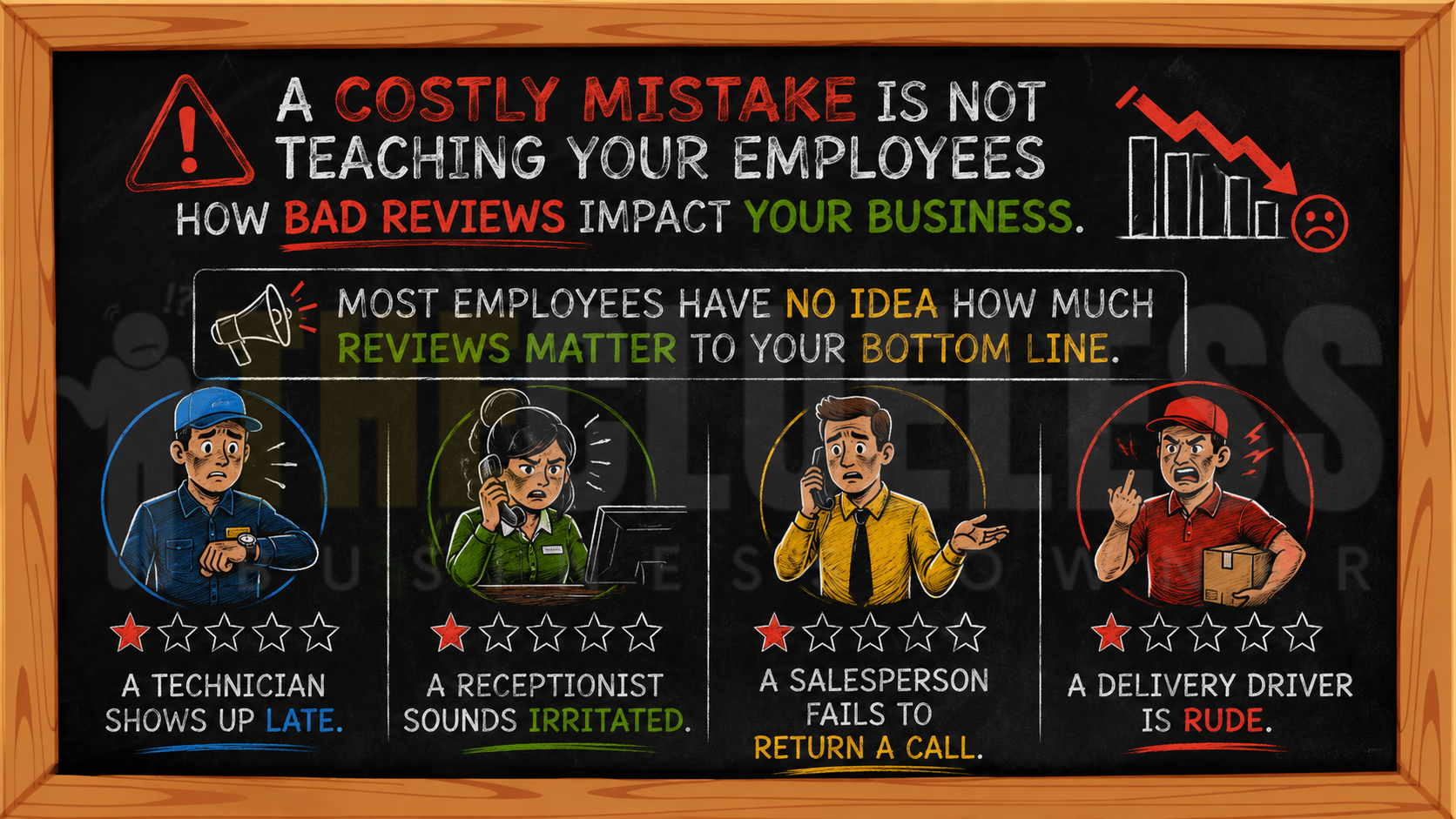
An "Internal" Blind Spot: Failing to Educate Your Team About Reviews
A giant mistake is not teaching your employees the impact they could have on your company reviews.
The vast majority of your employees have absolutely no idea how much an online review impacts your company's bottom line.
To an employee, these might seem like minor, isolated incidents:
- A service technician shows up fifteen minutes late without calling.
- A front-desk receptionist sounds short or irritated on the phone.
- A salesperson forgets to follow up on an estimate request.
- A delivery driver leaves a gate open or acts curt in the driveway.
To the employee, it was just a stressful Tuesday. But to the customer, it is the exact frustrating experience that drives them to open their phone, leave a scathing 1-star review, and vow to never hire your company again.
That single 1-star review doesn’t just hurt feelings. It actively triggers algorithm penalties that drop your local visibility, drops your star score, and tanks your leads.
A single unhandled employee interaction can easily equate to thousands of dollars in permanently lost revenue.
Reviews Impact Far More Than Just "Reputation"
Your team needs to understand that reviews are the literal fuel for your entire digital asset ecosystem.
Reviews directly dictate:
- Consumer Trust: The immediate psychological validation required to hire you.
- Search Rankings: Google actively prioritizes profiles with steady, high-quality review velocity.
- Google Maps Visibility: The physical proximity and frequency with which your map pin shows up.
- Conversion Rates: The percentage of people who actually call you instead of clicking away.
- AI Recommendations: Modern AI search models explicitly cross-reference review sentiment before recommending a local business.
In the modern digital landscape,
a customer will almost always read your reviews before they ever lay eyes on your website. Your reviews are your front door.
Your Employees ARE Your Marketing Team
Whether they realize it or not, every single person on your payroll contributes directly to your company’s digital reputation—and therefore, your financial survival.
Every single phone call answered. Every service visit completed. Every customer interaction handled. Every complaints resolved with grace. Every simple detail ignored.
The real-world customer experience your team creates today seamlessly morphs into the digital reviews your future customers will read tomorrow.
The Operational Solution: Connect the Dots
Your staff members don't need to go back to school to become digital marketing experts. They simply need you, the leader, to explicitly connect the dots for them. They must understand that the way they treat a human being in the field directly impacts the company’s reputation, growth, and overall success.
When employees finally realize that a 5-star review is the ultimate goal of a service call, they become infinitely more intentional about the customer experience they provide.
The Bottom Line
Your marketing agency can generate brilliant leads. Your website can attract massive traffic. Your paid advertising can drive endless clicks.
But if the real-world customer experience isn't excellent enough to naturally harvest positive reviews, every other marketing effort you pay for becomes harder, more frustrating, and drastically more expensive.
Online visibility is not just a marketing agency responsibility. It is an operational responsibility. It belongs to everyone in your building, and it is your job as the owner to communicate that truth to everyone who represents your name.
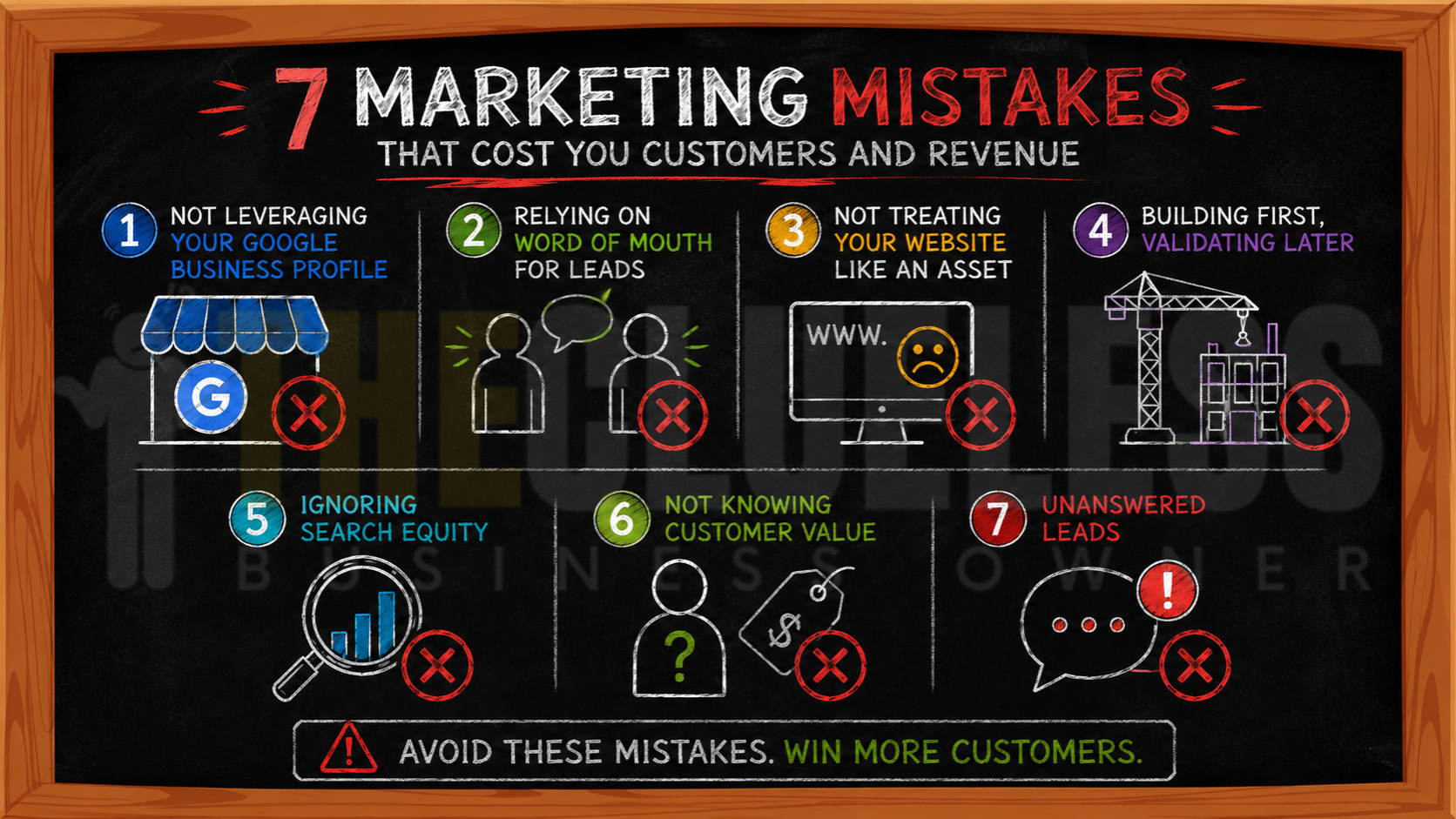
Common Marketing Mistakes
Leaving a Valuable Digital Asset Unclaimed
If I had to look at the entire digital landscape and pick the single biggest, most expensive marketing mistake I see local businesses make, it is this: failing to leverage one of the most valuable marketing assets on the internet—which, by the way, is 100% FREE.
I am talking about your Google Business Profile (GBP).
I always tell my clients to view internet search positions as digital real estate. In that ecosystem I consider your Google Business Profile as prime beachfront property.
Making a disciplined, consistent investment in building this asset and driving reviews can quite literally add multiple zeros to your company's bottom line.
The Handyman Case Study: The $200K Shift
I want to share an experience I had with a client that had a small handyman business in the very competitive Atlanta market.
He had a Google Business Profile and was in position 7, sometimes a little lower depending on the search.
If you don’t already know this, Google's local map interface only shows a "Three-Pack"—the top 3 prominent profiles. To see anything lower, a user has to manually click "More Businesses."
Because searchers want fast answers, most will make a choice from those 3 profiles.
We spent six focusing on getting new reviews.
To get his field crew onboard, we came up with an incentive: anytime a technician was mentioned by name in a 5-star customer review, they received a $50 cash bonus.
It was one of the greatest financial investments he made in his business that year. Once we broke into position 3, the phone started ringing.
When we finally pushed all the way to position 1, that single free asset brought an additional $200,000 in revenue to his business that year alone.
To a massive corporation, $200K might not sound like an earth-shattering amount. But to a small, independent service business, this is a giant deal!
I have dozens of stories just like this one.
It is why I am so relentlessly passionate about this asset. If you haven't claimed yours, do it
TODAY. Fill it out completely, and start maximizing the opportunity for your business.
Your Google Profile is Now the Fuel for AI Overviews
For years, local business owners optimized their profiles solely to rank higher on Google Maps and traditional mobile searches.
Today, the stakes are even higher.
Your Google Business Profile is one of the largest data sources that AI systems use to decide recommending your business.
When a consumer opens ChatGPT, Gemini, or Claude and asks for a trusted local plumber, chiropractor, attorney, or electrician, the AI engine cannot guess.
It searches for verified data points to determine which local businesses are active, legitimate, and deeply trusted by their community.
Your Google Business Profile provides the exact algorithmic signals these AI models crave:
- Your precise business name and contact structure (NAP data)
- Micro-targeted service categories and designated service areas
- Real-time customer reviews, ratings, and contextual sentiment
- Geotagged project photos and regular operational updates
- Business hours and other important data points
If your GBP data is broken, inaccurate, or non-existent, you don't just disappear from Google Maps—you could ALSO become completely invisible from AI Overviews.
The Common Profile Mistakes Sucking Profit From Your Business
Most business owners treat their profile like a static digital business card: they claim it once, fill out the basic text, and never log in again. This "set-it-and-forget-it" mentality is bleeding leads.
Watch out for these common mistakes:
- The Ghost Town Profile: Claiming the listing but never posting updates or adding new photos.
- Hidden Service Areas: Failing to explicitly list all the local zip codes and towns your trucks physically service.
- Incomplete Data Blocks: Leaving out information about your services etc.
- Review Response: Leaving positive reviews unthanked and negative reviews unaddressed.
The Zero-Click Reality: Your Real Front Door
Your reviews are the strongest online trust signal in existence. Consumers read them, search engines track them, and AI models crawl them.
The data is undeniable: between 40% to 65% of all local searchers interact entirely with a Google Business Profile and make a buying decision before they ever visit a company’s actual website.
This is the modern "Zero-Click" reality. A complete, hyper-active profile builds immediate psychological credibility, giving you a massive competitive advantage over local competitors who choose to ignore it.
The Bottom Line
If you own a service business and you are treating your Google Business Profile as an afterthought, you are leaving a lot of money on the table.
The companies get the local calls are not always the ones with the deepest advertising budgets. More often, they are the businesses that show up, maintain a great digital real estate footprint, build authentic trust, and make it effortless for a customer to hit the "Call Now" button.
Your profile allows you to do all three. Maximize it.
Relying Solely on Word-of-Mouth: The Dangerous Illusion of Safety
A giant, systemic mistake I see local service business owners make year after year is completely depending on word-of-mouth referrals to sustain and feed their business.
Now, let’s get one thing straight: word of mouth is incredibly valuable.
In fact, it is often the single highest-converting source of new business you can get because it arrives with built-in, pre-packaged trust. When a homeowner recommends your business to their neighbor or coworker, that endorsement carries immediate credibility.
Word-of-mouth business itself is never the problem. The problem is your total reliance on it. If a handful of casual referrals is your only source of inbound leads, you have some incredibly tough, unpredictable times ahead.
The Real Bottleneck: Word of Mouth Doesn't Scale
Let’s look at a common scenario. Imagine you own a plumbing company and business is going great. Most of your customers come from referrals, and you have built a fantastic reputation in your local community.
Because you're busy, you decide to make a big move: you buy another truck and hire an additional technician to grow your revenue.
Now, ask yourself an honest operational question: Where are the additional customers going to come from to keep the new tech busy?
If your only lead source is word of mouth, you cannot simply demand more referrals because you suddenly need more work. You cannot turn a physical dial on your desk and generate more neighborhood recommendations.
Instead, you are forced to sit on your hands. You have to wait for past customers to happen to bring you up in conversation.
You have to wait for someone to need a water heater replaced. You have to wait for those referrals to eventually trickle down to you.
Do you know what that actually means? You are NOT in control of your own company.
Passive Marketing = Other people are in control of your growth.
Active Marketing = YOU are in control of your growth.
The success of your business is entirely anchored to the effort of others.
You cannot control word-of-mouth business; it is either there on a Monday morning or it isn't. And when you are not in control of where your leads are coming from, it is structurally impossible to scale a company. It is impossible to create a plan for growth.
The businesses that grow consistently month-over-month have intentional systems in place that generate predictable visibility and demand when they need it.
They invest heavily in search visibility, review acquisition, content, local advertising, and a online presence. As a result, they are never entirely dependent on other people talking about them to keep the lights on.
Word-of-mouth business should be the delicious cherry on top of your marketing sundae—but it is NOT the sundae.
Even Referrals Get "Googled" First
Consumers do not buy services the same way they did twenty, ten, or even five years ago. Today, even when someone receives a glowing, enthusiastic referral from a trusted friend, they almost never pick up the phone immediately.
Instead, they head straight to Google to perform a digital background check.
They type in your specific business name. They look at your overall star rating. They read your recent reviews, and they explicitly compare you to the local competitors ranking right next to you.
In other words: Word of mouth may start the conversation, but the internet finishes it.
A great recommendation from a neighbor might land you a spot on a homeowner's brief shortlist, but your online presence determines whether you actually get the phone call or get passed over for the guy with 300 good reviews.
Backyard Barbecues vs. AI Algorithmic Signals
This reliance on passive marketing becomes an absolute death sentence as AI continues to transform how local consumers discover home services.
When a modern homeowner opens an AI platform and asks for a recommendation, that system has no idea that your neighbor thinks you're the absolute best plumber in town.
AI cannot eavesdrop on backyard barbecues. It doesn't care what Uncle Billy thinks about your business.
AI can only evaluate the structured data it can physically find online.
AI models aggressively crawl and evaluate your Google Business Profile, your website optimization, your online directory listings, and your digital review signals.
If your business has a weak or non-existent online presence because you’ve spent a decade "coasting on referrals," you are completely invisible to the exact ecosystem consumers are rapidly shifting toward to find help.
Investing in your digital visibility isn't something you do only when business slows down.
You must invest in your online asset footprint when referrals are strong so that you build a predictable, scalable lead generation engine that you control.
Turn your marketing into an active system, stop waiting for the phone to ring, and take the steering wheel of your business growth.
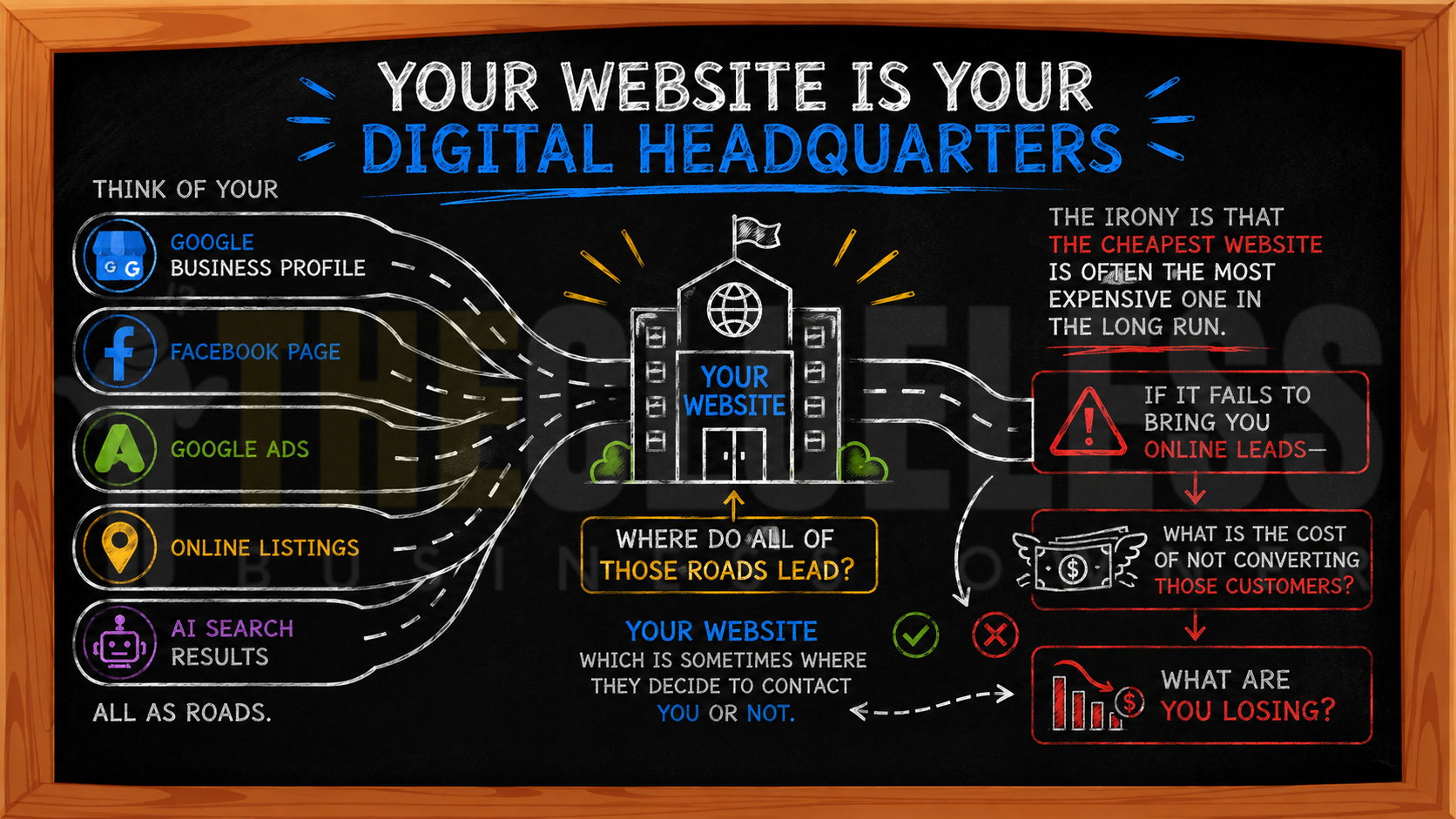
Your Website is Your Digital Headquarters
Think of your Google Business Profile, your Facebook page, your Google Ads campaigns, your online directory listings, and generative AI search results as a complex network of roads.
Where do all of those roads ultimately lead?
They lead directly back to your website. Your website is the ultimate destination where a high-intent prospect makes the final, critical decision to either pick up the phone and call you, or click away and call your biggest competitor.
The great irony of digital marketing is that the cheapest website is almost always the most expensive one in the long run.
If you pay $1,000 for a generic, unoptimized site that fails to generate a single qualified online lead, what is the actual cost of those lost customers?
How many tens of thousands of dollars in revenue are you letting walk out the door? The consequence of choosing the cheapest option is a total failure to create a visible presence.
And if you aren't visible on the screen, you aren't even in the game.
The New Rule: You Are Writing for Humans and Training AI
We are no longer building websites for just human eyes. AI platforms rely heavily on crawling your website’s text to deeply understand what your business does and whether it should recommend you.
Potential customers are increasingly trusting AI search engines to find the local services they need.
Your website is the primary textbook that helps these AI models understand:
- Exactly what services you offer.
- What areas of town you service.
- What types of experience you have.
The deeper, more authoritative, and better structured your website’s content is, the easier it becomes for both traditional search engines and advanced AI systems to confidently drop your name in front of a searcher.
The Ultimate Digital Property: Why Ownership Matters
When you invest in your own website infrastructure, you are building an independent asset that you completely control.
It stands head and shoulders above every other marketing channel:
- Unlike Advertising: Your website does not magically stop working or disappear the exact second you stop spending money on daily ad budgets.
- Unlike Social Media: You actually own it. You are not at the mercy of a random algorithm change or a platform shutting down your account overnight.
- Unlike Aggregators (Angi): You control 100% of the real estate. There are no middlemen skimming your profits, and no local competitors listed right next to your phone number.
The Bottom Line
Stop focusing strictly on the upfront cost of web development and start focusing heavily on the long-term value that digital visibility delivers to your business.
The question you ask a marketing professional should never be: "What is the cheapest website I can get away with?"
The right, growth-minded question is: "How much do I need to invest in my website so that my business becomes the most visible, trusted option to a local searcher?"
Your website is not just another annoying business expense. It is the beating heart of your entire online marketing operation. Everything else on the internet in relationship to your brand is simply the veins designed to pump life back into it.
Treat it like the foundational asset it is.
Building First and Validating Later: The High Cost of Assumption
One of the most devastating, capital-draining mistakes an entrepreneur or established business owner can make is investing massive amounts of time, energy, and money into a brand-new business concept before proving there is an actual, hungry market demand for it.
Some people spend tens of thousands of dollars on custom web development, trademarked logos, premium signage, heavy machinery, bulk inventory, and shiny marketing materials before they have a single shred of verifiable evidence that a human being wants to buy what they are selling.
It Doesn't Care About Your Excitement
One of the hardest, most brutal lessons for any ambitious business owner to learn is this: the market does not care how excited you are about your idea.
It does not care about the sleepless nights you’ve pulled, the passion you feel, or the personal savings you’ve poured into the venture.
The only dynamic that dictates your survival is whether a large enough group of people is willing to pull out their wallets and fork over money for you're selling.
Before you launch, you must ruthlessly map out the financial realities:
- What will it cost to get this concept off the ground?
- What will it cost to sustain the overhead once it’s running?
- How much revenue does it need to generate to hit profitability?
- What is your actual revenue goal?
- What will it cost to actively acquire customers to reach that goal?
Once you have those numbers, you have to identify the exact sandbox where those buyers live.
Is that population large enough to support your financial targets, and how do you plan to reach them?
Demand Modeling: Let the Market Vote First
One of the greatest competitive advantages business owners have today is access to consumer data. Before you risk a single dollar of your family's savings on a business venture you can estimate your exact market demand for free.
This process is called Demand Modeling.
At its core, demand modeling means looking objectively at the data to see if a customer base is actively looking for your specific solution before you build it.
Whether you are launching a deck-building company, expanding a pressure-washing business, or rolling out a new B2B consulting offer, you need to let the market vote first by asking the hard questions:
- Are people in my target geographic area actively searching for this?
- What is the monthly search volume, and is that demand highly seasonal?
- Is the market saturated?
- The Competitor Paradox: If you see a total lack of competitors in your space, is that a blue-ocean opportunity, or is it a flashing warning sign that the problem you are solving isn't real or urgent enough to sustain a business?
- What will it cost-per-click or cost-per-lead to realistically get in front of these searchers?
Far too many business owners make critical, irreversible financial decisions based entirely on what they want to sell rather than what the market is actively trying to buy.
Research Tip: Modern AI models like ChatGPT can be phenomenal, rapid sounding boards to help pull industry benchmarks, demographic breakdowns, and localized feasibility data to kickstart this process.
Search Data as Elite Business Intelligence
Many people mistakenly assume that keyword and search volume research is a technical task reserved strictly for SEO geeks.
I completely disagree.
Search data is the single best business intelligence tool available on the planet.
Every single day, billions of people type their deepest frustrations, urgent needs, and immediate desires directly into search fields.
They are telling us exactly what they want, when they want it, and what they are willing to pay for it.
If nobody in your target market is searching for the specific product, service, or solution you are offering, that is a massive, valuable piece of data.
On the other hand, if there is a massive wave of search activity coupled with low-quality competitor websites, you have found a genuine goldmine.
Search metrics should never be your only consideration, but they absolutely deserve a primary seat at the executive table when you are making big business decisions.
Test Small Before You Go Big
Instead of deploying heavy capital upfront, design a low-risk experiment to validate your thesis.
- Build a simple, high-converting single-page landing page.
- Put a few hundred dollars behind a targeted local search ad campaign.
- Offer the service on a strictly limited, manual basis to an existing audience.
Measure the actual conversion interest before making a major financial commitment. Your goal during this phase isn't to prove that your idea is brilliant; your goal is to let real-world customer behavior prove whether they will pay for it.
This mistake isn't exclusive to brand-new startups. Established, multi-million-dollar companies fall into this trap constantly.
They purchase an expensive new piece of equipment, hire dedicated staff, or launch an entirely new service division on a gut feeling, only to find out months later that the demand pool is completely dry.
A tiny amount of disciplined research upfront would have saved them months of immense financial frustration and wasted overhead.
The Bottom Line
Enthusiasm is not validation. A beautiful logo is not validation. A premium website sitting in a vacuum is not validation.
True validation only occurs when real buyers show real intent and exchange real money for whatever you are selling.
Before you build, validate.
Before you invest, verify.
Make sure the market completely agrees with your assumptions before you sign the check.
Building something nobody wants is an incredibly expensive mistake; finding out exactly what people want before you build it is remarkably cheap.
Not Claiming Your Search Equity
Certain business models—like electricians, plumbers, HVAC technicians, handymen, and roofers—possess a massive, built-in marketing advantage that most business owners completely take for granted. I call this Search Equity.
Search equity means that every single second of every single day, there is already a pool of local consumers going to the internet to search for your services.
The demand is already there, just waiting to be claimed.
However, according to research, up to half of local service contractors do not even have a company website.
That statistic might not have sounded crazy a few years ago, but today?
We live in a world where literally everyone carries a supercomputer in their pocket and uses the internet to solve every real-world problem.
Now with AI in the picture - the stakes are even higher.
Here is the reality, if you run a local service company and you are completely invisible on the internet, every single time a homeowner in your city conducts a search for what you do and you are absent, you have permanently forfeited a revenue opportunity to your closest competitor.
Search Equity is a Permanent/Valuable Asset
The core issue is that too many business owners view building a digital presence as a painful, monthly marketing expense instead of an appreciating asset.
It is exactly this backwards, defensive thinking that keeps your business small and forces you to constantly struggle for leads.
When you funnel your hard-earned cash into third-party platforms like Angi you are purchasing leads from an asset that they own.
Paying for Third-Party Leads = Renting an apartment.
You pay forever, and own nothing.
Investing in Search Equity = Buying the building.
You pay to build it, and it generates wealth for life.
If you stop paying rent to an aggregator, your business vanishes from their system instantly. You are literally leasing the daily survival of your company from a middleman.
Conversely, a highly optimized, strategically written website that ranks at the top of organic search results will quietly generate leads for years to come.
A disciplined investment in a great Google Business Profile backed by hundreds of authentic 5-star customer reviews will attract premium, high-paying customers to your business every single day on autopilot.
The Bottom Line: Claim What is Already Yours
The absolute greatest advantage a service business has is that at "hello," the market is already looking for you.
Unlike a software startup or a trendy new clothing brand, you do not have to spend millions of dollars educating the public on why they need a plumber when their basement is actively flooding.
They already want, need, and are ready to buy what you sell.
The search equity in your city is a massive pile of gold sitting on the table. If you remain invisible to search and AI engines, you are willingly forfeiting that asset.
Stop renting your business from middlemen, claim your digital real estate, and start capturing the equity your hard work deserves.
Not Knowing Your Customer Value: Making Strategic Investments on Incomplete Math
Knowing what one customer is really worth changes the way you make marketing decisions.
The problem?
Most local business owners only consider the first invoice.
For many businesses, a customer's true value is much bigger than that. It includes repeat business, referrals, and other revenue that often goes unnoticed.
The Three Layers of True Customer Value
To calculate what a new client is actually worth to your bottom line, you have to look beyond day one and factor in these three critical components:
1. The Frequency of Need: How often does a customer require your services in a twelve-month cycle? For example, the average homeowner calls a reliable handyman service roughly twice a year. If your initial ticket is $300, that customer's annual value is actually $600.
2. Customer Lifetime Value (LTV): How many years will a satisfied customer stay loyal to your brand? If you run a high-integrity HVAC or landscaping company, an acquired customer might stay with you for 10, 15, or even 20 years. A client who pays you a few hundred dollars a year over two decades morphs into a massive financial asset.
3. The Referral Multiplier: Do your happy customers actively evangelize for your brand? If one new customer loves your work and refers three of their friends, neighbors, or family members over the next two years, the acquisition value of that original customer has effectively quadrupled.
When you understand that bringing a new customer through your front door means capturing long-term frequency, lifetime loyalty, and referral network equity, your entire perspective on marketing spend completely flips.
The Cost-Per-Lead Trap: Shifting From Spend to Gain
Unrealized customer value forces business owners into a defensive, scarcity-minded trap.
They don't focus on the big picture instead they consider questions like this:
- "How much does an individual lead cost?"
- "How much am I paying for a single click?"
- "What is this ad campaign costing me this month?"
While tracking your expenses is vital, evaluating these numbers in a vacuum is not a
profitable (growth) mindset.
The far superior, executive-level question is:
What am I receiving in return for the acquisition cost?
Small Picture Thinking = "This lead cost me $75. That's too expensive."
Big Picture Thinking = "I spent $75 to acquire a client worth $5,000 over their lifetime."
A business owner who mistakenly believes a customer is only worth a one-time $200 service fee will constantly panic, pull back budgets, and hunt for the cheapest, lowest-quality marketing shortcuts.
Conversely, the business owner who has done the math and knows that a single customer generates $5,000 in lifetime value will confidently out-invest and completely crush their local competitors.
They aren't looking at what they spent; they are looking at what they gained.
The Bottom Line: Know Your Numbers, Remove the Emotion
The businesses that scale consistently and make the absolute best marketing decisions always know their baseline intelligence numbers by heart.
They track:
- Their Average Transaction Value (The initial invoice)
- Their Sales Closing Rate (How many leads turn into paying jobs)
- Their Repeat Purchase Frequency (How often customers return)
- Their Referral Rate (The percentage of clients who send new business)
- Their Ultimate Lifetime Customer Value (The total historical revenue per customer)
When you know these foundational metrics, marketing stops being an emotional, stressful gamble and becomes a predictable, strategic machine.
If you do not currently know what a customer is truly worth to your business over time, stop spending money and calculate that number immediately.
Until you possess that definitive financial anchor, you are making major business decisions completely in the dark. Calculate your value, own your data, and invest with absolute confidence.
Unanswered Leads: How Much Money Are You Leaving On The Table?
Sometimes, a local service business isn't suffering from a lack of inbound leads at all. Instead, they are suffering from lead leakage—the quiet, internal destruction of opportunities they have already paid hard-earned money to generate.
Shocking industry research reveals that up to 62% of small business inbound phone calls go completely unanswered, and the average company takes over two full days to respond to a digital web inquiry or contact form.
Do you know what today's internet-armed (and savvy) searcher does when you don't pick up the phone within minutes? They click back to the search results, skip your name, and call the next one on the list - your competitor.
The Anatomy of a Leaky Bucket
If your operational infrastructure is broken, throwing more money at marketing will never benefit your business.
Take an honest look at how local companies lose opportunities every single day:
- The Unanswered Call Drop-Off (62% Missed): When a homeowner has an urgent service need and gets sent to a voicemail box, they almost never leave a message or wait for a callback. They hang up instantly and dial the next company in line.
- The Delayed Response Trap (2-Day Lag): While the average small business takes days to reply to an email or lead form,
78% of consumers ultimately buy from the very first company to respond to them. Speed-to-lead is the ultimate conversion metric.
- The Follow-Up Failure (83% Abandoned): Up to 80% of service calls (mostly of companies with a sales cycle) require at least 2 to 3 consistent contact attempts to finalize an estimate or schedule a job. Yet, the vast majority of local companies stop trying after just one unanswered call or text.
- The Missing Digital Inbound (25% Ignored): Shockingly, up to a quarter of all local service providers fail to follow up on native digital ad leads at all. They write the check for the advertising budget, capture the leads - and have no solid process in place after that.
Far too many business owners panic and assume their marketing agency is failing them because "the phone isn't ringing enough."
But more often than not, the marketing is working perfectly—the operational infrastructure built around the lead intake process is what's broken.
And when that bucket is full of holes, it doesn't matter how much water you pour into it.
Stop Pouring Water. Patch the Leak.
How are you managing your lead bucket? Do you feel like you are losing money simply because you or your employees are dropping the ball?
Here are some great questions to answer:
- How many inbound phone calls is my office staff missing every single week?
- How many minutes—not days—does it realistically take us to respond to a web inquiry?
- How many times do we actively follow up with an open estimate before giving up?
Sometimes, the easiest, fastest, and most profitable way to completely double your business revenue isn’t to manufacture more leads. It is to stop losing the ones you are already getting.
Fix the leak, secure your perimeter, and value every opportunity that hits your desk.
Keep Learning

Growth Mindset
Give a group of people the same business to run and access to all the same resources. Some will succeed and some will fail. What is the deciding factor? Their mindset. This is what divides.

Marketing Strategy
Want to blow your competitors out of the water? It really isn't that complicated. Just HAVING a strategy can do the trick! (Pssst they don't usually have one.)