
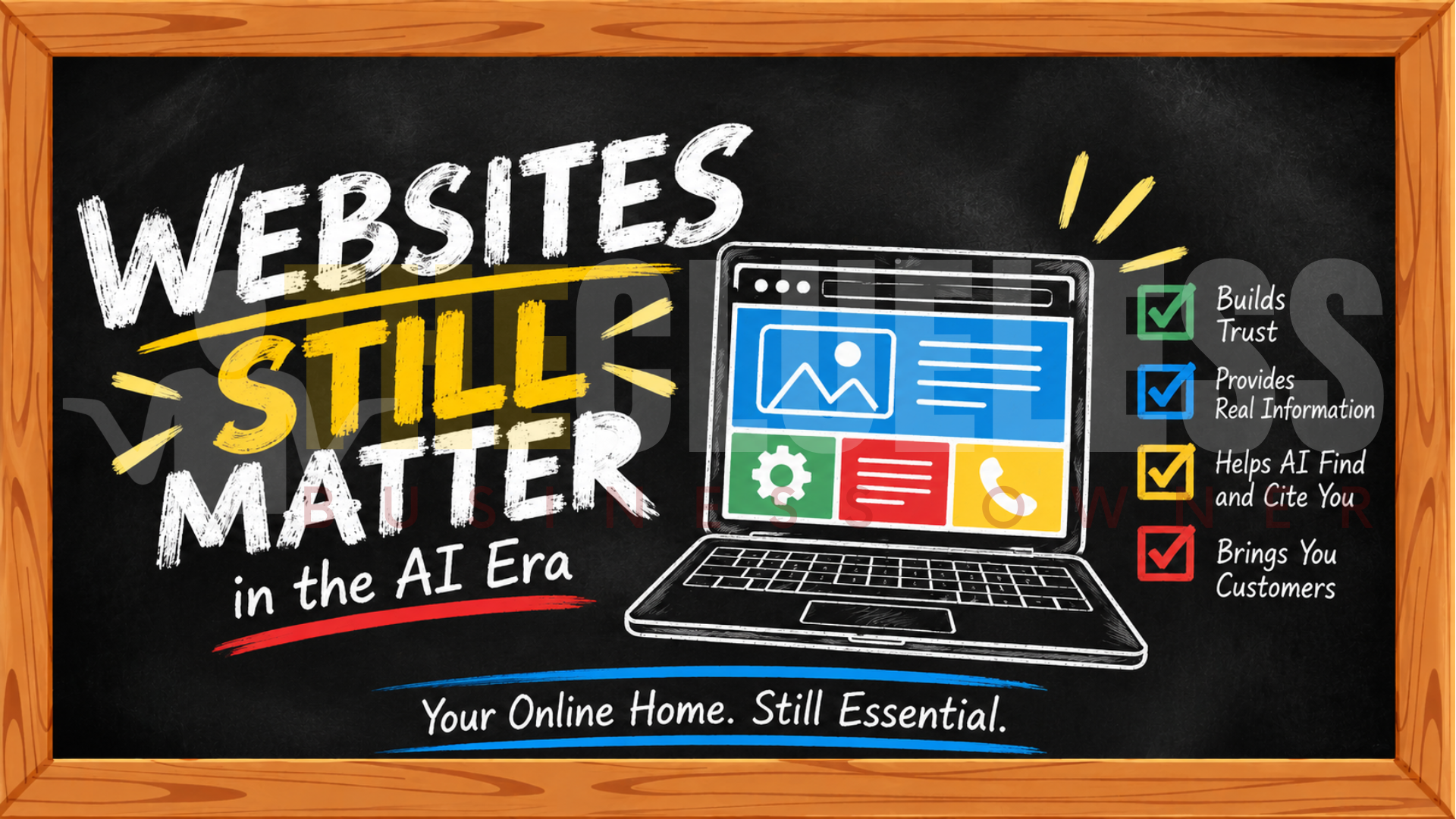
Are Websites Still Important in the Age of AI?
Absolutely.
This is an area where business owners need to be careful about some of the information being circulated online.
There is an enormous amount of confusion surrounding AI and search right now.
Claims like “SEO is dead,” “websites don't matter anymore,” or “people will never need to visit websites because AI gives them the answer” are often repeated as though they are established facts.
They aren't. Some of these claims don't even hold up logically.
AI systems need information to generate answers.
Search engines need information to retrieve (no it doesn't come from the air). Customers still need places to verify businesses, compare services, see examples of work, understand pricing or processes, read about a company, and ultimately take action.
Where is that information supposed to come from if businesses stop publishing it?
AI has changed how people discover and consume information, the original sources of that information are irrelevant.
Your website is one of the most important sources of information you control about your business. It tells search engines, AI systems, and potential customers who you are, what you do, where you operate, what experience you have, and what you know.
Think of your website as your business's digital source of truth.
Your service pages explain what you actually offer.
Your About page establishes who is behind the company. Your project pages, photos, case studies, reviews, FAQs, and educational content provide evidence of your experience.
And your website gives you room to answer the real questions potential customers are asking — something that cannot be accomplished through a short directory listing or Google Business Profile alone.
This becomes even more important in an AI search environment because search engines and AI systems are trying to understand businesses, entities, topics, relationships, and information well enough to provide useful answers.
Your website also remains one of the few digital properties your business actually fully controls. Google can change its search results. Social platforms can change their algorithms. Directories can change their listings.
AI interfaces will continue to evolve. You don't control any of those platforms. But you do control your website.
And when someone discovers your business through Google Maps, an AI Overview, AI Mode, ChatGPT, social media, a referral, or somewhere else entirely, your website can still become the place where that person verifies what they found and decides whether to contact you.
So no, AI did not kill the business website. AI just changed it's job.
A modern business website isn't simply an online brochure designed to rank for a handful of keywords.
It is becoming a structured library of authoritative information about the business — information that can help customers understand the company while also helping search engines and AI systems understand it.
That doesn't make a useful, accurate, well-organized website less important.
It makes publishing trustworthy information on your website more important than ever.
What Is The Call Pool, and Why Does Your Website Matter?
The Call Pool is the total number of potential customer calls available for a particular service in any given internet search.
Every day, people in your area search for services like plumbing, HVAC, window replacement, etc.
These searches create opportunities for local businesses to earn calls and new customers, but not every search becomes a call, and businesses compete for a share of those opportunities.
But getting found is only half the battle. Google Maps, paid ads, and AI search may introduce customers to your business, while your website helps them evaluate your services, experience, and credibility.
Your website doesn't just help you compete for visibility in The Call Pool. It helps turn that visibility into actual customers.
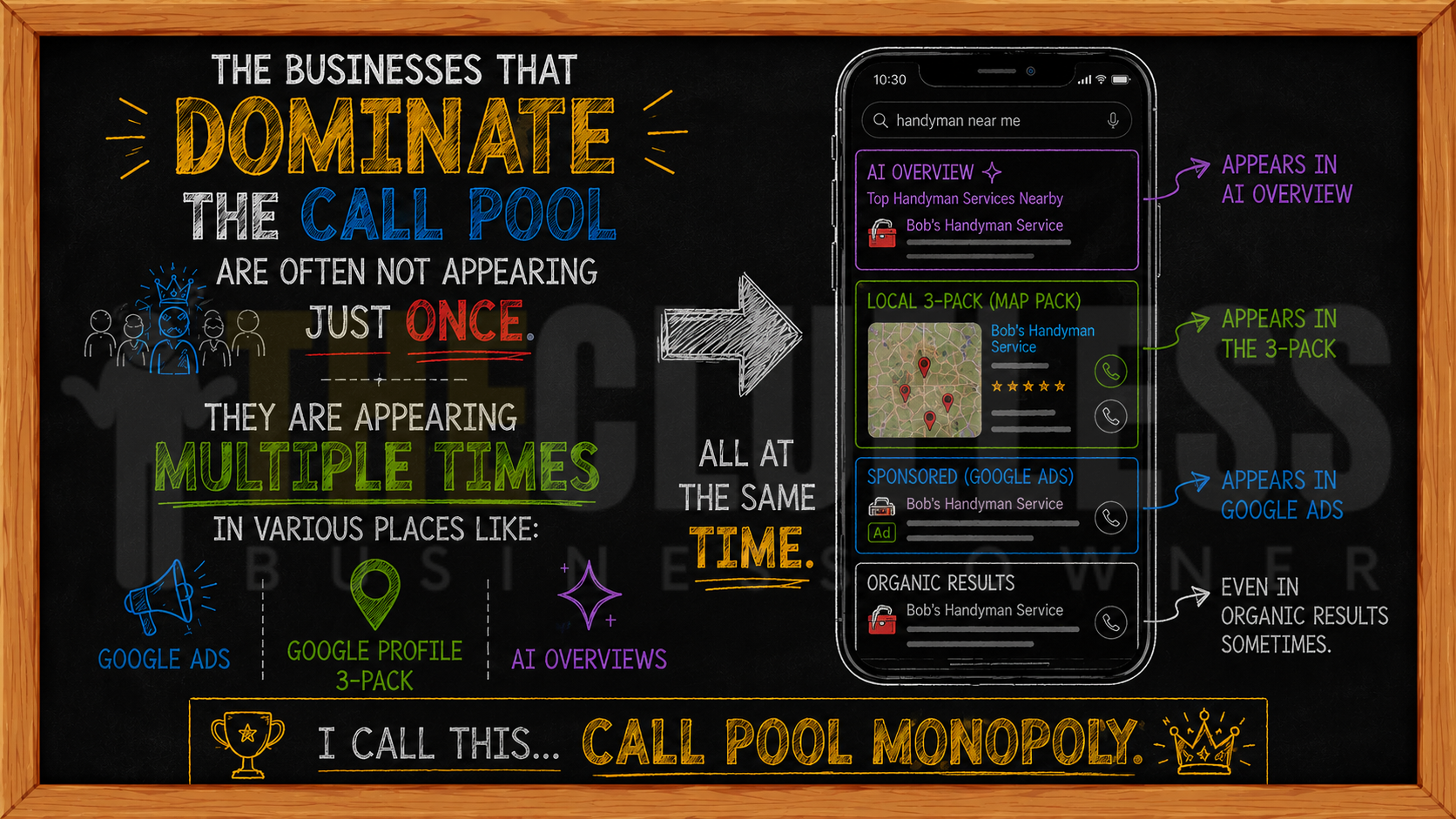
Achieving a "Call Pool Monopoly"
I always tell business owners to look at the Google search results page as extremely valuable, high-stakes digital real estate.
The local businesses that are getting the leads in their market are usually the ones occupying multiple pieces of property across a particular search. You don't just want one listing; you want to take more than one space on the block.
[ Google Ads ] -> You own the top of the page.
[ Google Maps ] -> You own the local map results.
[ AI Search ] -> You appear in AI-powered answers and recommendations.
[ Organic SEO ] -> You appear at the top of organic search.
[ Directories ] -> Your business appears in top directories like Yellow Pages and Yelp.
The more search real estate you control, the more familiarity, trust, and automatic authority your business builds in the mind of the searcher.
When they see your name over and over again on the same screen (or at least more than once), you stop looking like just another option.
This is how you create what I call a Call Pool Monopoly.
A Call Pool Monopoly is when your business takes up more than one space in results for any particular search.
By monopolizing the screen, you make your company look like the only logical choice for the searcher.
This kind of visibility creates a consistent supply of leads for your business over time.
Your Website: The Engine of Your Business
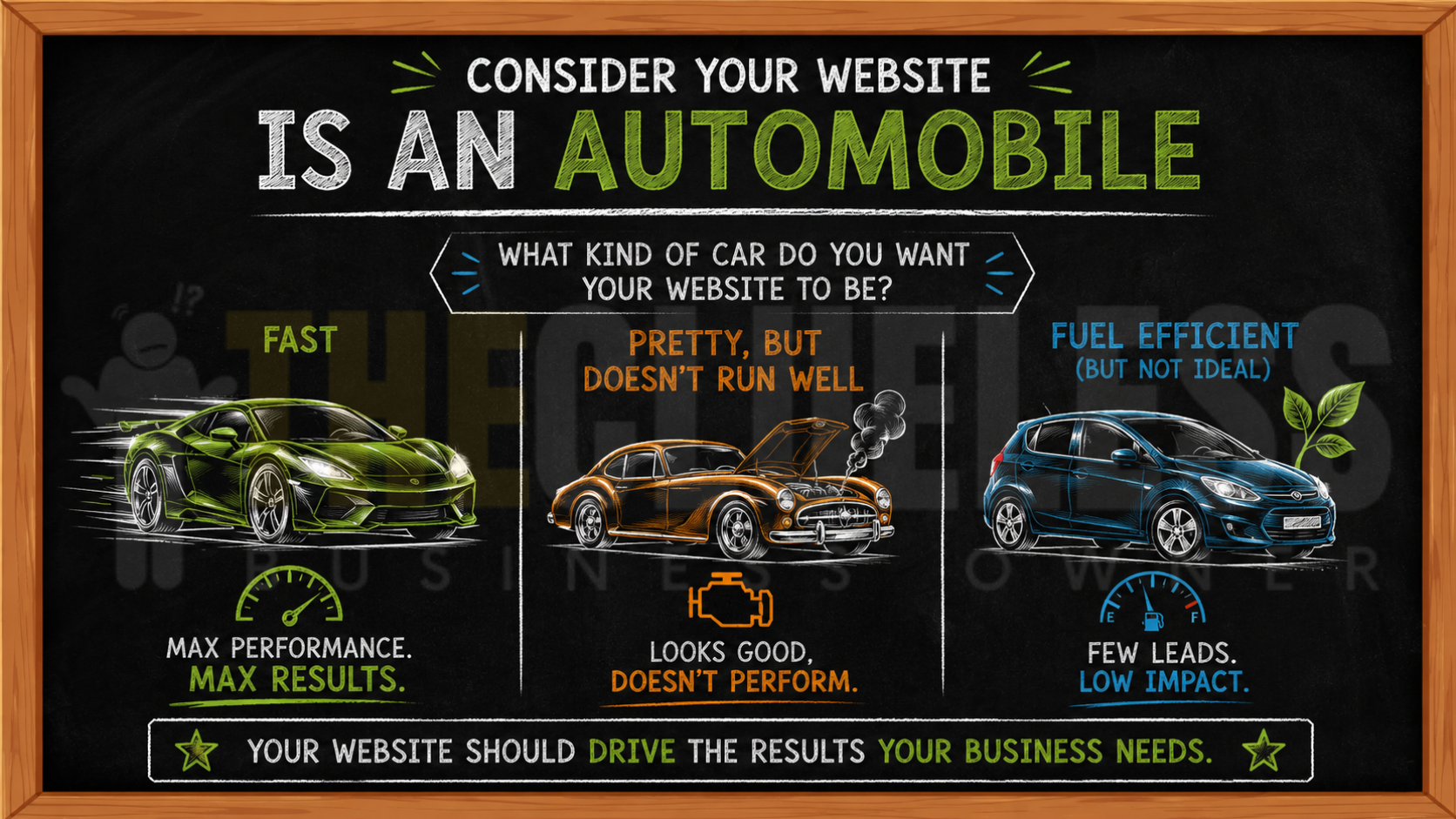
I want you to think of your business website exactly like an automobile. When it comes to growing your company, what type of car do you actually want your website to be?
Let’s really consider it:
- Do you want a car that is built for speed and engineered to win races?
- Do you want a car that looks incredibly pretty on the outside, but doesn’t actually run under the hood—or maybe doesn't even start at all?
- Or perhaps you want a car that is highly fuel-efficient (CHEAP)? It barely gets you down the road, it breaks down constantly, and you certainly wouldn't trust it to carry your family on a long vacation.
I know these scenarios sound a bit silly at first glance, but take a moment to really think about it. This exact thought process is how you begin to shift your mindset.
It forces you to honestly evaluate how you use the digital tools in your business—or, in most cases, how you are completely neglecting them.
Okay, let’s go for a little test drive under the hood.
The graphic below demonstrates how to do an incognito search.
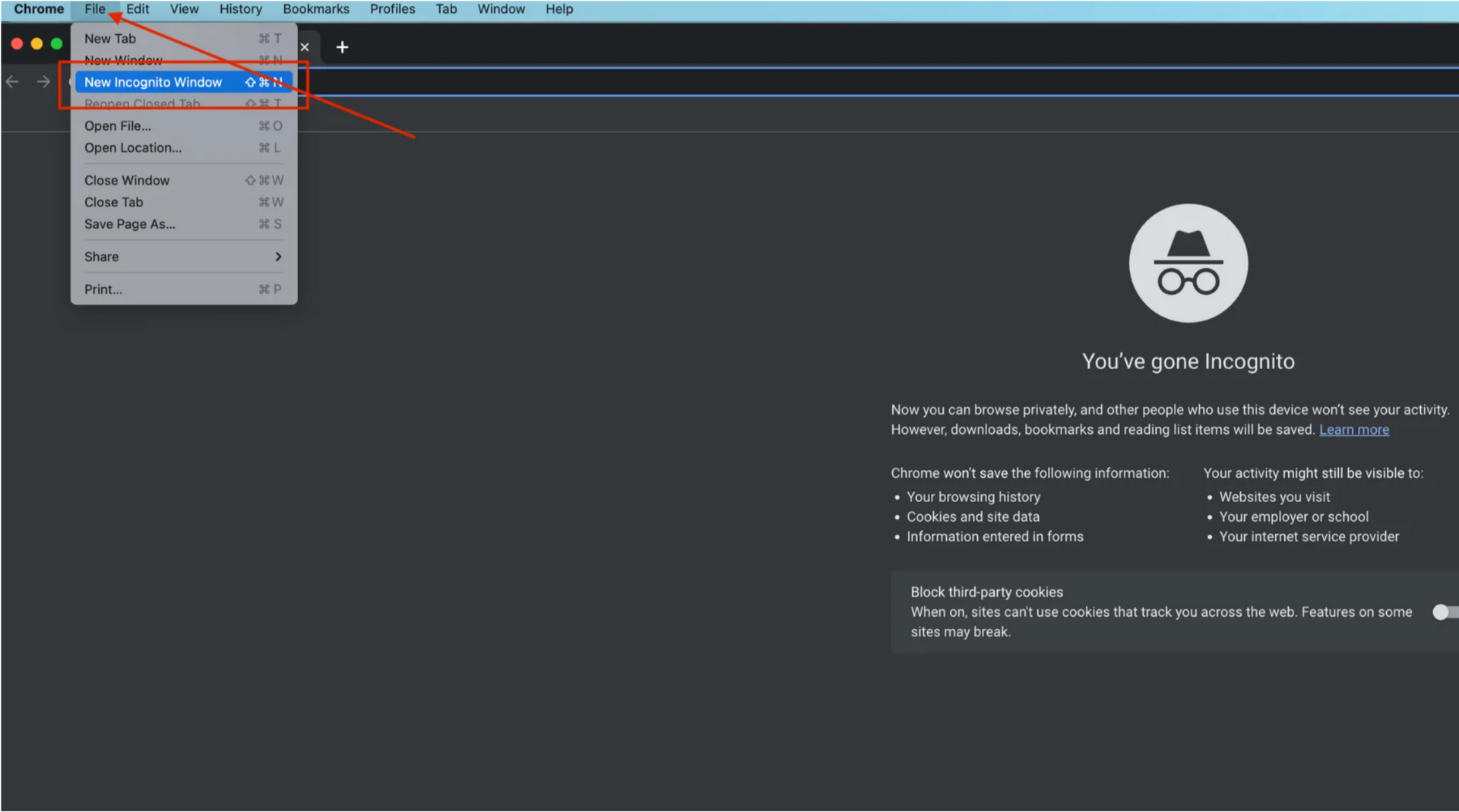
The Incognito Challenge: A Quick Real-World Experiment
I want you to perform a simple, eye-opening experiment right now.
Open Google Chrome on your phone and search for your services the exact same way a potential customer would search for them online. (And yes, it is important to use Chrome because it absolutely dominates the search market and handles the overwhelming majority of local mobile searches.)
Before you type anything, open an Incognito browser window. This reduces the influence of your previous browsing activity and gives you a cleaner view of the search results. Keep in mind that your physical location can still influence what you see—which is especially important in local search.
Now, type in a phrase a homeowner or client would realistically use to find your business when they have an urgent problem:
- “Plumber Atlanta”
- “Handyman Birmingham”
- “Window replacement Nashville”
Do not search your own business name. Search for the problem you solve. Now, look carefully at the results that appear at the very top of the scroll.
(Notice I specifically said top of scroll because today, the vast majority of consumers are searching from mobile devices, not a desktop computer.)
Evaluating the Reality of the Call Pool
As you look at your phone screen right now, ask yourself these hard questions:
- Which local businesses appear first?
- Which companies are highlighted right away in the
AI Overview
at the top?
- Which businesses are aggressively occupying multiple positions across Google Ads, (also consider Ask Maps) Map listings, and organic rankings to achieve a dominant Call Pool Monopoly?
- More importantly… is your business anywhere in the mix?
Whether most business owners realize it or not, the companies appearing at the top of the scroll are the ones capturing the lion's share of local phone calls, clicks, and jobs inside your market.
If your business is invisible on this screen, you are actively losing high-paying opportunities every single day to the competitors who do show up.
Is Your Website Built for Profit?
Not showing up in those search results creates a bleed in your business's profitability.
Think of it this way: Imagine you have a beautiful, pristine red sports car sitting in your driveway. The paint is flawless, the rims are shining, and it looks incredibly impressive to the neighbors.
There is just one major problem: It has no engine.
It might look fantastic on the outside, but without an engine, it cannot actually take you anywhere. This is exactly what happens when a local business has a gorgeous website that cannot be found online.
If people are actively searching for your services right now and your business is completely missing from the Call Pool, your website is nothing more than a sports car without an engine. It exists, but it isn't generating a single inch of movement, visibility, phone calls, or revenue.
So, how do you drop a high-performance engine into your digital presence?
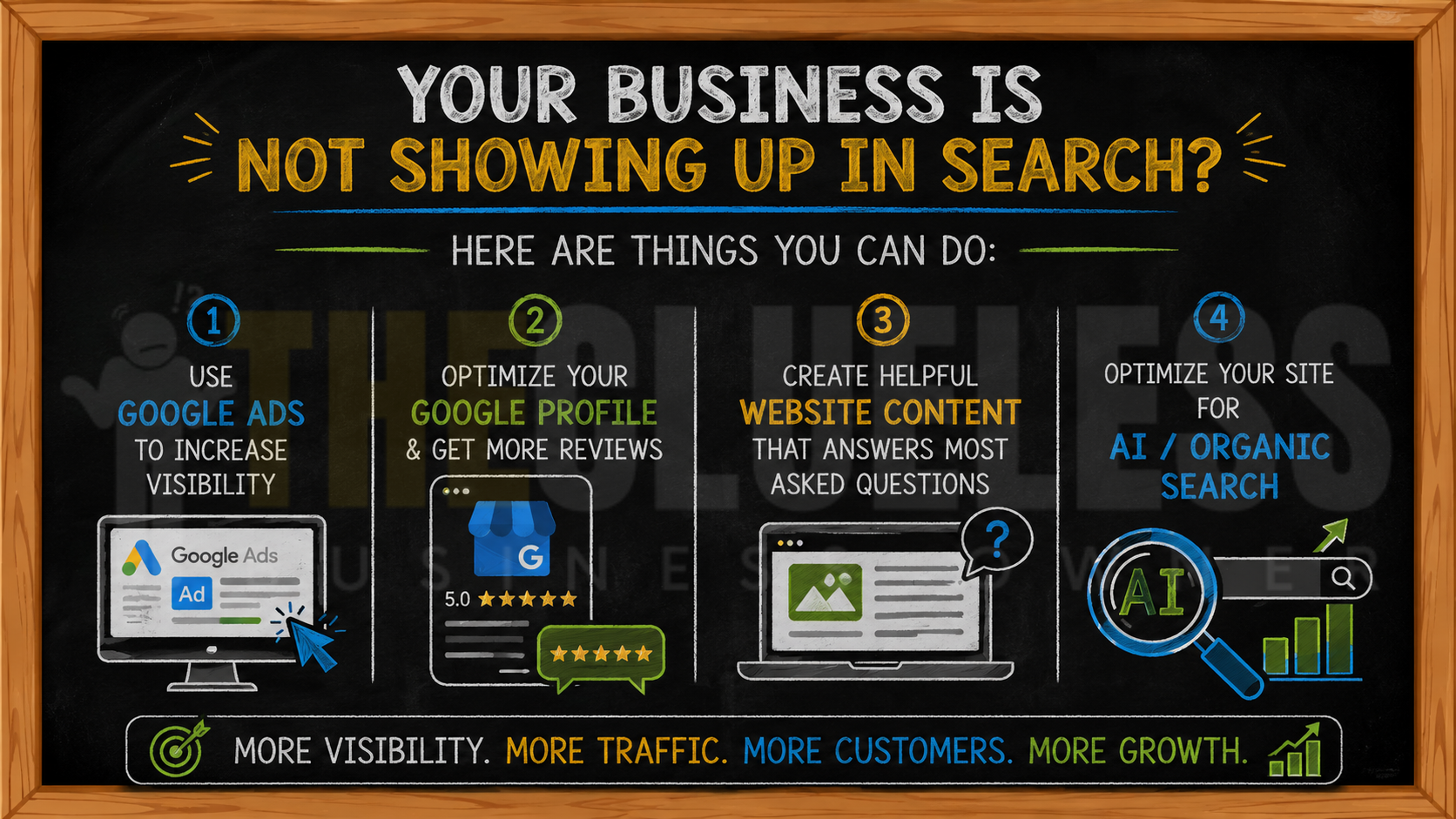
You focus heavily on these four pillars:
The 4-Pillar Digital Engine Checklist
A. Use Google Ads to Force Immediate Visibility
Google Ads can instantly launch your business into premium local searches where your website doesn't rank organically yet.
This buys you immediate,
top-of-scroll visibility, allowing you to aggressively compete inside the
Call Pool today while your long-term organic strategy quietly builds steam in the background.
B. Optimize Your Google Business Profile
Your map profile is one of the single most valuable pieces of digital real estate your company can ever own. You want your business dominating the top local map results whenever possible.
Winning this space requires clean optimization, consistent updates, accurate details, and—most importantly—a relentless system for collecting high-quality customer reviews. Reviews are the fuel that builds your map authority and trust.
C. Create Helpful Content That Answers Real Questions
One of the fastest ways to jump ahead of the competition today is by creating useful, straightforward content that answers the real questions your local consumers are asking. Those questions are becoming longer, more conversational and more specific as search evolves through AI and tools like Ask Maps.
The more specific the customer's question becomes, the more important it is that Google can clearly understand what your business does, where you do it, and the specific problems you solve. Your website is one of the sources Google can use to understand that information.
D. Optimize Your Structural SEO for Organic & AI Search
Your core website must be engineered to rank within the top organic placements for the heaviest-hitting keywords in your city.
This means your site requires:
- A clean, fast-loading technical SEO structure.
- Highly optimized service pages with effective titles and meta descriptions.
- A strong off-site authority profile built through legitimate business listings, citations, mentions and backlinks from relevant, trusted sources. Some examples are - Yelp, the BBB, Dunn & Bradstreet, and your local Chamber of Commerce, etc.
The business owners who take the time to improve their visibility across all four of these areas are the ones who achieve a true Call Pool Monopoly and dominate their local market over time.
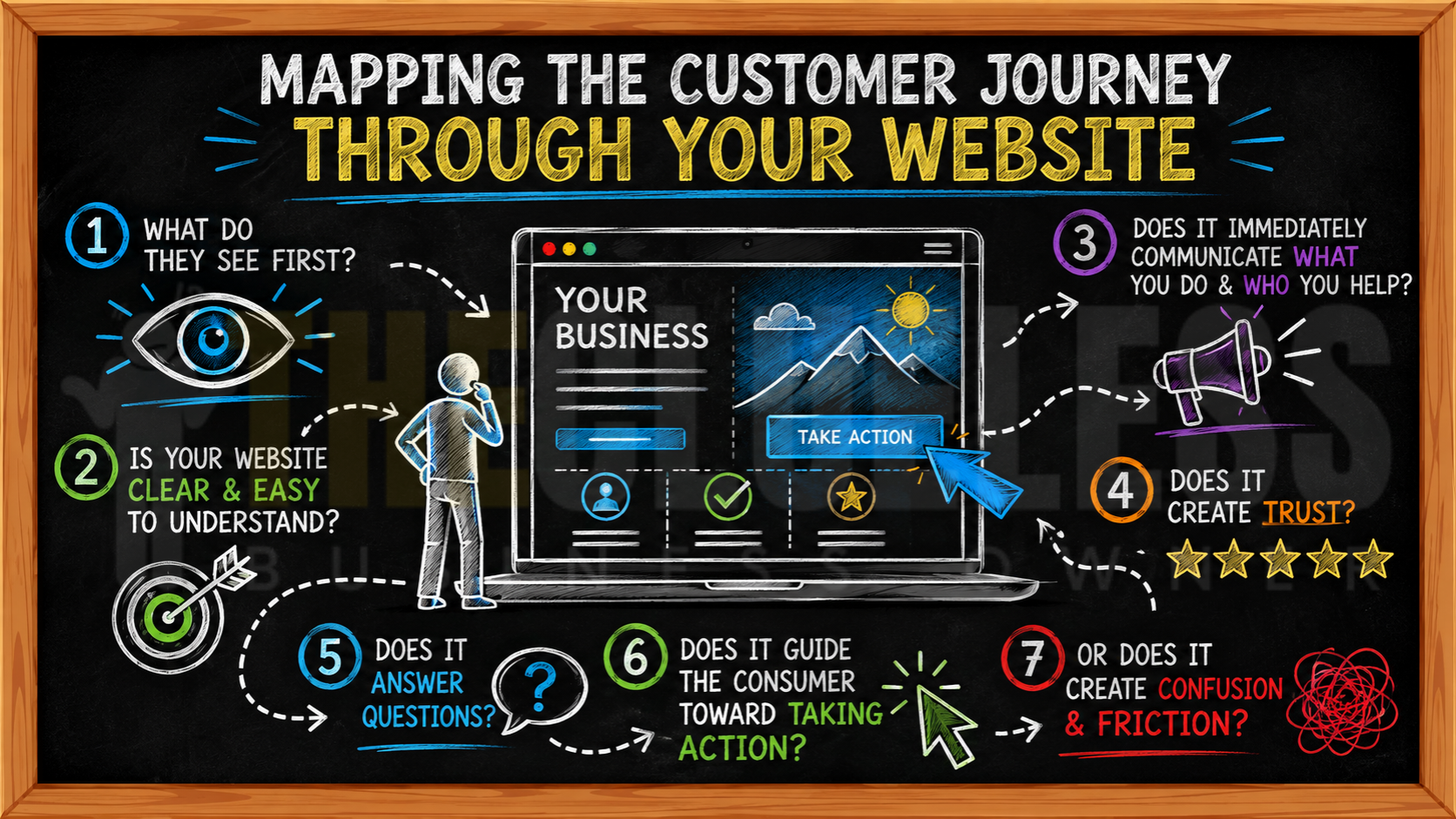
Mapping the Customer Journey
When someone walks through your front door or calls your shop on the phone, you have a direct, personal opportunity to shape exactly how they experience your company.
You influence that interaction through your tone of voice, your personality, your professionalism, and the trust you build in real-time.
But what happens when you aren’t there? What happens when a potential customer is experiencing your business completely on their own, late at night, sitting on their couch?
That is exactly what happens when someone visits your website.
Your Website = The First Impression
Your Headline = The Salesperson
Your Layout = The Storefront Atmosphere
Your Content = The Conversation
Consumers form a rock-solid opinion about your company within a few split seconds of landing on your page. This is why mapping the online customer journey is so incredibly important.
You have to look past the technicality of simply "having a website" and start looking at the actual human experience a consumer is having while interacting with your brand online.
The Silent Evaluation: Friction vs. Flow
As you look at your digital storefront, you need to ruthlessly evaluate it through the eyes of a stressed-out consumer.
Ask yourself:
- What do they see first? Does the top of the page immediately communicate exactly what you do and the specific geographic area you serve?
- Is it clear and easy to understand? Can a customer figure out how to hire you within three seconds, or do they have to hunt through menus to find a phone number?
- Does it instantly create trust? Are your five-star reviews, certifications, and real team photos proudly on display, or does it look like a cold corporate template?
- Does it guide them toward taking action? Is there a clear, bold button telling them to "Call Now" or "Book an Estimate," or does the page create confusion and decision fatigue?
Remember, the exact second someone enters the
Call Pool and clicks over to your website, they are actively judging your business.
And in most cases, they have three other competitor tabs open on their phone, comparing you directly against the guys down the street at the exact same time.
Your website is not a passive digital brochure. It is the critical frontline of your entire sales process.
Every headline, image, review, and call-to-action directly dictates how a consumer experiences your company.
That experience is everything, because perception drives trust. Trust plays a major role in whether they call you or click away to a competitor.
Overcoming the Ego Trap: The True Customer Perspective
Now, I want you to do something that is surprisingly difficult for most business owners.
I want you to temporarily take off your "business owner" hat and look at your company entirely through the eyes of a short-attention-spanned potential new customer.
This may sound simple, trust me, it isn't.
One of the biggest, quietest things that holds business owners back from growing is ego.
To be completely fair, we are all guilty of it from time to time.
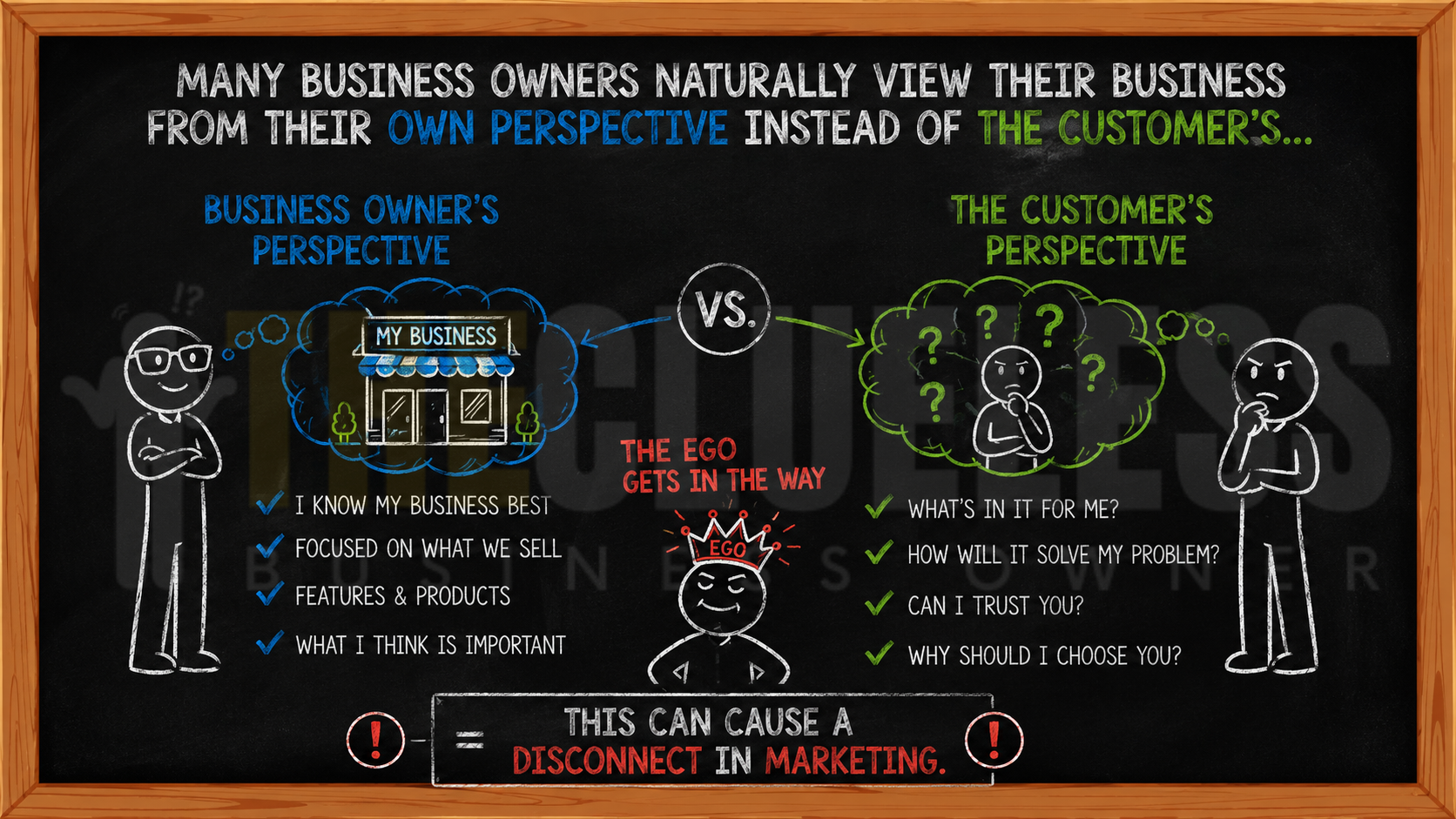
After working closely with business owners for more than a decade, I have noticed an incredibly common pattern: many owners naturally view their business from their own perspective instead of the customer's.
We become so deeply focused on what we want to sell, how long we’ve been in business, or how proud we are of our office, that we completely ignore what the customer is actually looking for, worried about, confused by, or trying to solve in real-time.
This disconnect can cost a business a lot of money in lost opportunities over time.
Ego interferes with your growth because it makes it impossible to objectively evaluate how a regular consumer experiences your business.
To win, you have to stay brutally focused on the customer’s actual perspective instead of your own assumptions.
The 30-Second Mobile Audit
With your business owner hat completely removed and your customer hat firmly on, I want you to pull out your mobile phone right now and pull up your website.
The reason I am asking you to use your phone is because that is exactly how the majority of potential customers will view your website.
The Desktop Illusion
Assuming customers sit at computers researching you for hours.
The Mobile Reality
Customers are searching quickly on their phones while at work, stuck in traffic, sitting on the couch, or dealing with a stressful, real-time problem.
When they pull you up from the
Call Pool, your website becomes their primary decision-making tool almost instantly.
As you look at your screen right now, ask yourself these hard, unbiased questions:
- What is the customer experiencing during those first three seconds? Does the top of the page look clean, professional, and trustworthy, or does it look cluttered and outdated?
- Does it immediately explain what you do? Is the core service and your local service area crystal clear before they even start scrolling?
- Does the page load lightning-fast? Or are they sitting there watching a loading wheel spin while they get more impatient by the second?
- Can someone easily contact you? Is there a prominent "Tap to Call" button right at the top, or do they have to zoom in and hunt through a footer just to find a number?
- Does the layout guide them naturally toward the next step? Or does it create immediate confusion, technical friction, and uncertainty?
Take a deep breath and look at that screen honestly. Now that we've stripped away the assumptions, let’s begin mapping your customer’s actual journey.
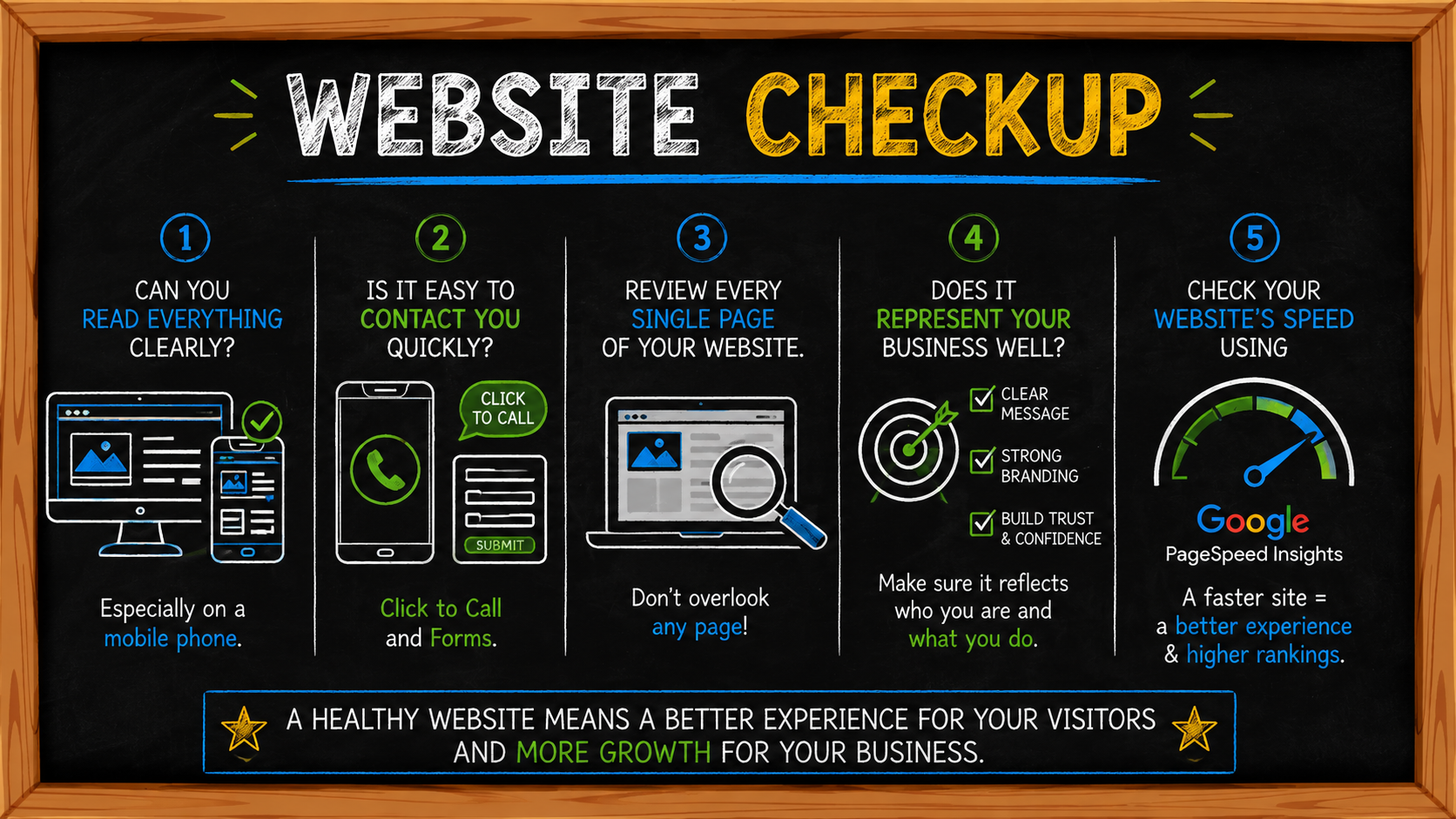
The Screen-by-Screen Mobile Audit
Now that you are looking at your website on your mobile phone, let's carefully evaluate what your future customers will experience.
Remember, in today’s top-of-scroll world, your mobile layout matters infinitely more than your desktop layout. Consumers are making split-second decisions within seconds.
As you click around your site, ask yourself these four foundational questions:
1. Can You Read Everything Clearly Without Straining?
How does the text actually look on your phone? Is the font tiny? Is the layout cramped? Does the content feel dense and difficult to read?
A massive percentage of your local consumers—especially older homeowners —will immediately leave a site if they have to squint.
As a general rule, your mobile website should use a font size that is perfectly legible without zooming. An 18px font size is usually the sweet spot for clean readability.
If a user has to work too hard to read your words, they will simply close the tab and call the next guy in the Call Pool.
2. Is It SUPER-Simple to Contact Your Business Instantly?
One of the single most frustrating mistakes local businesses make is hiding their contact info. Within the first two seconds of landing on your page, a consumer should instantly know who you are, what you do, and how to reach you.
The absolute top of your mobile screen should always feature:
- A prominent, brightly colored Click-to-Call phone button.
- A one-sentence explanation of what you do and where you do it.
- A simple, clear button to request an immediate estimate.
Online attention spans are shorter than ever. No one is going to spend three minutes hunting through your menus to find a contact page. Make the next step blazingly obvious.
I also strongly recommend placing a second Click-to-Call button directly in the footer at the bottom of the page so they don't have to scroll all the way back up when they finish reading.
3. Does Your Site Earn its Keep as a 24/7 Salesperson?
Navigate through every single page on your site right now. Look closely for grammar mistakes, broken links, outdated information, missing services, or weak calls-to-action.
Small details matter because consumers automatically associate website quality with business quality.
Ask yourself this critical question: If a customer never spoke to you personally, would this website represent your business flawlessly in your absence?
Does it answer the exact same questions customers always ask you over the phone? Does it radiate professionalism and clearly explain your value? If it doesn't, your sales process is broken.
4. Is Bad Tech Dragging Your Rankings Down?
Website speed is an absolute killer. A slow-loading website creates instant frustration and pushes eager buyers directly into the arms of your competitors.
Furthermore, if your website relies on outdated tech or clunky elements like excessive pop-ups, heavy animations, or overloaded JavaScript scripts, you are actively destroying both your user experience and your visibility in Google's eyes.
You are creating an experience for a very small screen and a highly impatient audience. Everything needs to be fast, lightweight, and smooth.
The Tech Check: Test Your Speed
Google provides a completely free tool that allows you to see exactly how fast your site loads and what might be broken under the hood.
Go to Google PageSpeed Insights, type in your website URL, and run the test. It will give you a clear performance score and hand you a specific list of technical recommendations to speed your site up.
At the end of the day, remember this: even if your
marketing strategy successfully forces your business directly into the Call Pool, a frustrating, slow, or confusing mobile website experience will push those potential customers right back out of it before you ever get a chance to win the job.
Keep Learning

Growth Mindset
Give a group of people the same business to run and access to all the same resources. Some will succeed and some will fail. What is the deciding factor? Their mindset. This is what divides.

Marketing Strategy
Want to blow your competitors out of the water? It really isn't that complicated. Just HAVING a strategy can do the trick! (Pssst they don't usually have one.)