
The Growth Mindset
Small Business Trivia: The Uncomfortable Reality
Did you know that over 86% of small business owners in America make less than $100,000 per year in net income?
The overwhelming majority of businesses in this country are not massive, multi-million-dollar corporations with endless marketing budgets and bloated executive teams. They are tiny, local operations.
But here is the truth almost no one in the industry wants to talk about: A massive percentage of struggling businesses have far more growth potential than they realize if they learn how modern digital visibility works and use it strategically.
Instead, the vast majority choose to market their businesses incorrectly—or worse, they choose not to market at all. They rely almost entirely on passive word-of-mouth referrals just to survive.
While word of mouth is fantastic, it is entirely unpredictable and outside of your control. You might have an incredible, high-revenue month because a few local homeowners happened to mention your name at a cookout, and then the following month your phone goes completely silent.
That isn't a growth strategy. That is a gamble.
If you own a local service company and your digital footprint isn't prominent, you are completely absent from the Call Pool—the small group of businesses a customer sees first when they search online for a product or service.
If you aren't in that pool, your business isn't even being considered.
The Clock is Ticking: Why 70% of Businesses Vanish
According to historical data from the
Bureau of Labor Statistics, the survival math for a small business is brutal:
- Roughly 20% of new businesses are no longer operating after their first year.
- By year two, 30% are completely gone.
- By year five, nearly 50% have collapsed.
- By the end of a decade, only 30% are still standing.
Seven out of ten businesses will not survive long term. While companies go out of business for tons of reasons, one problem that shows up over and over again is lack of cash flow: not enough money coming through the front door consistently.
Not enough cash flow typically comes from not having a enough business or income after expenses are me
Building a sustainable business requires disciplined investment. Investment in visibility, modern marketing assets, and growth.
Marketing is not an annoying monthly expense that hurts your business. Done correctly, marketing is the fuel line that feeds it.
Deep Roots: Surviving Pandemics, Recessions, and Economic Storms
When the world turned upside down in 2020, small businesses were thrown into an unprecedented tailspin of fear and uncertainty.
Overnight, consumer activity locked down, and weak companies vanished by the thousands.
But as a business owner, you must always know that these types of things can and will happen.
Whether it is a global pandemic, a sudden economic downturn, skyrocketing inflation, shifting consumer behavior, or massive technological leaps like generative AI, the business landscape is in a constant state of evolution.
When these macro-shifts hit the market and your business fails to adapt, you don’t just plateau—you begin a slow, painful slide into being left behind.
The Root System Analogy
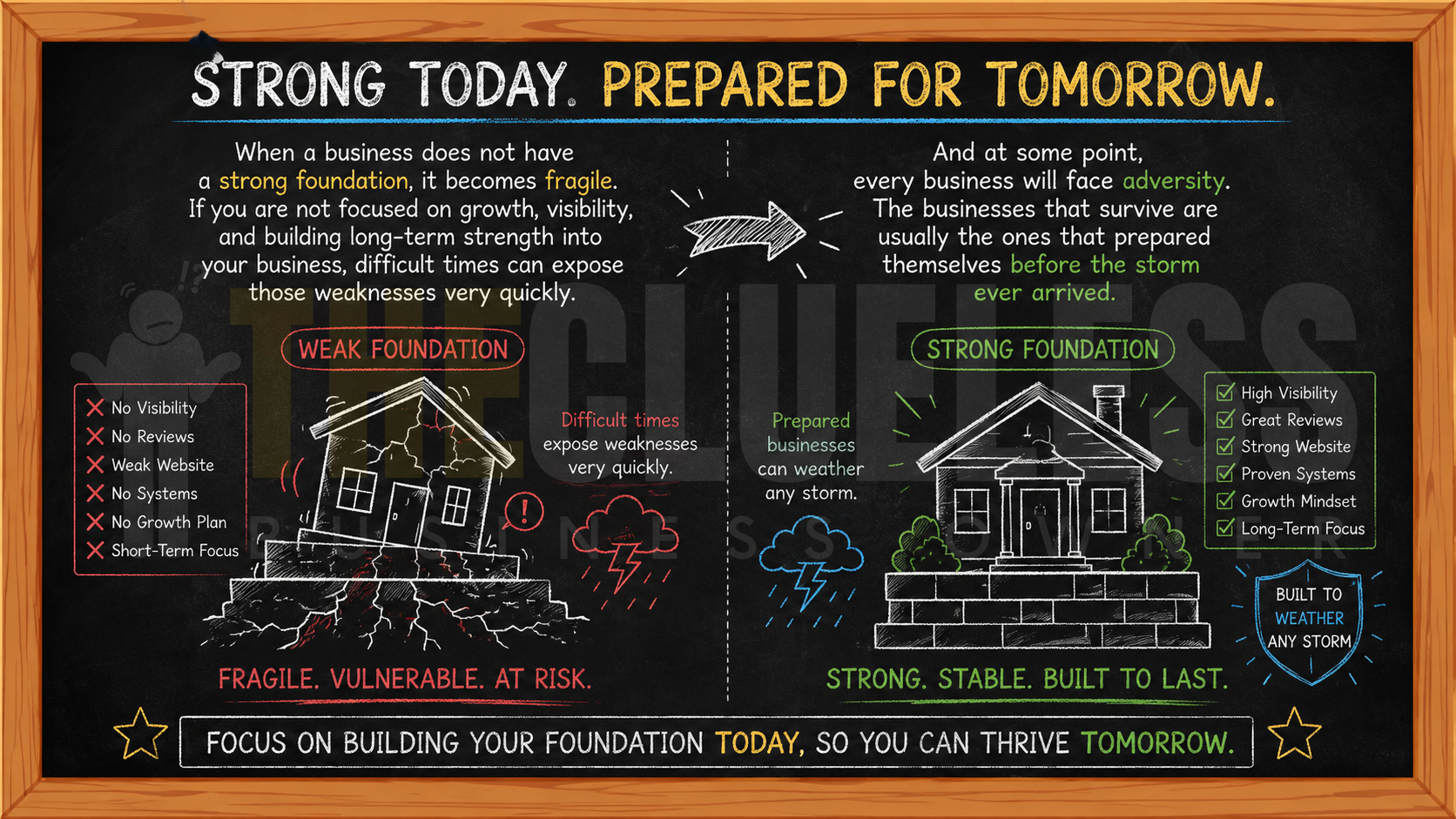
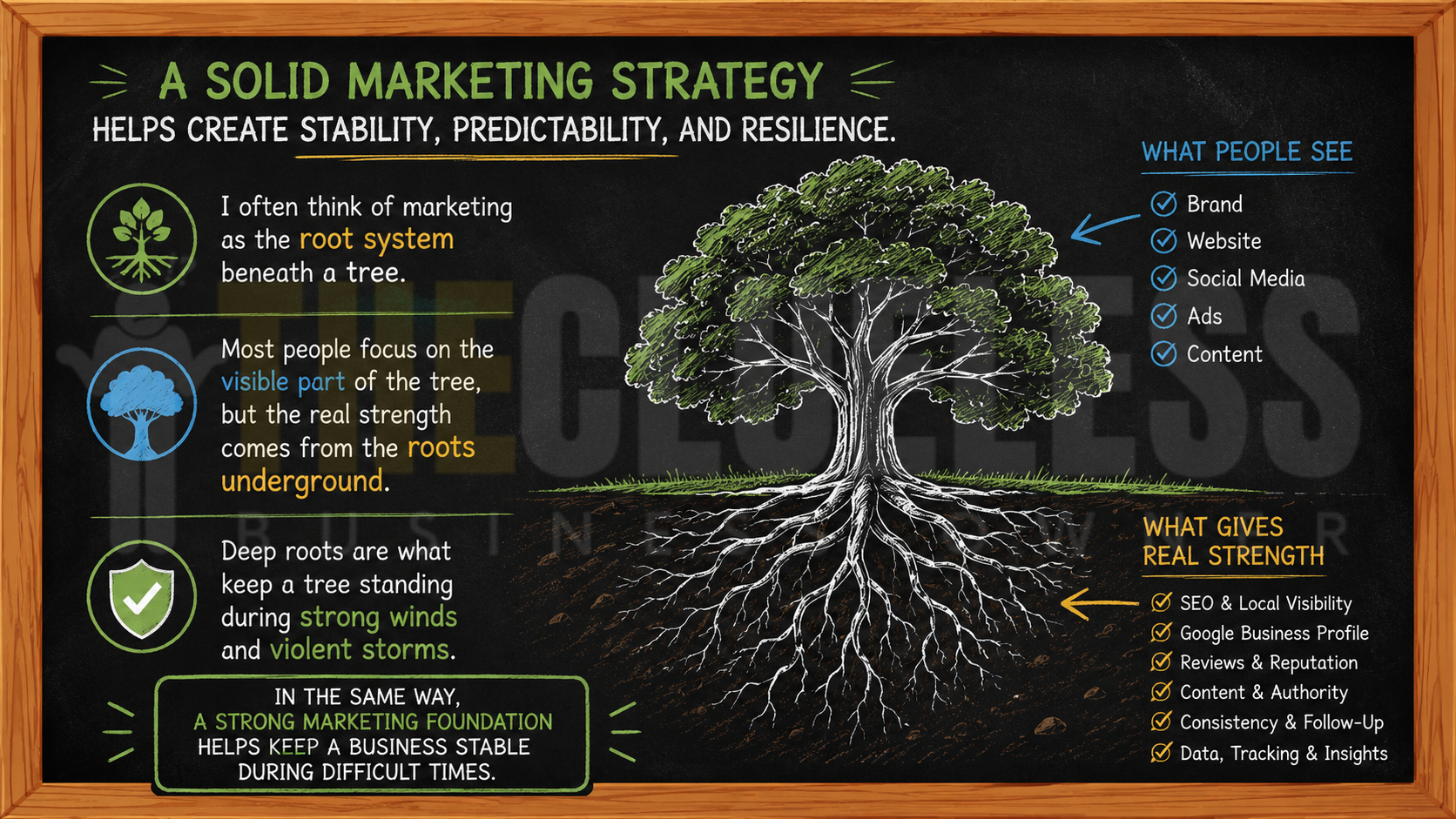
I always visualize a company's marketing foundation as the invisible root system beneath a massive tree.
The real structural strength of that tree comes from the complex network of roots anchored deep below the dirt. Those deep roots are the exact mechanism that keeps the tree standing when violent winds and storms strike.
Adversity Doesn't Create Weakness—It Exposes It
What I am about to say next might tick a few folks off, but it is an undeniable truth I have witnessed across my entire consulting career: adversity has a way of exposing weaknesses that were already hiding inside a business.
The business didn't come to end because of a crisis, the business ended because the crisis exploited the already existing weakness.
If you are not actively focused on growth, visibility, and building long-term digital assets into your company, you are building a fragile house of cards.
Adversity is guaranteed to strike your business at some point. The companies that survive and completely dominate their local markets are always the ones that built their foundations before the storm ever arrived on the horizon.
Continuous learning and digital evolution aren't optional. Evolve your visibility, protect your asset footprint, and build a lasting business.
Fixed vs. Growth Mindset: The Ultimate Divider
A few years ago, a client of mine called my office to celebrate a massive milestone—a definitive "first" in his company’s history. He had just wrapped up his very first $100,000 month.
To be clear, he didn't own a massive, multi-state corporate enterprise. He owned a small, local handyman business.
That excited phone call sparked a massive epiphany for me.
If you gathered a room full of entrepreneurs who all operated the exact same type of business, and gave every single one of them access to the identical tools, software, operational playbooks, and market information, would they all achieve the same level of financial success?
The answer is NO, hands down. And I have seen it.
Some locations would explode with rapid growth. Some would remain painfully average. Some would constantly struggle to make payroll, and others would eventually go out of business.
So what helps create such a massive divide? One factor I saw repeatedly was the mindset of the business owner.
The Franchise Experiment: Eliminating the Excuses
The client who celebrated the $100K month was actually an independent owner within a national franchise network. Over time, his specific territory became the number-one revenue-producing location in the entire country.
The corporate founders took notice of the growth happening in his market and requested a meeting with me.
Eventually, I was brought on as a marketing consultant and strategic advisor for the entire national franchise system.
My job was to work directly with owners across the country, educating them on making their business more visible online and what types of investments to make.
Once corporate handed me the master spreadsheet containing the raw revenue numbers for every single location, the dividing line between the thriving and not became instantly clear.
Every single one of these owners had bought the exact same business model. They used the same corporate logos, the same software, and the same operational resources. Yet the financial performance gap between locations was staggering.
- The Growth-Minded Owners: These individuals were hungry to learn, adapt, and evolve. They embraced the discomfort of trying new marketing ideas and invested in tools like targeted Google Ads campaigns.
- The Fixed-Minded Owners: These individuals had tremendous reluctance to grasp the same marketing ideas. They dug their heels in and insisted on things like running traditional direct mail print campaigns because that is where their comfort level was. They were comfortably writing checks that resulted in a $85 cost-per-lead, while our digital campaigns were capturing premium Google Ad leads for $35.
Many of these struggling owners flat-out refused to even discuss digital visibility. They were running their companies with a fragile, defensive survival mindset instead of an offensive growth mindset.
To be completely fair, market factors like local demographics, population density, competition and regional economics absolutely affect the amount of demand available in a market.
But after months of conversations with these franchise owners, the ultimate truth became undeniable.
The market determines the opportunity available. But, the owner's decisions and mindset determined how effectively the business captured those opportunities.
Mindset directly controls how a business owner learns, adapts and solves problems. It is the ultimate factor that dictates exactly where you land in the financial hierarchy of your industry.
What Makes a $100K Month Possible for a Small Business?
Well, first of all, hiring a great marketing consultant certainly doesn’t hurt! 😉
But jokes aside, the foundational prerequisite is a growth mindset. The owner of that top-performing handyman location succeeded because he accepted that he must adapt and remain open to new strategies and ideas.
He recognized that the modern landscape of how local consumers discover, communicate with, and buy from home service providers is in a state of constant evolution—and he chose to evolve with the market - not to push against it.
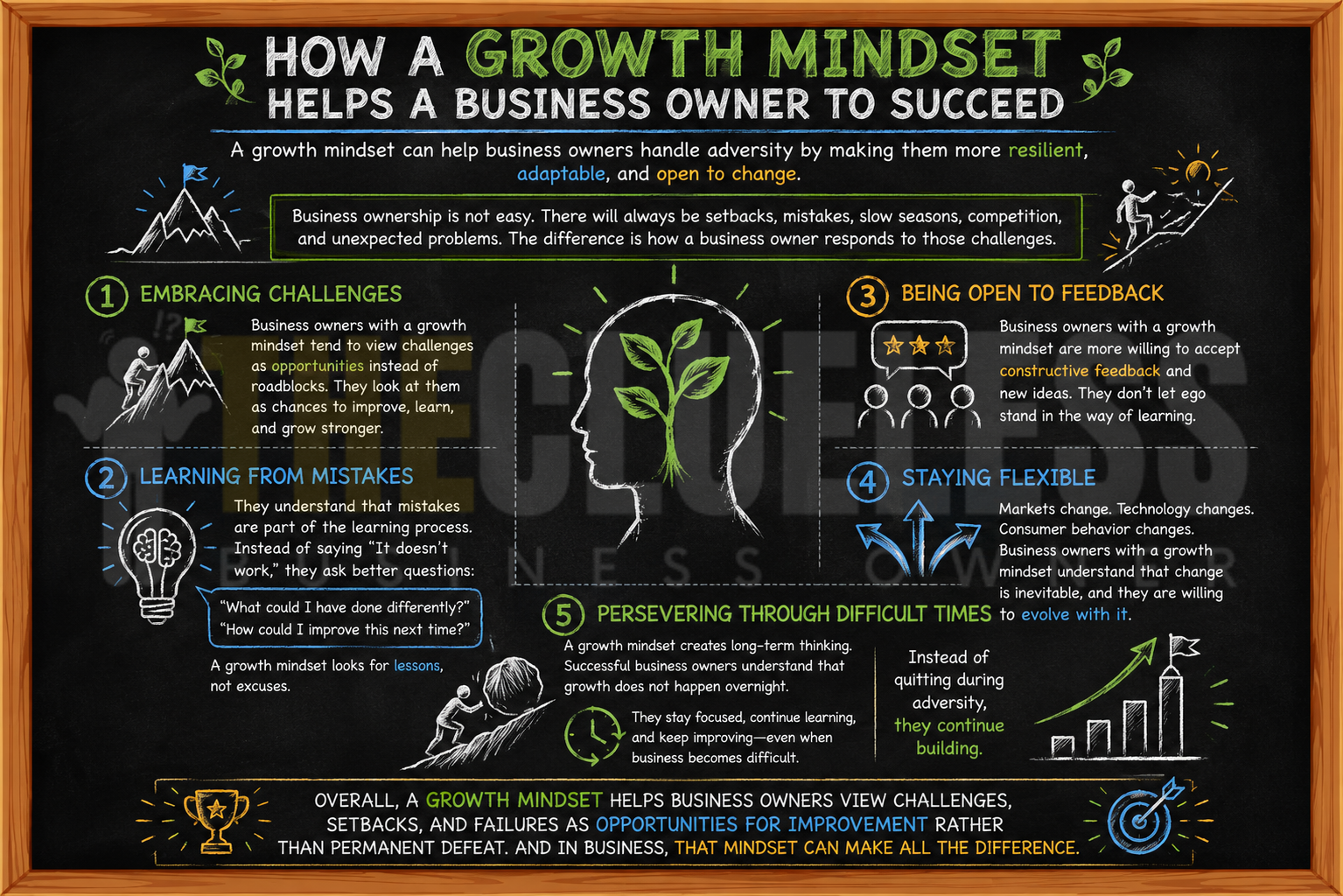
The 5 Operational Traits of a Growth-Minded Owner
A growth mindset is the ultimate shield against market adversity. It turns setbacks into data points and keeps your business resilient when competitors start to panic.
Here is exactly how that psychological shift manifests in the real world:
1. Embracing Challenges as Market Data
Fixed-minded owners see a new competitor or a shifting algorithm as an unfair roadblock. Growth-minded owners view them as a challenge to optimize their systems, tighten their operations, and build a stronger, more dominant perimeter. They run toward the friction, not away from it.
2. Transforming Mistakes into Refined Strategy
When an ad campaign underperforms or a new offer falls flat, a fixed mindset throws their hands up and proclaims, "Facebook Ads don't work!" or "SEO is a scam!" A growth mindset removes the emotion, analyzes the data, and asks important questions:
- "Was our ad copy too weak, did we not have a strong enough offer?"
- "Did we point the traffic to a low-converting landing page?"
- "Was our geographic targeting wrong?"
3. Stripping Away Ego to Welcome Feedback
Successful business owners never let their personal ego stand in the way of a higher profit margin. They actively seek out constructive feedback, audit their own blind spots, and are completely willing to adopt a perspective they hadn’t considered before—even if the initial learning curve makes them feel uncomfortable or intimidated.
4. Maintaining Total Strategic Flexibility
Markets move, search technology evolves, and consumer expectations change.
A growth-minded leader stays loose on the status quo and tight on the ultimate vision. They pivot faster, test new channels early, and remain highly competitive while old-school operators drift into irrelevance.
5. Committing to Long-Term Asset Cultivation
True growth is an aggregate game. Successful business owners understand that compounding digital equity doesn’t happen in a single weekend.
They are willing to put in the quiet, disciplined work of acquiring reviews, optimizing content, and training their staff even when the economic climate gets tough. Instead of pulling back and freezing in fear during adversity, they keep building.
Where Do You Fit? The Real-World Mindset Checklist
I want to map out exactly what these two mindsets look like in everyday business life. Read through them and honestly ask yourself which side of the fence you sit on most of the time.
It is completely normal to have a little bit of both, but your default pattern is what really controls your business.
The Fixed Mindset
If you lean toward a fixed mindset, you generally believe that your skills, intelligence, and business talents are mostly set in stone. You either have a natural knack for something, or you don’t.
People with a fixed mindset usually hate sudden changes, avoid risks, and get highly uncomfortable when they are pushed outside their usual routine.
They often resist trying a new strategy because they are terrified of making a mistake, losing money, looking foolish, or feeling like a beginner.
Now, can a business owner with a fixed mindset still make a good living? Sure, it happens. But the journey may be a little harder.
The Growth Mindset
If you have a growth mindset, you look at business skills as things that can be learned and sharpened over time through hard work, practice, and experience.
Growth-minded owners aren't afraid of change—they expect it.
They are willing to stumble through the awkward learning curve of a new tool or marketing channel if it means making the business stronger.
Where a fixed mindset sees a threat, a growth mindset sees a challenge.
Everyday Examples: Fixed vs. Growth
Fixed: "I’m just not good at sales. I'll never be able to land the big commercial jobs."
Growth: "I might be rough at sales right now, but I can practice, read a book, or take a course to get better at it."
Fixed: "We’ve always run coupon ads in the local paper. There’s no reason to change how we get leads."
Growth: "I’m open to testing Google Ads or optimizing my map listing to see if I can get cheaper, higher-quality calls."
Fixed: "I made a mistake on that estimate, but it's not my fault. Material costs are just crazy right now."
Growth: "I messed up that estimate. Next time, I need a better system to double-check my pricing before I send it to the client."
Fixed: "I tried Facebook Ads once for a week and didn't get any jobs. Facebook Ads are a total scam."
Growth: "The ads didn't hit. Maybe my offer was weak, or maybe I was targeting the wrong neighborhoods. Let me look at the data and tweak it."
The Dark Side of the Growth Mindset
I’m an entrepreneur with a heavy growth mindset, and I will be the first person to tell you it isn't all sunshine and rainbows. Any personality trait taken to the extreme can become a trap.
If I'm being completely transparent, here are the real-world problems I've run into by pushing the growth mindset too hard:
1. Perfectionism (A.K.A. Hidden Procrastination)
I am a recovering perfectionist. For years, I would endlessly tweak a project, rewrite an offer, or delay launching a new marketing campaign because I felt it wasn't "perfect" yet.
This line of thinking has cost me a fortune. Overthinking keeps you stuck in place.
I had to learn the hard way that a completed project out in the real world making money is worth infinitely more than a "perfect" project sitting on my laptop screen or being held captive in my brain.
2. Overworking and Burning Out
When you believe that enough effort, hustle, and persistence can solve any problem, you don't know when to hit the brakes. I have pushed myself way past healthy limits more times than I can count, thinking I could just outwork the stress.
If you don't build balance into your growth, your body or your mind will eventually force you to stop.
3. Unrealistic Expectations of Your Crew
This is one of the hardest lessons I’ve had to swallow when hiring and managing help.
Because I have an entrepreneurial mindset, I used to expect my employees to care about the business with the exact same fire, urgency, and attention to detail that I do.
But here is the cold hard truth: They won’t. It isn't their name on the building. Expecting an hourly employee to think like the founder just isn't realistic and is only going to cause you to feel frustrated.
Breaking the Mindset Barrier
The world is moving faster than ever. The way a homeowner discovers a plumber, reads reviews, and books a service has completely flipped in the last few years. If you refuse to accept this reality, your business will suffer for it.
Remember those handyman franchises I mentioned earlier? They all had the same brand, the same tools, and the same corporate support.
Yet, one growth-minded owner was pulling in almost the exact same amount of revenue in a single month that the lower-performing, fixed-mindset locations struggled to make in a whole year.
That massive gap wasn't luck. It was the fact that the top owner was willing to step out of his comfort zone, look at the big picture, and commit to a long-term marketing strategy instead of just trying to survive the next 30 days.
You simply cannot build a highly profitable, six or seven-figure business if you are operating with a short-term, (5-figure) survival-based mindset.
Your default thinking shapes your daily habits, your habits dictate your business decisions, and your decisions determine your bank balance.
How to Step Up: Your First Action Steps
If you want to pull yourself out of small-scale survival mode and start building an actual asset, you have to stop managing your business based on emotion and start managing it based on data.
To bridge the gap between where your business is today and where you want it to be next year, you must know your numbers inside and out:
- Audit Your Revenue: Exactly how much did you bring in this month compared to this exact time last year?
- Track Your Profit Margins: Which specific services are making you the most clean profit? Which jobs are barely breaking even while causing massive headaches for your crew?
- Locate Your Weaknesses: Are you losing easy jobs because you are completely invisible on Google? Are local competitors capturing calls that could be yours because their
website, Google Business Profile and overall local visibility are stronger?
- Calculate Your Metrics: What does it actually cost you to acquire a new customer? What is that customer worth to your business over 12 months, or over a lifetime of repeat business?
When you possess the data, the path forward becomes incredibly clear. You stop guessing, you stop burning cash on marketing hacks, and you start investing with confidence.
At the end of the day, the distance between the business you have and the business you want is always filled by one simple thing: a structured, long-term marketing strategy backed up by decisive daily action.
Keep Learning

Marketing Strategy
Want to blow your competitors out of the water? It really isn't that complicated. Just HAVING a strategy can do the trick! (Pssst they don't usually have one.)