
The (No B.S.) Guide to AI (AEO) Search for Small Businesses
Plus: A Step-by-step (NO B.S.) checklist on how to make sure your business is AI search ready!
(Date of last guide edit: August 7, 2026)
What is an AI Overview and How Do I Get My Service Business Listed?
An AI Overview is an automated generated summary (or an answer to a question) that appears mostly at the top of searches. It uses artificial intelligence to evaluate multiple resources across the internet and then it provides the best answer to the searcher.
Regarding how to get your business listed, first understand that AI does not
randomly choose a business, it uses many variables to decide which business to feature in an AI Overview.
Secondly, unlike traditional search engine optimization (SEO), AEO optimization is not something you can trigger with keywords.
The 3 Variables of Being Visible in AI Search
1. The Trust Trail
Your business needs to have a consistent and credible presence across the internet. Your website, Google Business Profile, directories, review platforms, social profiles and other reputable sources should reinforce the same basic information about who you are, what you do, where you do it and why people should trust you.
I call this your Trust Trail.
Think of your Trust Trail as the information AI and search engines can find across the internet that helps confirm what your own website says about your business. The stronger and more consistent those signals are, the easier it is for search engines and AI platforms to understand your business and establish confidence in the information they find about you.
2. Recent Content
Creating relevant content that answers the questions your potential customers are actually asking has always been an important part of SEO, but freshness appears to be particularly important in AI search.
Ahrefs analyzed 17 million AI citations and found that the content cited by AI assistants was, on average, 25.7% fresher than the content appearing in traditional Google search results.
That doesn't mean you need to constantly publish new blog posts just to make your website look active, nor does it mean you should change the date on an old article and call it new.
The content still needs to be relevant, useful and accurate.
Instead, focus on creating content that genuinely answers the questions your customers are asking, while also revisiting your important existing content to make sure it remains accurate and useful. When you have something meaningful to add, update it.
But, let me tell you that freshness alone isn't going to make AI choose your content, but when AI has several relevant and credible sources to choose from, having useful and current information may give you an advantage.
3. A Top Source
This is where traditional SEO becomes especially important.
Google has made it clear that traditional SEO best practices remain foundational for visibility in its AI search experiences. That doesn't mean your website has to rank #1 — or even appear among the top organic results — to be cited in an AI Overview.
Google can and does surface supporting sources beyond the highest-ranking traditional organic results.
However, if your website is already performing well in traditional search, you have an important advantage.
Google already knows about your website, can crawl and index your content, and has signals indicating that your pages are relevant to the searches for which they rank.
So while ranking at the top of Google does not guarantee that you will be selected as a source for an AI Overview, strong traditional search visibility gives you a head start.
SEO Isn't Dead
You are going to hear plenty of marketers proclaiming that "SEO is dead." That simply isn't true.
In fact, SEO is the foundation of AEO.
AI search hasn't suddenly erased everything we know about getting a business found online.
If your business already has a well-optimized website, strong traditional search visibility and an established online presence, you aren't starting from scratch.
You've already built much of the foundation you need to compete for visibility in AI search.
The fundamentals are still remarkably familiar. You need a great website that clearly explains what you do and answers your customers' questions. You need great reviews and an accurate, updated Google Business Profile.
You need useful content, and you need to continually build credibility across the internet through your Trust Trail.
Now, we're adding another consideration: keeping the all the digital information about your business useful, accurate and current.
AI search isn't replacing good SEO. It's creating another opportunity for good SEO to pay off.
Question: "What is an AI Overview and How Do I Get My Business Listed There?"
Answer: An AI Overview is an automated generated summary (or an answer to a question) that appears mostly at the top of searches. It uses artificial intelligence to read multiple resources across the internet and then it provides an answer to the searcher.
To get your business listed (mentioned) in an AI Overview you need to become a trusted source. That means creating helpful content that answers real customer questions, keeping your Google Business Profile and website up to date, and building credibility across the web.
Local Search Adds Another Layer
The three variables we just discussed — The Trust Trail, Recent Content and being a Top Source — apply whether you're trying to build visibility locally or nationally.
However, when someone searches for a local service provider, such as a plumber, dentist, chiropractor, spa or window company, Google has another important consideration: local relevance.
Google has long explained that traditional local search results are primarily based on relevance, distance and prominence.
In simple terms, Google is trying to determine whether your business provides what the person is looking for, whether your business is relevant to the location being searched, and how established and prominent your business appears to be.
That means local businesses have some additional things to get right.
Your Google Business Profile needs to be complete and accurate, your address or service area needs to make sense for the market you're trying to reach, and your important business information should be consistent across your website, Google Business Profile and other credible places where your business appears.
This is also where your Trust Trail becomes especially important.
Reviews, local directories, backlinks, community mentions, industry websites and other credible references can reinforce what your website and Google Business Profile say about your business.
Reviews Can Tell AI More Than "This Is a Good Business"
Reviews become particularly interesting when we start thinking about AI search because they contain more information than a star rating.
Consider the difference between these two reviews for a window replacement company:
- "Great company. Highly recommend!"
- "The Window Guyz did an amazing job replacing the windows in our home."
Both are excellent reviews, but the second provides much more context.
It doesn't simply tell Google and AI platforms that the customer had a positive experience; it also tells them what the customer actually hired the company to do.
Now, I want to be careful here.
Google has not told us that getting customers to mention a particular service in their reviews will automatically improve your rankings or cause your business to be selected for an AI-generated answer.
But, what we can say is that detailed, authentic reviews create a richer body of information about your business, the services you provide and the experiences your customers have had.
For a local service business, that's valuable.
Rather than telling customers exactly what to write, encourage them to describe their actual experience.
- What service did they have performed?
- What problem did you solve?
- What did they appreciate about working with your company?
Over time, those reviews become another source of information about your business. If you have a ton of customers describing the services you've provided and the experiences they've had, you're creating a substantial body of customer-generated content that reinforces what your business says about itself.
So when you're thinking about reviews in the age of AI, don't think only about how many reviews you have or how many stars you've earned. Think about the information contained inside those reviews.
Local AI visibility isn't an entirely different game from traditional search.
The same foundation still matters, but local businesses have an additional layer of relevance, distance and prominence to consider — and reviews can provide another valuable source of context about exactly what your business does.
Question: “Are people actually clicking on the websites cited in Google AI Overviews?”
Answer: Not very often.
Research shows that while people may read an AI Overview, very few click through to the websites it cites.
One 2026 study found that users clicked a source cited within an AI Overview on only about 1% of visits where an AI Overview appeared.
That doesn't mean people aren't using AI Overviews. It means they're often getting the information they need directly from the AI-generated answer rather than clicking through to the source.
Having Acronym Anxiety? Here are 6 Things to Know
If you’ve been paying attention to the marketing buzz lately, you’re probably hearing the sky is falling.
Opportunistic marketers love shouting things like "SEO is dead!" They create urgency and fear using acronyms like AEO (Answer Engine Optimization) or GEO (Generative Engine Optimization).
SEO is alive and well BUT, it has moved from just being keyword-triggered and page-ranking to also being a more broad result that focuses on the entire online ecosystem of a business.
Fundamentally, there are 6 major things you need to know about AI and search.
Let's go over each one in plain English before we get too deep into your AI education.
1) There Is New Digital Real Estate Up for Grabs
The easiest way to understand search engine optimization is to look at it like physical real estate. The various spots where your business can pop up are just different types of digital land.
And just like real land - not all pieces of real estate have the same value. Some real estate is
premium.
And premium real estate comes at a higher cost on real land - digital real estate is no exception.
For example, I call the
Google Business Profile section
beachfront property.
For a local service business, the 3-pack (the first three local map results a customer sees before clicking "more") is where most people decide who to call. It’s the most valuable land on the screen.
Using that same real estate comparison: Google did not bulldoze the old neighborhood. It simply built a new luxury condominium next door called AI Overviews. 😎
AI search doesn't invent new facts out of thin air.
There is NO secret system to list your business with.
It uses the exact same Google information ecosystem (SEO) you are already familiar with.
What IS different, at the very top of around 70% of searches, you will see a box displaying an automated AI answer to a search query.
2) Trust, Authority, Expertise, and Helpful Information Matter More Than Ever
Here is the honest truth about AI search. (And what those acronym-pushing marketers won’t tell you.) This is not a new trend.
Question: Is SEO Dead?
No SEO is not dead. It is the core foundation that AEO is built on.
Google uses the same framework E.E.A.T. it has used for many years. Additionally, there is no research to support that traditional SEO is irrelevant, in fact it is still critical in partnership with AEO.
Google has been moving in this direction for years. Since 2020, Google's core algorithm updates have consistently rewarded businesses that demonstrate real expertise, answer actual customer questions, and build genuine trust.
To rank businesses, Google uses a strict quality framework called E-E-A-T.
While it sounds like tech-jargon, it actually represents four very simple, real-world questions:
- Experience: Have you physically done the work the searcher needs?
- Expertise: Do you actually know what you are talking about?
- Authoritativeness: Are you recognized as a credible, go-to local source?
- Trustworthiness: Can a searcher trust your business not to rip them off?
Modern AI search models look for these exact same trust signals. If your digital footprint proves you have high E-E-A-T, your business will be listed higher in search results.
At the same time, Google is actively burying low-quality, robotic content written purely to trick search engines.
You can't cheat the system anymore. To win the search game, you just have to prove you are a great local business.
3) The AI Ecosystem: Your Complete Digital Footprint
In the past, ranking well for a service business was simple. You just focused heavily on two main things: your website and your Google Business Profile.
Question: "Where exactly does AI go to find information about my business?"
Answer:
Historically service business search results mainly came from websites and Google Business Profiles.
Today, authorativeness is a strong signal and search systems are increasingly pulling search data from a variety of sources.
Today, AI search systems gather information from a much larger ecosystem of sources. To build an answer, the AI scans across the entire web.
It pulls details from:
- Your main company website
- Your Google Business Profile
- Third-party customer reviews (Yelp,Yellow Pages etc.)
- Local directory listings and citations
- Social media profiles and videos
- Industry-specific blogs and forums
(But remember: for a local business it still primarily treats
your website and your Google Profile as the master sources of truth.)
This means your online presence is no longer evaluated in just one isolated corner of the internet. AI is actively looking for consistency, credibility, and supporting information across the entire web.
The more complete, accurate, and trustworthy your digital footprint is, the easier it becomes for AI systems to understand exactly who you are, what you do, and whether you are safe to recommend to the searcher.
This is the exact reason why local businesses can no longer rely on a single, isolated marketing tactic. Real visibility today is built through a diversified online presence.
Your website, reviews, social media, and business listings must all work together to reinforce your expertise and build trust.
Question: "I keep hearing that more than 50% of searchers aren't clicking on websites anymore??"
Answer:
That's a half-truth that needs context. The widely quoted 50%+ “zero-click” statistic looks at Google searches overall — not specifically local service-business searches.
Many local searchers have been "zero-clicks" for decades. Someone searching for a plumber, dentist, or HVAC company may find the business in Google Maps, view its Google Business Profile, read reviews, get directions, or call directly — all without ever visiting the business's website.
So yes, the search can be counted as zero-click — even though it potentially resulted in a phone call and a new customer.
So yes, many searches don't result in a website click. But that doesn't mean they don't result in a customer. And it certainly doesn't mean AI caused it.
In fact, research suggests that local searchers rarely click the sources cited inside AI Overviews either JUST FYI.
Bottom line: Don't confuse “zero website clicks” with “zero business activity".
😎
4) The Zero Clicks Search
A zero-click search happens when someone types a question into Google, gets their answer instantly on the screen, and leaves without ever clicking on a website.
Think about how often you look up things like:
- Local weather or flight statuses
- Driving directions or business hours
- “What time does the hardware store close?”
- “How much does a 50-gallon water heater cost?”
- “Who has the best reviews for a roofer near me?”
These are great examples of zero click searches.
For over twenty years, the internet operated on a very simple model: a person conducted a search, clicked on a website, and decided who to contact.
Today, Google and AI systems increasingly attempt to answer those questions directly within the search experience itself.
The question is how does this impact a local service business?
I have seen several marketers doing video ads on Facebook and they mention that over 50% of searchers are not clicking on a website.
Here is What Marketers Aren't Telling You
Many content creators in the service business space in an effort to create fear and urgency are telling you "most searchers are not clicking on websites anymore".
So, first of all that statement IS true.
BUT it is out of context and does not explain the
real data.
Additionally, that statement has been true for many years even before AI.
But here is is the big consideration, where ARE they clicking?? Because it's
NOT AI results.
Most transactional searches for a service-based business clicks on Google Maps and that is considered by Google to be a
zero click search.
(BTW this is NOT new behavior, in fact searchers have been tapping "Call," getting directions, or merely reading reviews off Google local listings for decades.)
Transactional VS Informational Searches
Understanding the difference between
Informational and
Transactional search intent is crucial to understanding the data and where traffic comes from.
Informational Searches (Zero Click Search): Learn a fact or get an answer to a question that does not require an action.
EX Search: "Should I repair or replace my hot water heater?"
Transactional Searches: Take immediate action (buy, hire, call, request a quote).
EX Search: Find a plumber near me or hot water heater repair near me.
Transactional searches can also be zero click, the reason why is most service based searches end with the searcher clicking on Google Maps.
That is considered a zero click search because they did not visit an actual website.
You cannot compare the data of a transactional search to an informational search they are not the same.
These are very 2 different types of searches and the behavioral data and how they impact a service business search is completely different.
So why are these marketing agencies etc yelling this out?
Well, first because they can, business owners for the most part are uneducated.
Secondly, because they are trying to create interest, fear and urgency, which just so happen to generate clicks.
Question: "Is AI search going to kill the phone calls I get from my Google Map listings?"
Answer:
NO.
Most transactional searches click on Google map listings. This is considered by Google to be a zero click search.
By the way this has always been the case. MOST searches have always chosen Google Maps over any other real estate in the search, way before AI came on the scene.
Imagine a homeowner searches: “How much does it cost to install a ceiling fan?” Google may display a quick AI Overview box that summarizes the typical price range, lists the factors that affect the cost, and mentions that labor rates vary by location—all right there on the search page.
This does
not mean websites no longer matter. It simply means Google is answering basic questions directly on the screen. (And by the way with information it gathered FROM your website!)
In fact in the case of a service business clicking through to a place to read more, call or contact your business is necessary.
Because of this shift, your online content now has two distinct jobs:
- Job #1: Help Google understand and trust your information so it uses your business data to fuel those quick answers.
- Job #2: Give the customer a compelling reason to click your link when they are finally ready to pull out their credit card and hire a company.
5) Your Website Content Must FEED the AI Engine
In the past, you only had to write website content for two audiences: search engines, traditional keywood-triggered Google, and human visitors.
Now, there is a third audience sitting at the table: AI.
Question: "Does my website impact my business showing up in AI Overviews?"
Answer:
The framework of your website content is CRITICAL to your ability to populate in search. AI search systems do not read your website like a human; they crawl it looking for structured data, it is then stored for later use.
It looks for heading hierarchy and things like Q & A formats. If your website content is thin or vague it will simply move onto another website (your competitor's) in the search.
As Google continues to weave AI into search results, its automated systems need detailed, deep information about your business.
It needs this data so it can answer customer questions, make recommendations, and qualify local leads for you.
A huge transition for me as a marketer has been moving completely away from the old mindset of thinking in terms of "keywords."
Today, we have to think in terms of searcher intent:
- What specific questions are customers asking about your services?
- What problems do they have that your business solves?
This framework is exactly how all of your online content should be created moving forward.
If your website content is vague, incomplete, or poorly organized, Google's AI simply won't have enough clear data to work with. If it can't find detailed proof of your expertise, it will skip your business entirely.
So, do you need a complete website content rewrite? You very well might. We are going to talk about exactly how to fix your website content in a future section.
6) Real Human Reviews Can Influence AI Search Returns
Your company website is no longer the only voice telling Google who you are and what you do.
To find the real truth about your business, AI search systems now rely on User-Generated Content (UGC).
Question: "If I have bad Google reviews will that impact my business showing up in search and AI Overviews?"
Answer: Yes, it can.
What customers are saying about your business on the Internet influences how/when your business is returned in searches. Now more than ever before user-generated data heavily fuels search results. BUT - how many stars are not just what is considered anymore. It's also what people say in the reviews that is being considered.
Google's AI actively scours platforms like Reddit, local community forums, and online discussion boards to see what actual, living humans say about your business.
For a local service company, this means your customer reviews are no longer just "nice to have" badges or decorations on your profile.
They are active search signals that the AI uses to grade your business.
And here is a massive realization you need to hear loud and clear: Google's AI isn't just counting how many 5-star reviews you have—it is reading what people SAY.
AI scans your reviews looking for specific details and real-world confirmation:
- Did a customer write: "They fixed my water heater fast in an emergency"?
- Did they say: "Gave me a fair and honest price on my roof repairs"?
- Did they mention: "Best residential electrician in [Your Town]"?
If real local people are praising the specific details of your work across the web, the AI engine will trust you, cite you, and enthusiastically recommend you.
It will choose you over a massive competitor who might have a much bigger, fancier website but has zero recent, detailed proof from real human beings.
AI Did Not Create the Shift—It Just Sped It Up
Let’s get one thing straight: AI did not invent this shift in marketing. It simply accelerated it.
The core fundamentals of online visibility have remained remarkably consistent for over a decade.
To win clients online, businesses still need:
- A strong, fast website
- Accurate, matching business information (NAP)
- Consistent, detailed customer reviews
- Helpful, problem-solving content
- Real-world trust signals
The technology platforms are evolving, but Google's obsession with trust, expertise, and authority is nothing new.
Remember the Voice Search Craze?
Every few years, a major technology shift occurs online. And like clockwork, opportunity-seeking marketers use that shift to convince you that everything you’ve previously built (or paid for) is suddenly obsolete.
Think back to the Voice Search Craze around 2017–2019.
- Amazon Alexa exploded in popularity.
- Google Assistant was expanding rapidly.
- Apple Siri became a household name.
At the time, tech gurus were making terrifying predictions like: "By 2020, more than 50% of all internet searches will be done by voice!"
Marketers claimed you needed an entirely brand-new, expensive strategy to be visible through smart speakers. But what actually happened?
In reality, voice search assistants use the exact same information ecosystem as typed searches.
Businesses that were already visible on traditional Google maps and websites were the exact same businesses appearing in Alexa and Siri results.
Why? Because voice search only changed how people asked a question. It did not change where the answers came from.
If a local business missed out on voice search leads, it wasn't because of voice search. It was because they were completely invisible on standard search to begin with.
A typed search and a spoken search still require the exact same thing: relevant, trustworthy information that ranks above the competition.
The AI Search Reality Check
Today, AI search is creating another massive wave of hype. Once again, the marketing bullies are screaming that your sky is falling.
But if you look past the buzzwords, the underlying principles are exactly the same.
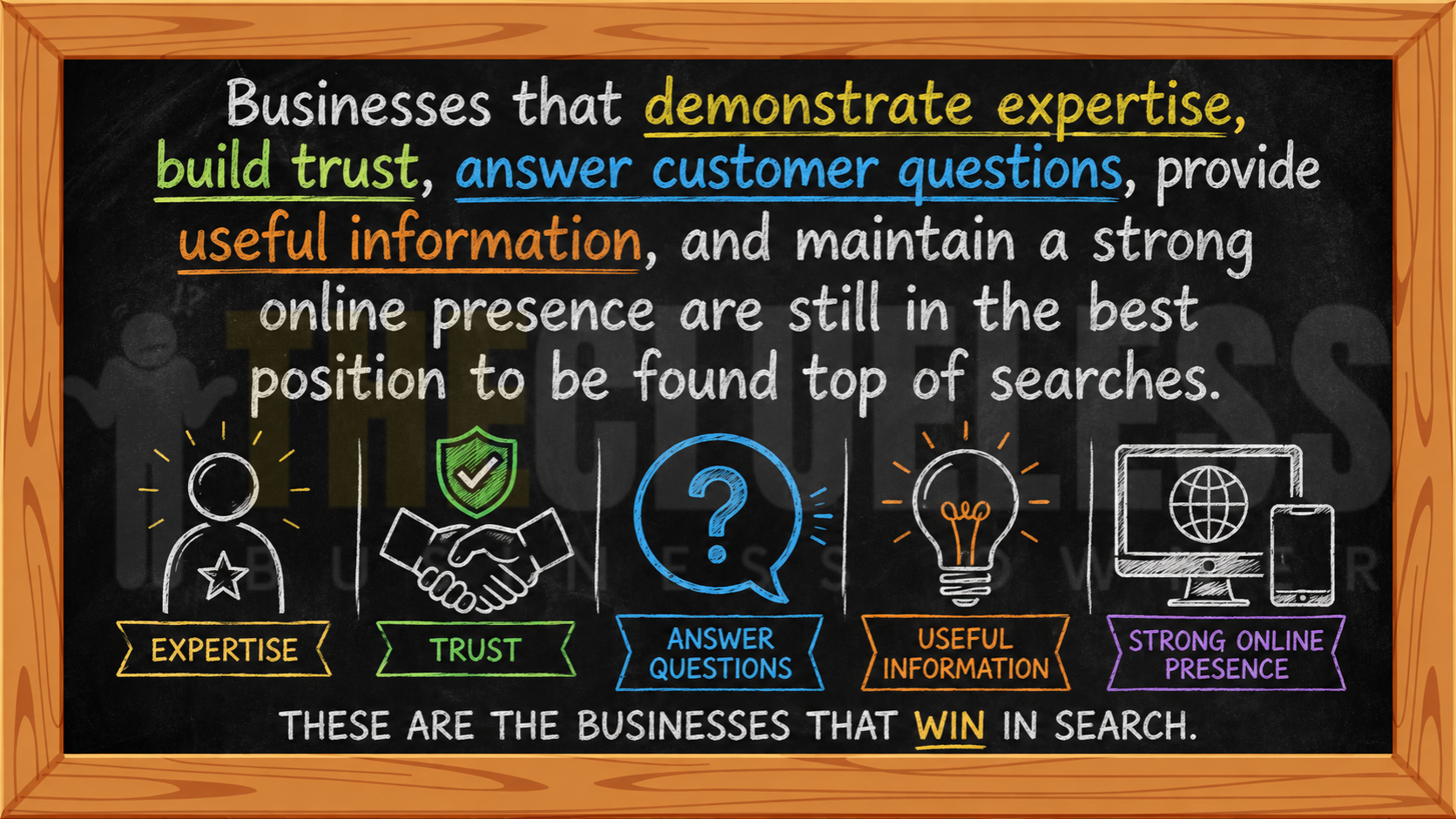
The businesses that demonstrate real expertise, build genuine trust, answer real customer questions, and maintain a clean online presence are still the ones sitting at the top of the scroll.
In fact, Google has publicly stated that traditional SEO best practices remain completely relevant because its AI-powered search experiences are built directly on top of the same core ranking and quality systems they've always used.
When there is a massive disagreement between a loud marketer's hype and what Google says about its own computer systems, I tend to listen to Google. I highly suggest you do the same.
Yes, the technology is evolving. Yes, the layout on your phone screen looks a little different.
But at its core, Google's ultimate goal has never changed, which is to provide searchers with the most helpful, relevant, and trustworthy information possible.
What
has
changed is how Google gathers and presents that data.
Today, it reads from a much broader ecosystem of sources and uses AI to better understand what a human actually means when they ask for help.
In a nutshell, that is what is really happening.
Why I Created The Call Pool Blueprint™
New marketing acronyms tend to create way more confusion than clarity.
- SEO (Search Engine Optimization)
- VSO (Voice Search Optimization)
- AEO (Answer Engine Optimization)
- GEO (Generative Engine Optimization)
Every single time the internet evolves, a new acronym pops up. Suddenly, hard-working business owners are told they need an entirely new strategy, a new service, or an expensive new "expert" to help them manage it.
That’s exactly why I created The Call Pool Blueprint™.
The Call Pool is simply the select group of businesses a customer immediately sees when they look for a service online.
Instead of chasing acronyms, The Call Pool Blueprint™ is a straight-forward
marketing philosophy built to strip away the confusion.
It focuses entirely on teaching a local service business owner how to earn maximum
visibility in that prime, "top-of-scroll" real estate so they can secure more qualified leads.
The Objective Never Changes
Whether a searcher is typing an urgent request into Google, asking ChatGPT for a recommendation, pulling up Google Maps on their dashboard, or browsing a local directory—your ultimate goal is identical:
You want your business to be one of the first they see.
Consumers make decisions fast. They choose options from the top of the scroll. They rarely dig around or click on results buried at the bottom of a page.
Yes, technology and consumer behaviors are constantly shifting. Search engines update. AI platforms emerge.
New devices hit the market. But the underlying target remains remarkably consistent: Your business must be visible right at the exact moment a customer wants to buy what you sell.
Forget the Acronyms. Simply Build Your Digital Footprint.
The fundamentals that earn you that top-of-scroll real estate have not disappeared.
Real-world trust, verified expertise, local authority, problem-solving text, consistent reviews, and accurate business data will always matter—regardless of what acronym is trending on social media this week.
- The platforms may change.
- The technology may change.
- The terminology may change.
- But the objective remains exactly the same.
I prefer to focus on the big picture: helping you build a bulletproof online presence that naturally adapts as technology evolves.
Real digital visibility isn't about mastering the latest tech fad.
It's about building a great digital footprint overall. It's about ensuring that whenever a local customer needs your services, your business is automatically seen inside the Call Pool.
So, before you get all worked up and stressed out about AI, ask yourself one honest question:
Was your business even visible in standard search to begin with???
What Google Says About SEO and AEO
"From Google Search's perspective, optimizing for generative AI search is optimizing for the search experience, and thus still SEO."
"The best practices for SEO continue to be relevant because our generative AI features on Google Search are rooted in our core Search ranking and quality systems."
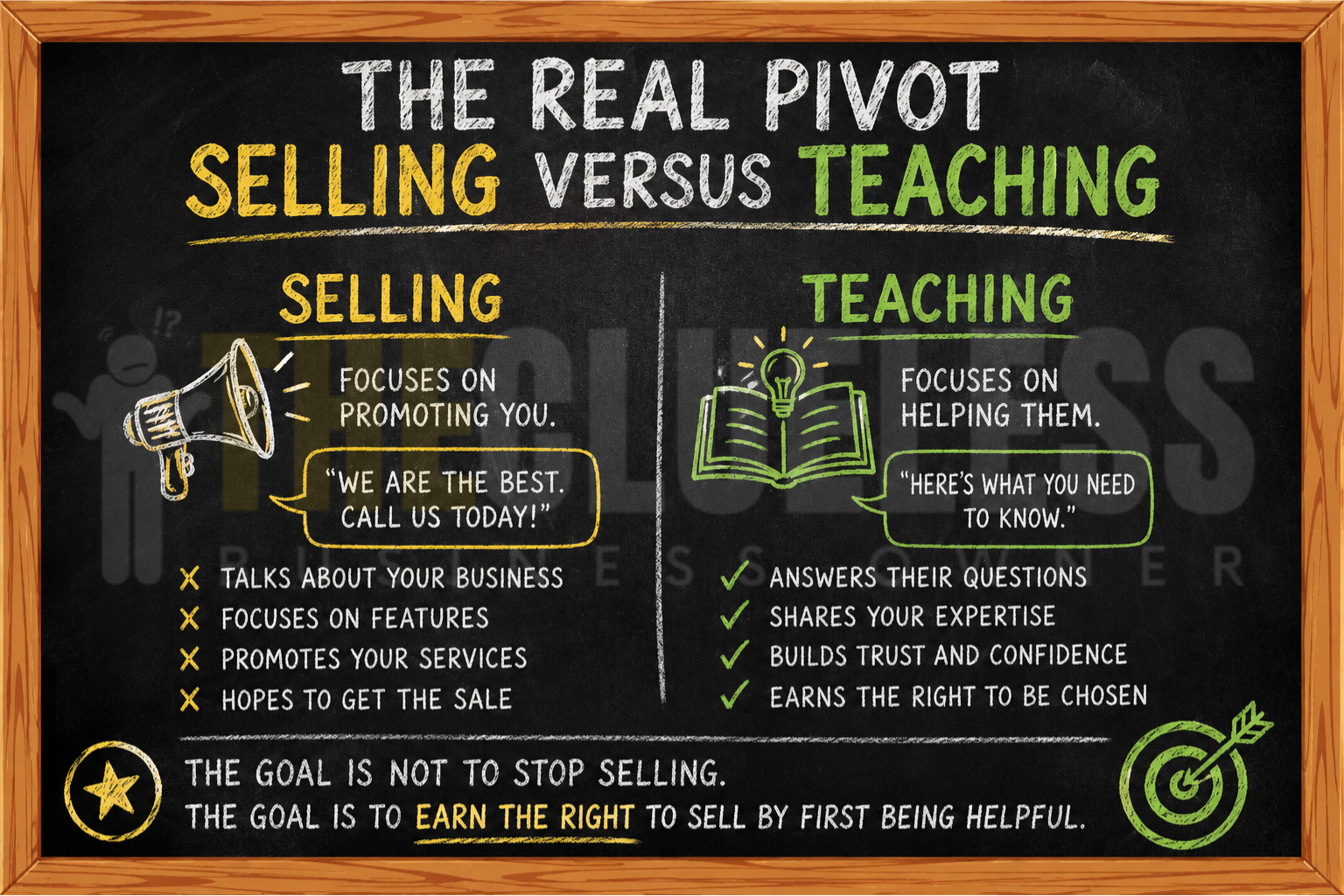
The Real Pivot in Search: Selling Vs Teaching
If there is one major shift you need to grasp in the age of AI search, it is this: You need to stop focusing so much on selling, and start focusing on teaching.
For years, most local business owners approached their websites with a single, simple goal, to shout a sales pitch, get the lead, and close the job. The pages were designed to tell visitors how great the company was, why they were the best choice, and how to call them.
While those things still matter, they are no longer enough to win the game.
Modern customers do way more research before pulling out a credit card. They ask deeper questions, compare more options, look into pricing, and expect helpful information before making a decision. (Many searchers have had a bad experience with a service business in the past.)
AI search isn't just accommodating this behavior—it is speeding it up. When a homeowner asks ChatGPT or Google AI a question, they are not looking for an advertisement. They are looking for an answer.
Shift Your Online Presence
Moving from selling to teaching doesn’t mean giving away your hard-earned labor for free. It simply means helping potential customers understand the reality of their situation.
You want your online content to explain:
- What their specific problem actually is
- Why that problem occurs in the first place
- What solutions and options are available to them
- What real-world factors affect the total cost
- What they should expect during the repair process
- How to make a smart, informed decision
The Water Heater Test
Consider the massive difference between these two marketing approaches:
- The Selling Approach:
“Is your water heater making weird noises? Call us today for fast, reliable service!”
- The Teaching Approach:
“If your water heater is making a popping or rumbling noise, sediment has likely built up inside the tank. Over time, this traps heat, spikes your energy bills, and will eventually crack your tank. Here is how we flush it out to save you money...”
One approach is just a loud, generic commercial. The other approach instantly demonstrates real-world expertise.
Earn the Right to Sell
The businesses that consistently answer questions and educate their local audience are the ones that earn ultimate trust.
They are also the exact businesses that get referenced and recommended by AI search engines—because they are providing the literal answers that people are typing into their screens.
The goal isn't to stop selling.
The goal is to earn the right to sell by being the most helpful professional in your town.
The real pivot happening online today is not some technical mystery like shifting from SEO to AEO.
The real pivot is moving from selling to teaching. It’s about realizing that a great website and good reviews are just the baseline—winning requires building an online arsenal of helpful information that makes your business completely stand out.
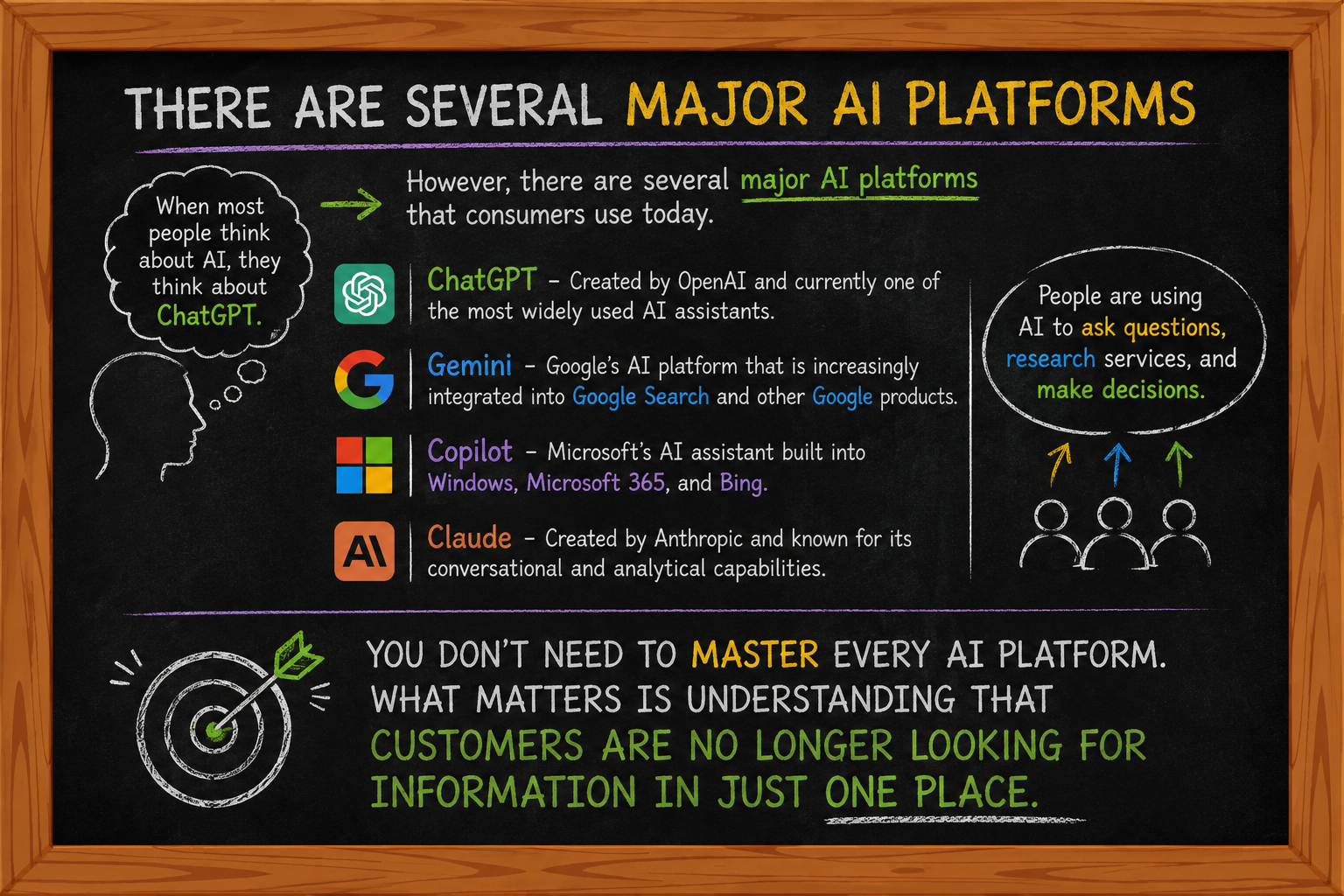
The 4 Major AI Platforms
When most business owners think about AI, they only think of ChatGPT.
In reality, there are four major platforms local consumers are using right now to ask questions, research services, and make buying decisions:
- ChatGPT: (~900 Million Weekly Users) Created by OpenAI. It is currently the most widely used conversational AI assistant on the planet.
- Gemini: (~750 Million Monthly Users) Google's native AI platform. It is being heavily baked straight into traditional Google Search and Android devices.
- Copilot: (~420 Million Monthly Users) Microsoft's AI assistant built directly into Windows, Microsoft 365, and Bing search.
- Claude: (~300–600 Million Monthly Visits) Created by Anthropic. It is highly popular for its advanced conversational and analytical capabilities.
As a business owner, you don't need to master the technical inner workings of all four. What matters is understanding a simple truth: Your customers are no longer looking for information in just one place.
The Explosion of AI Growth vs. The Google Reality
To understand how fast this is moving, ChatGPT handles approximately 2.5 billion prompts every single day worldwide, with around 330 million of those coming right here from U.S. users.
To put those numbers into perspective, look at how AI compares to traditional search today:
- ChatGPT: 2.5 Billion prompts per day
- Google Search: ~14 Billion searches per day
Even with AI exploding, traditional search engines still control roughly 80% to 90% of all online search activity. AI assistants currently capture the remaining 10% to 20%.
Traditional Google Chrome is still the undisputed king, but AI is carving out a massive piece of the pie.
Chatgbt VS Google AI (Gemini) - What's the Difference?
A question I get asked alot is what is the difference between Chatgbt and Google AI (Gemini)? Well think of it like this, one is an apple and other is an orange, but they are both fruit. However, they were designed with different purposes.
Google's Gemini was built to help people search the web. It works by analyzing Google's search index and summarizing the information it finds.
ChatGPT was built to have conversations and answer questions. When it needs current or factual information, it can search the web and combine information from multiple trusted sources to provide a direct answer.
Here is another consideration:
Google AI is like a librarian.
You ask a question.
The librarian walks over to the bookshelf (Google Search), pulls out the best books, and summarizes what they say.
ChatGPT is like a knowledgeable consultant.
You ask a question.
The consultant doesn't walk you through a list of books. Instead, they give you an answer based on everything they know and, when appropriate, check reliable sources to make sure the information is current. And yes when needed searches the web.
Another fundamental difference:
Google AI asks: "Which websites should I summarize?"
ChatGPT asks: "What's the best answer to this question?"
| Google AI (Gemini) | ChatGPT |
|---|---|
| Wants to know what Google's search ecosystem says. | Wants to know what trustworthy sources across the web say. |
| Strong Google rankings help. | Strong overall online authority helps. |
| Google Business Profile is especially important for local businesses. | Your website, business listings, reviews, and mentions all contribute to confidence. |
| Traditional SEO is a major factor. | Authority, expertise, and consistent information are major factors. |
| Google's own signals carry significant weight. | Multiple trusted sources agreeing carries significant weight. |
How to Get Your Business Listed on Chatgbt
The first thing to know is, despite what some marketers would have you believe, you don't submit your business to ChatGPT.
There isn't a form to fill out or a directory to join. There is no button to push.
It's NOT something you can buy. (Unless you buy ads but that is an entirely different thing.)
Instead, ChatGPT discovers and evaluates businesses using publicly available information across the web. When someone asks for a recommendation, it looks for enough trustworthy evidence to confidently mention a business.
Here's what helps your business get mentioned in ChatGPT:
- A professional website with helpful, original content.
- Accurate and consistent business information across the web.
- Positive customer reviews.
- A complete Google Business Profile.
- Mentions on reputable websites and local organizations.
- Content that demonstrates your expertise and answers your customers' questions.
As you can see, the strategy isn't much different from improving your chances of appearing in Google's AI Overviews.
The mistake many business owners make is trying to optimize for one AI platform or another. Instead, focus on building a strong digital presence that any AI can trust.
The stronger your online reputation, the more helpful your content, and the more consistent your digital footprint, the more likely your business is to be mentioned—not just by ChatGPT, but by Google AI and other AI-powered search tools as well.
A Partnership with Yelp
As AI search continues to evolve, so do the sources these platforms use.
OpenAI recently announced a partnership with Yelp that allows ChatGPT to use Yelp's reviews, ratings, photos, and business information when answering certain local search questions.
What does that mean for your business?
It's one more reason to claim your free Yelp Business Profile and make sure your business information is complete, accurate, and up to date.
As AI platforms continue expanding the public data sources they rely on, maintaining consistent business information across the web becomes increasingly important.
One more thing...
No—you do not need to buy Yelp advertising for ChatGPT to access your business information.
The partnership is based on Yelp's business data, not whether you're a paid advertiser.
The Game-Changer: ChatGPT Advertising is Open
In May 2026, OpenAI quietly disrupted the digital marketing landscape. They opened up ChatGPT advertising to any U.S. business.
There is no minimum spend, no waiting list, and no special invitation required. You can manage ads directly inside their dashboard. Even better, they just rolled out conversion optimization.
In plain English, this means the AI can actively learn which users are clicking your ads and automatically show your business to similar local buyers.
Why should a local service provider care about this? Because people are starting to talk to ChatGPT the exact same way they used to search on Google.
They are asking things like:
- “Why is my toilet constantly running?”
- “My water heater is leaking. Who is the best local plumbing company to call?”
- “How much does a full HVAC replacement cost in Atlanta?”
Instead of sifting through pages of links, they want a direct answer. Sponsored ads now appear clearly marked at the bottom of these ChatGPT responses.
They don't alter the AI's actual answer, but they put your business name right in front of a homeowner who is actively trying to solve a problem.
Should You Rush Out and Move Your Ad Budget to AI?
For most local service businesses, I would not pull money away from a proven lead source like Google Ads or Meta just to move that budget into ChatGPT advertising.
Google and Meta have mature advertising platforms with enormous audiences, established targeting capabilities, and years of performance data behind them.
ChatGPT advertising, on the other hand, is still relatively new. OpenAI began testing ads in the U.S. in February 2026 and has since expanded its advertising capabilities, including a self-serve Ads Manager, geographic targeting, conversion measurement, and additional campaign controls.
But that doesn't mean you should ignore it.
If you're already generating profitable leads from Google Ads or Meta and have some additional money available for experimentation, ChatGPT Ads may be worth testing.
One of the most interesting things about ChatGPT advertising is how ads can be matched to users.
ChatGPT can consider the context and intent of a conversation when determining whether an ad may be relevant, along with information from the advertiser's ad and landing page.
Advertisers can also provide context hints describing conversations, topics, or keywords where their offer may be relevant.
For a local service business, that creates an interesting new advertising opportunity: the potential to reach someone while they're actively researching, comparing options, or trying to make a decision.
But keep your expectations realistic.
This is still a developing advertising platform. Test it. Measure it. Learn from it. But don't abandon a profitable lead source because you're afraid of missing the AI train.
Businesses that experiment early may gain valuable experience with conversational advertising as the platform develops. But ultimately, your own conversion data should determine where your advertising dollars go.
Don't chase AI because it's new. Follow the leads.
Note: ChatGPT advertising information is current as of August 2026.
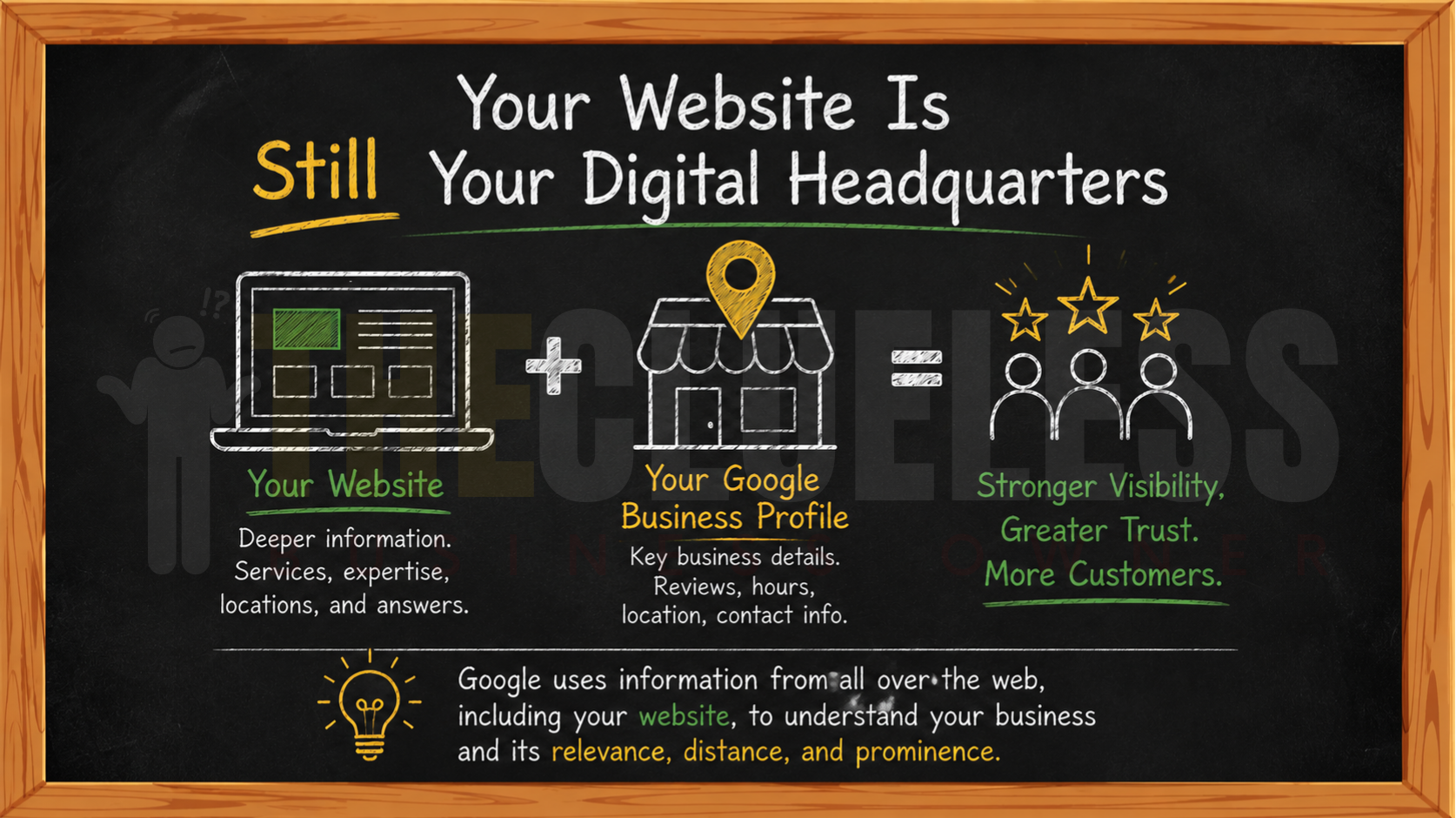
Your Website Is STILL Your Digital Headquarters
With all the attention being given to Google Business Profiles, AI Overviews, ChatGPT and other AI search platforms, you may be wondering:
Do I even need to worry about my website anymore?
Absolutely.
Your website is still the most important digital asset your business owns.
Your Google Business Profile may be what a customer sees first during a local search, but your website gives Google considerably more information about who you are, what you do, where you operate and the topics and services associated with your business.
And we know Google looks at this information.
Google says that information appearing in Business Profiles can come from several sources, including publicly available information that Google crawls on the web, such as a business's official website.
In other words, your website and your Google Business Profile do not exist in completely separate worlds.
Your Website and Google Business Profile Work Together
Google tells us that local search results are primarily based on three factors:
Relevance. Distance. Prominence.
Relevance refers to how well a Business Profile matches what someone is searching for.
Distance
considers how far the business is from the location used in the search.
Prominence
relates to how well-known Google believes the business is.
Google also says that its understanding of a business's prominence is based partly on information it has about that business from across the web, including links and reviews.
Your website is part of this larger ecosystem of information Google can use to understand your business, its services, its location and its relationship to a search.
There is an even more direct connection for some service businesses. Google says the services or jobs associated with a business may be determined from several sources, including the business's service list, website and other authoritative sources.
So if you're a plumber in Birmingham, AL and your website contains detailed pages about water heater repair, drain cleaning, sewer line repair and the areas you serve, you're giving Google more information it can crawl and use to understand your business and its services.
Does Your Website Determine Whether You Rank in the Top Three?
No. And this distinction is important.
Having a great website does not guarantee your Google Business Profile will appear in the Map Pack.
Google does not publish the exact formula or weighting it uses to determine local rankings, and there are many factors involved. Distance alone can mean that a business ranks prominently for one searcher and not another.
So I would never tell you:
"Build a better website and Google will put your Business Profile in the Top 3."
Nobody can legitimately promise that.
What we can say is that Google crawls business websites, uses information from across the web to understand businesses, and explicitly identifies relevance, distance and prominence as the primary factors behind local results.
That's why your website shouldn't be treated as something separate from your local search strategy.
And Now AI Gives Your Website Another Job
Your website isn't becoming obsolete because Google Maps and AI search are becoming more prominent.
It is still the digital property where you have the greatest control over how thoroughly you explain your business.
It's where you can establish:
Who you are. What you do. Where you do it. What you know. And why someone should trust you.
It's also where you can publish original, useful information that search engines can crawl and AI systems may potentially discover, understand, cite or use when generating answers.
We're no longer creating a strong website simply because we want someone to click a traditional blue link.
We're creating a clear, authoritative source of information about the business that can support visibility across traditional search, local search and emerging AI search experiences.
Your website isn't dead. Its job is getting bigger.
And that means we need to start thinking a little differently about how we structure the information on our websites. If search engines and AI systems are trying to understand your content and find answers within it, don't make them dig for the most important information.
One simple way to do that is something I call The Answer Zone.
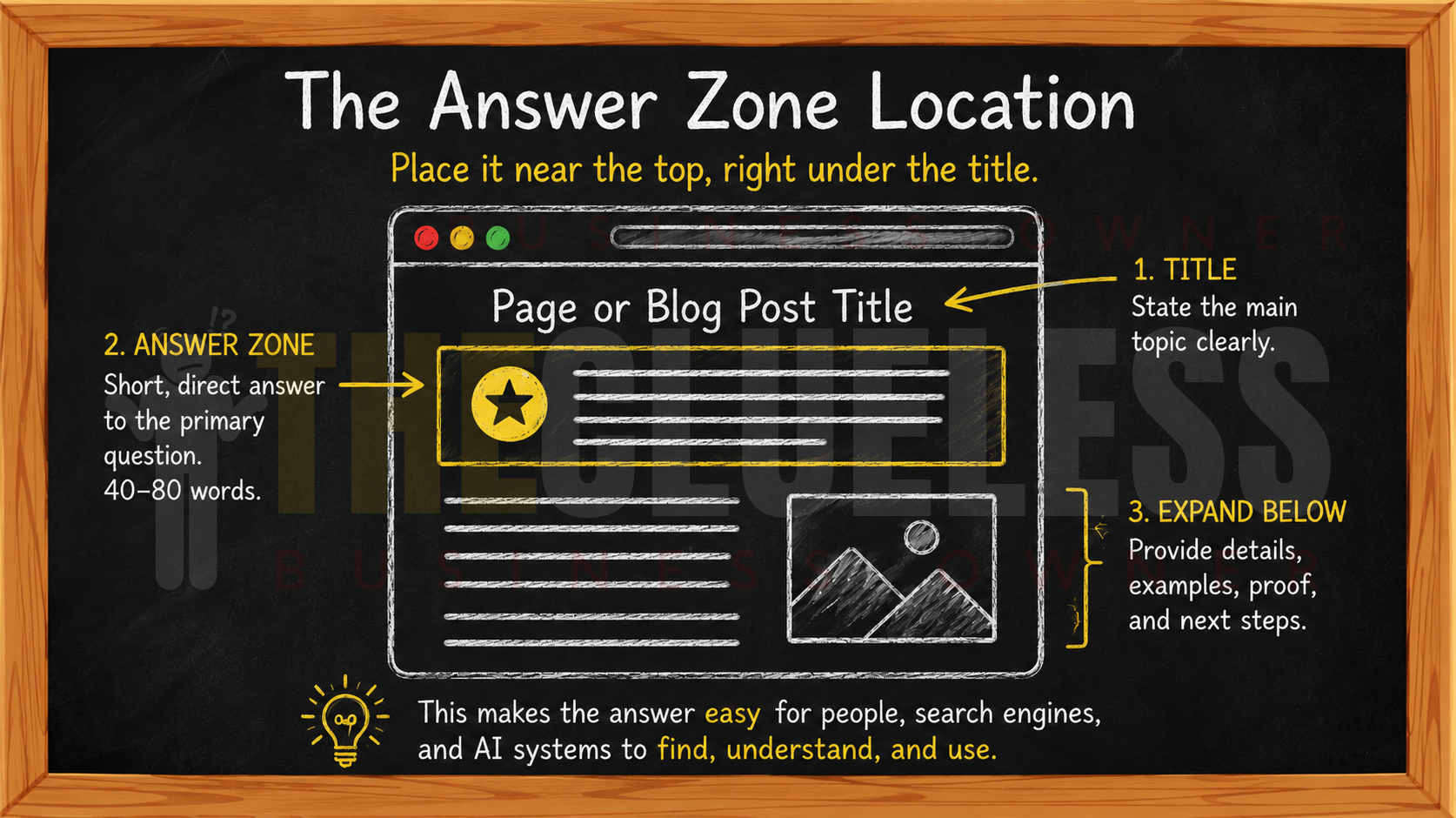
Create an Answer Zone
One of the easiest ways to make the important information on your website clear and easy to understand — for people, search engines and AI systems — is to stop making them hunt for the answer.
I call this The Answer Zone.
The Answer Zone is a short section placed near the top of an important webpage or blog post that clearly answers the primary question or search intent of that page.
Think of it as putting the short, direct answer front and center. Then you can spend the rest of the page explaining, educating, providing examples and demonstrating your expertise.
How to Create an Answer Zone
1. Identify the main question.
What is the primary thing someone searching for this page wants to know? Try to narrow it down to one clear question.
2. Answer it immediately.
Give a concise, straightforward answer. As a general guideline, I recommend approximately
40–80 words, but there is no magic word count.
The goal is simply to answer the primary question clearly without a long introduction, company history, sales pitch or several paragraphs of buildup.
3. Make the answer stand on its own.
Someone should be able to read only your Answer Zone and understand the basic answer without needing the rest of the page for context.
4. Include specifics when they're useful.
Names, services, locations, qualifications, numbers, product details or other factual information can make the answer more useful and precise. Don't stuff keywords into it just for the sake of SEO.
5. Expand below it.
Your Answer Zone isn't meant to replace the rest of your content. The remainder of the page should support and expand upon the answer with helpful explanations, examples, experience, FAQs, photos, supporting facts and other useful information that demonstrates your knowledge of the subject.
Here's the Test
Read your Answer Zone by itself and ask:
"If this were the only paragraph an AI system saw, would it understand the answer?"
If the answer is yes, you've created a strong Answer Zone.
One Important Thing to Remember
The Answer Zone isn't a magic ticket into an AI Overview.
There is no special paragraph format, word count or markup that guarantees Google or another AI platform will use, quote or cite your website.
Google has also made it clear that you don't need special AI-specific optimization techniques to be eligible to appear in its AI search experiences.
The Answer Zone is simply a content framework I recommend for making the most important information on a page clear, useful, specific and easy to understand.
That's good for AI systems.
It's good for search engines.
And, most importantly, it's good for the human being who came to your website looking for an answer.
Example: The Answer Zone in Action
Let's say you're a window replacement company and you have a page or blog post titled:
How Do You Know It's Time to Replace Your Windows? (H1 Title Tag)
Instead of beginning with several paragraphs introducing the subject, place a direct answer immediately below the title.
[ANSWER ZONE BELOW]
You may need to replace your windows if you're noticing drafts, condensation between the panes, difficulty opening or closing them, visible frame damage, or increasing heating and cooling costs.
Older windows may also lack the energy-efficiency features available in newer models. A professional inspection can help determine whether your windows need replacement or whether repairs may be sufficient.
Then continue with the rest of the article with the follow sections making sure to link back to other relevant pages of your website:
- Signs Your Windows May Need Replacing
- Drafts and Air Leaks
- Condensation Between the Glass
- Windows That Are Difficult to Operate
- Visible Damage or Deterioration
- Energy Efficiency Concerns
- Should You Repair or Replace Your Windows?
Why This Works
The reader doesn't have to dig through the article to find the basic answer.
You've provided a clear, self-contained response near the top of the page, while the rest of the content gives you room to explain each point in greater detail.
That's the purpose of
The Answer Zone —
answer first, expand second.
This makes it easily accessible to AI.
AI Results - Let's Conduct a Search and See What This Looks Like
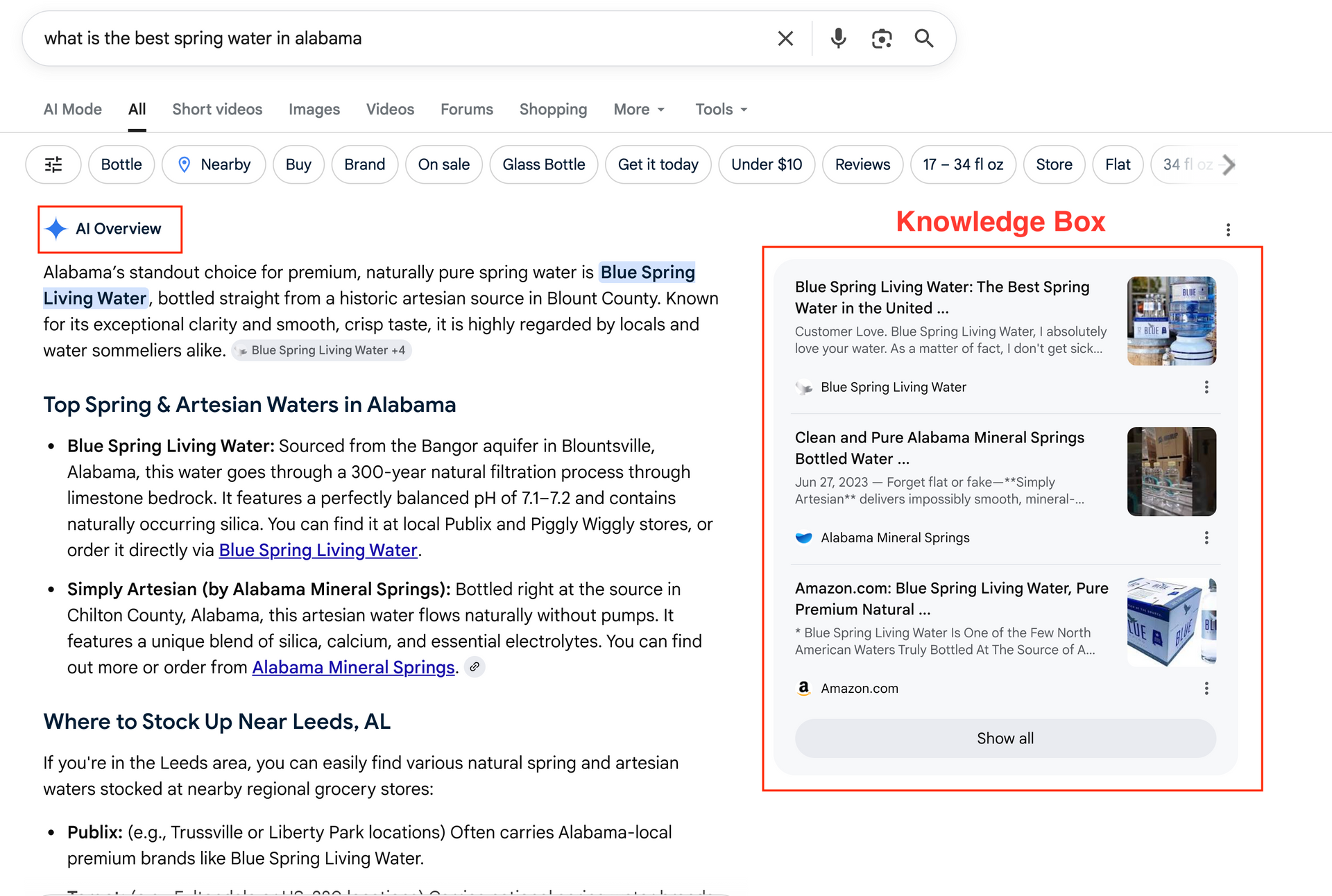
Keep in mind this is something that is constantly changing and not every single search is going to be heavily impacted by AI. But every single day (literally) I see more and more changes.
Let's talk about what and AI Overview looks like, so in this particular search I went to the search box and typed in "what is the best spring water in Alabama".
See the image below. Notice how it gives me the the AI overview and then to the right you can see the Knowledge Box which is more information you can click through to read.
(Side note this is a client of mine and not only do they have the best water in Alabama, they have won awards in WORLD competitions! Click here to check out Blue Spring Living Water.)
This search could look really different depending on what you are searching for, but you get the idea.
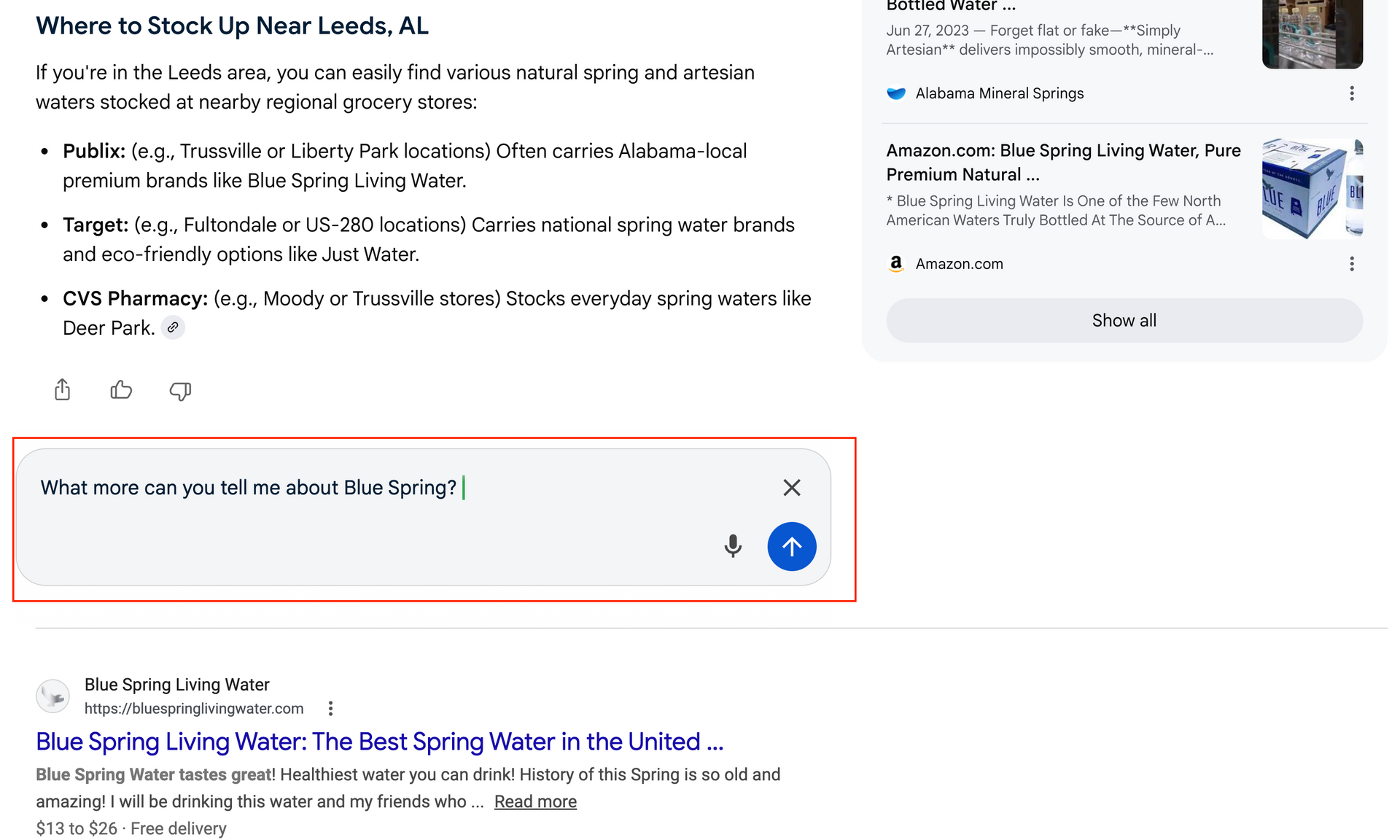
You can take this search as deep as you want to. Suppose you still have more questions, well you can type them in the box. Here I asked what more can you tell me about Blue Spring? Now when you hit enter TONS of info populates.
So this is how it looks and of course once again the real estate can look different depending on what you are searching for and what browser you are using.
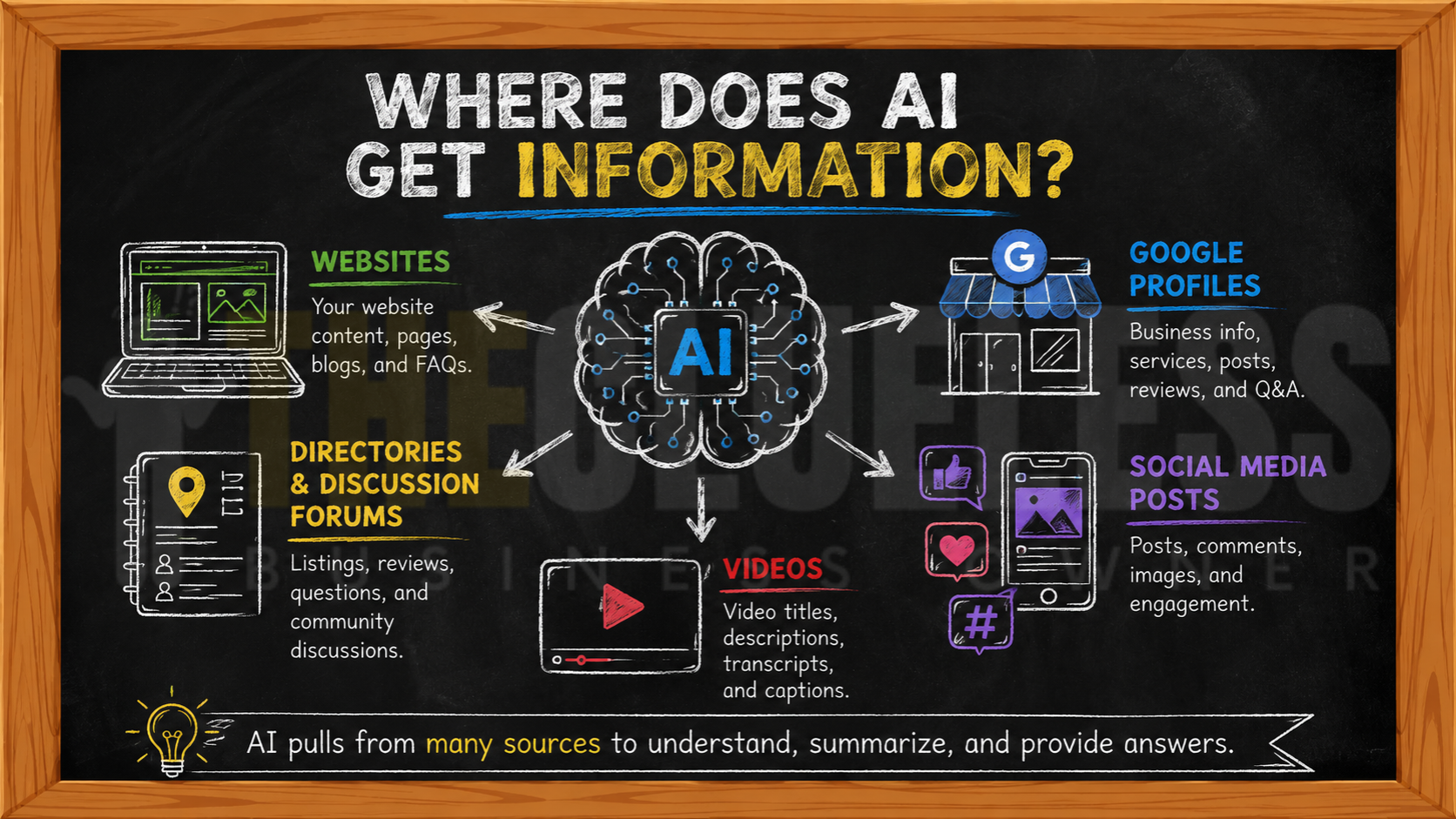
Where Does AI Actually Get Its Information?
AI platforms don't guess. They don't play favorites. They only use HARD data. They use a broad spectrum of online sources to gather the data they present to consumers.
Depending on the type of query, the resources the AI relies on will vary.
For local service providers—like plumbers, roofers, and electricians—the AI detective primarily cross-references five specific sources:
1. Your Company Website
The AI crawls your entire site to understand the exact scope of your services. It doesn't just read the main text; it reviews your meta titles, structural service pages, blog posts, and your FAQ section.
It also interprets hidden technical data like
schema markup, page titles, and image alt text to verify you are a legitimate operation.
Creating Answer Zones are very important. This gives AI a quick window to what your website is about and IF it answers important questions searchers ask.
2. Your Google Business Profile (The Gold Mine)
This is often the number one source for local AI search. The AI dissects every inch of your Google Profile, including your primary business categories, photos, and your main business description.
It also heavily reads your customer reviews—and your replies to those reviews. In fact, one of my favorite insider tricks is strategically sneaking important service keywords into my review replies to give the AI engine more data to read. The AI also scrapes your Google Posts, which is a powerful feature that most local businesses completely overlook.
3. Directory Listings & Discussion Forums
AI engines constantly reference major directory platforms like Yelp, Houzz, and the Yellow Pages to verify your phone number and address.
Crucially, they also pull real-world sentiment from discussion forums and community sites like Reddit and Quora to see what actual humans recommend when they think no one is looking.
4. Social Media Assets
Social media content is appearing inside AI search results more than ever before. If an AI engine finds a highly relevant, localized post on Instagram or Facebook, it will pull that information straight into its response box.
(This is yet another reason to stop posting generic graphics and start creating real, helpful social media content!) In many cases, the AI can even scan and analyze the text and objects contained directly inside your photos.
5. Helpful Video Content
AI loves video, and the beautiful irony is that
it heavily prefers raw, human-generated content over polished corporate commercials.
Creating a simple YouTube channel for your local business is one of the smartest things you can do today. Your videos do not need to be highly produced or expensive. Short, straight-forward videos shot on a smartphone that answer basic customer questions are gold mines for AI search data.
Helping our clients develop simple YouTube channels is one of our highest-priority initiatives this year because the visibility payoff is massive.
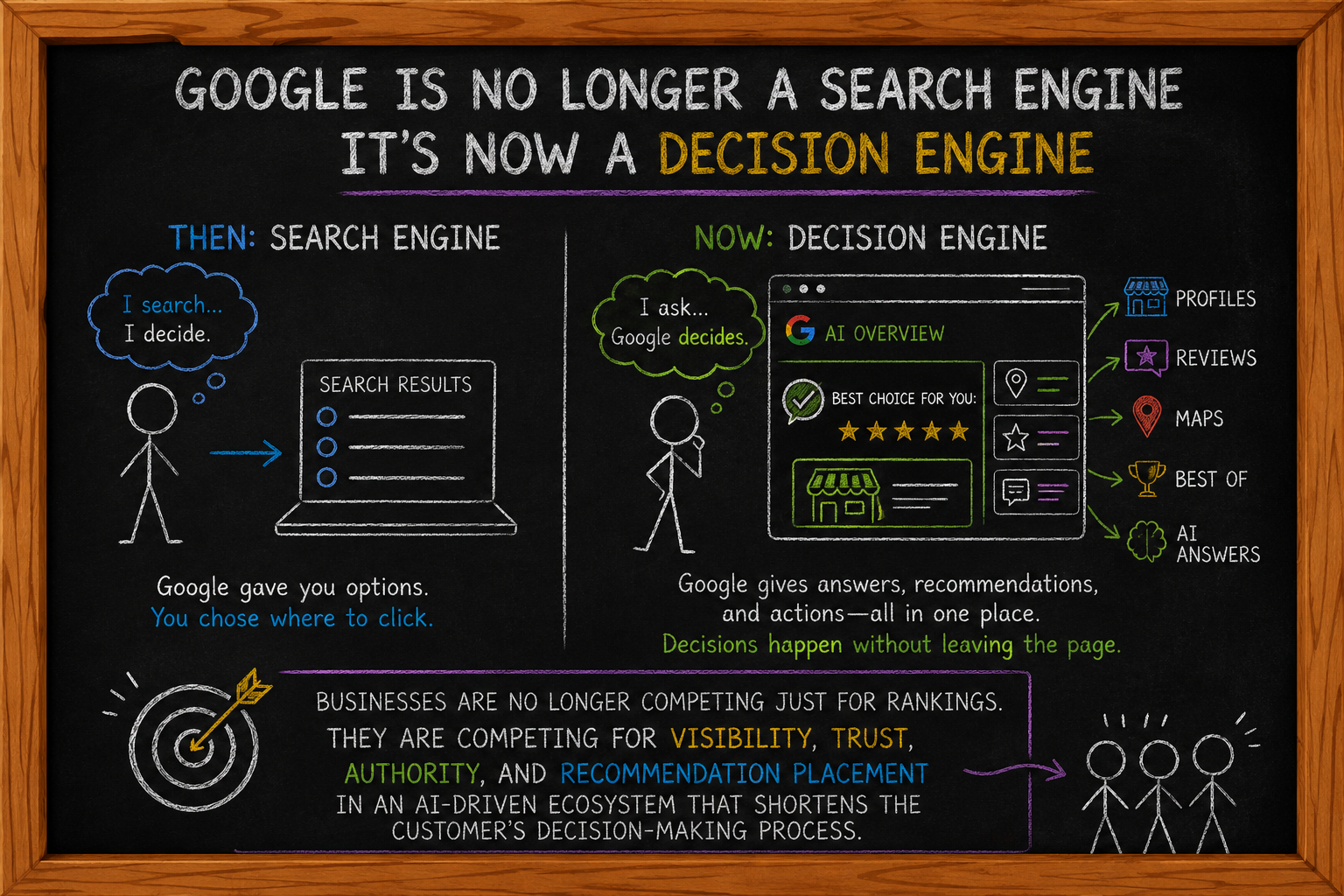
Google Is No Longer a Search Engine — It's Becoming a Decision Engine
For over two decades, Google functioned strictly as a search engine. You typed in a question, it handed you a long list of websites, and you had to click around to find your own answer.
Today, Google is executing its biggest evolution yet: It is transforming into a Decision Engine.
Instead of simply showing a customer a list of options, Google and modern AI platforms are actively trying to make the final decision for the searcher.
Through AI Overviews, Google Profiles, detailed reviews, smart maps, and automated "best of" summaries, Google is now filtering data, comparing local businesses, and highlighting trusted providers on the screen. It is guiding the user toward a specific action without requiring them to visit multiple websites.
In many cases, the consumer makes their final choice and taps the "call" button directly from the search results layout itself.
This means local businesses are no longer competing just for generic keyword rankings.
You are competing for visibility, authority, and the ultimate recommendation placement inside an AI-driven ecosystem.
The entire system is intentionally designed to shorten the customer's decision-making process.
The AI Filter Test
When a homeowner types a high-intent request into their phone—like “Help me find an affordable but trustworthy plumber”—the AI Decision Engine instantly filters the local market.
It attempts to answer six specific questions about your business:
- Who is the absolute best match for this specific searcher?
- Who talks about this specific plumbing issue the most online?
- Who has the highest proof of trustworthy service?
- Who is closest and most relevant to the searcher's physical location?
- Who best answers the exact question being asked?
- Who appears to offer the most fair and affordable rates?
If your digital footprint doesn't give the Decision Engine clear, undeniable answers to those six questions, you won't make the cut.
You will be filtered out, and your competitor will get the phone call.
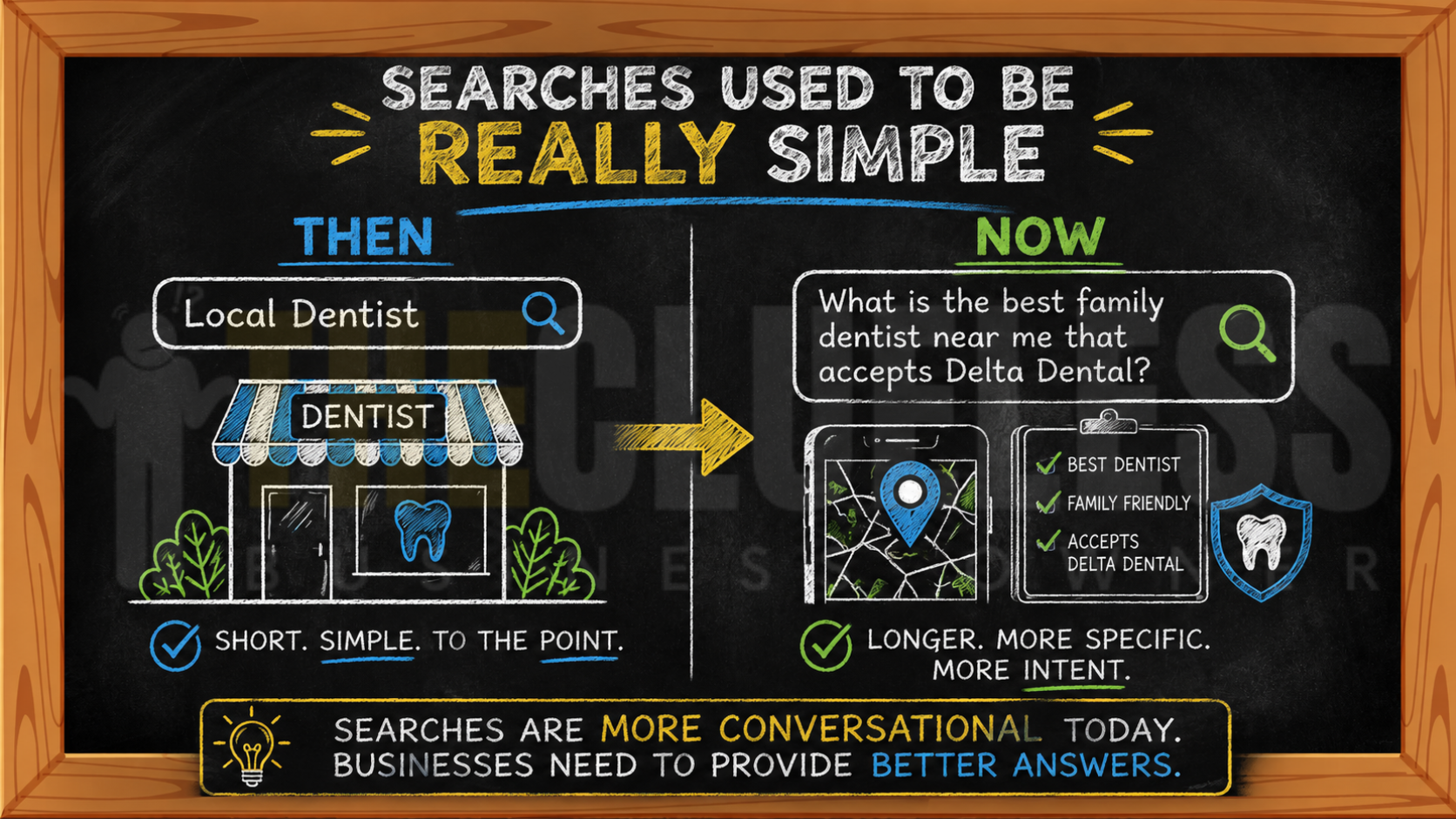
Searchers Trigger Results with Questions Not Keywords
When voice search first hit the scene years ago, a massive shift occurred: search queries became significantly longer and more conversational.
I remember diving into our clients' analytics data and watching this transition happen in real-time. It was fascinating.
In the old days, a typical search was incredibly simple and robotic: “Plumber Birmingham”
Today, searchers open their phones and search with extreme specificity:
- “Who is the best emergency plumber near me?”
- “What plumbing company can replace a hot water heater today?”
- “What local plumbing company works on weekends?”
- “What plumber is affordable but has the best reviews?”
- “What plumbing companies should I avoid?”
It isn’t just voice assistants driving this shift—it’s also human nature. As people become more internet-savvy, their expectations skyrocket.
They don’t want a generic list of 50 local plumbers anymore. They want a specific professional who is close to their house, fair on price, highly trusted, and open right now.
The "Black Dress" Principle
Think of it like this: A woman doesn't just walk into a store looking for "a dress." She is usually looking for something highly specific.
- Maybe she wants a formal black dress for an upcoming cocktail party.
- Maybe she is shopping for a wedding.
- Or maybe she just wants a casual summer dress for a night out with friends.
The internet works the exact same way. The more specific the customer's search, the more relevant the result will be.
Today's savvy searchers don’t want to wade through a mountain of generic websites; they just want a couple of really good, highly accurate options handed to them on a silver platter.
This means local businesses with rich, deeply complete, and highly detailed information online are in the ultimate position to win.
By answering specific customer questions on your website and profiles, your business gains a massive competitive advantage. You naturally force your way right to the top of the scroll—directly into the Call Pool.
At the end of the day, you need to remember one critical rule:
The real threat to your livelihood isn’t artificial intelligence. The real threat to your business is invisibility.
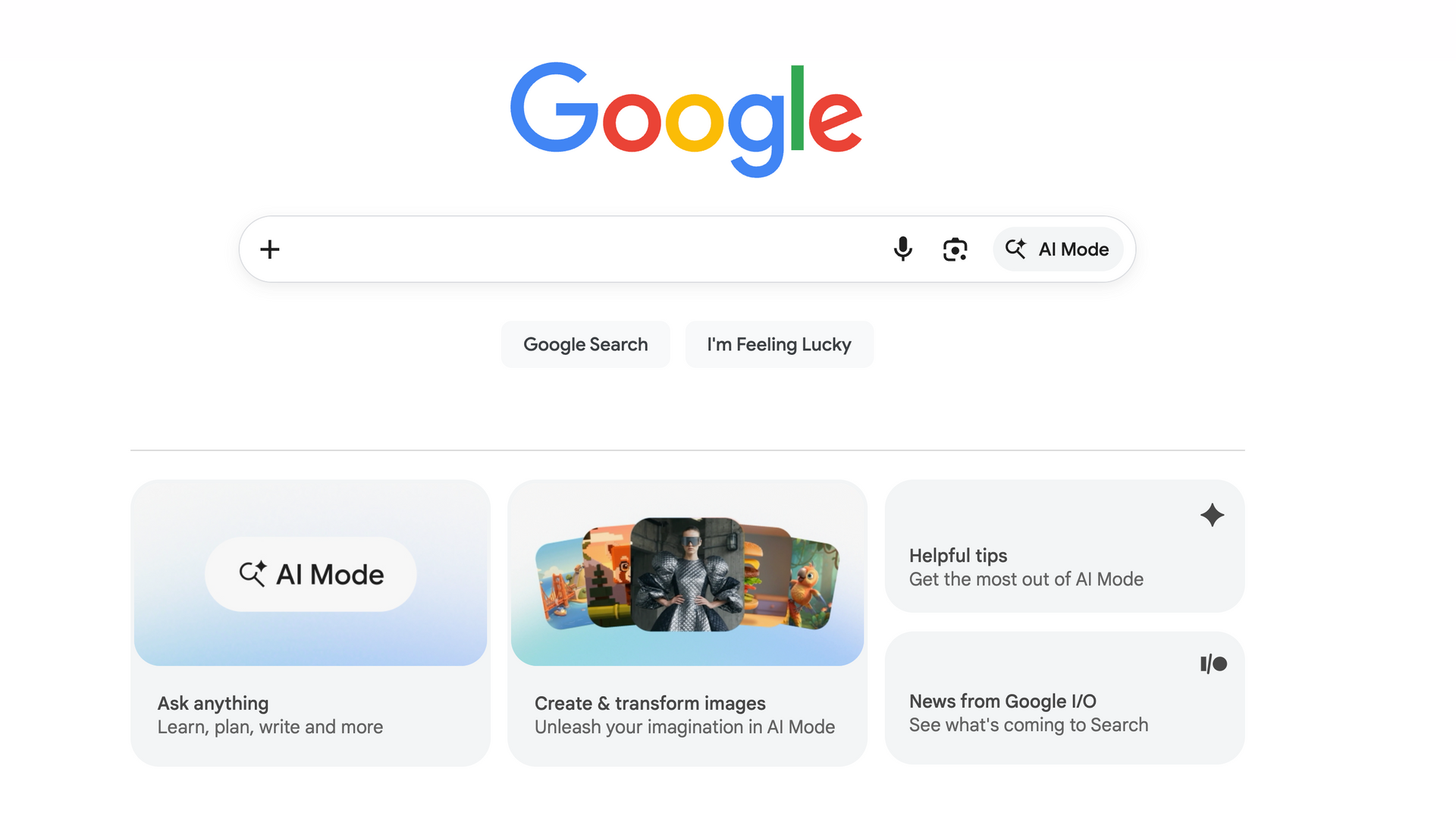
Google Just Made One of the Biggest Changes to the Platform in 25 Years
On May 19, 2026, Google announced a massive evolution to its platform. They expanded their iconic search experience to include advanced artificial intelligence capabilities powered by their newest, lightning-fast AI model: Gemini 3.5 Flash.
Instead of simply showing a traditional list of blue website links, Google now uses AI to summarize information, compare local businesses, answer deep questions directly on the screen, and help users make final decisions without ever clicking through to a website.
Cutting-edge features like AI Overviews, "Have AI Get Prices," advanced knowledge panels, and enhanced Google Business Profiles are completely rewriting how local consumers interact with information online.
The "Photo-to-Phone-Call" Reality
Perhaps the biggest shift is that users are no longer limited to typing words into a search bar. Today, customers can upload pictures, documents, and videos directly into Google to get help.
- Imagine a homeowner discovering a cracked, spraying pipe under their kitchen sink.
- Instead of typing "plumber near me," they snap a quick photo of the broken pipe and upload it straight into Google.
- They ask Gemini: "What is causing this leak, and which local company can come fix it right now?"
The AI analyzes the image, diagnoses the plumbing issue, and immediately serves up a direct recommendation for a trusted local specialist.
In this new reality, the customer’s entire search journey begins—and ends—directly inside the Google interface itself.
This is the ultimate example of a Zero Click Search. But note that just because there is a zero click does not mean a business isn't getting hired just the same.
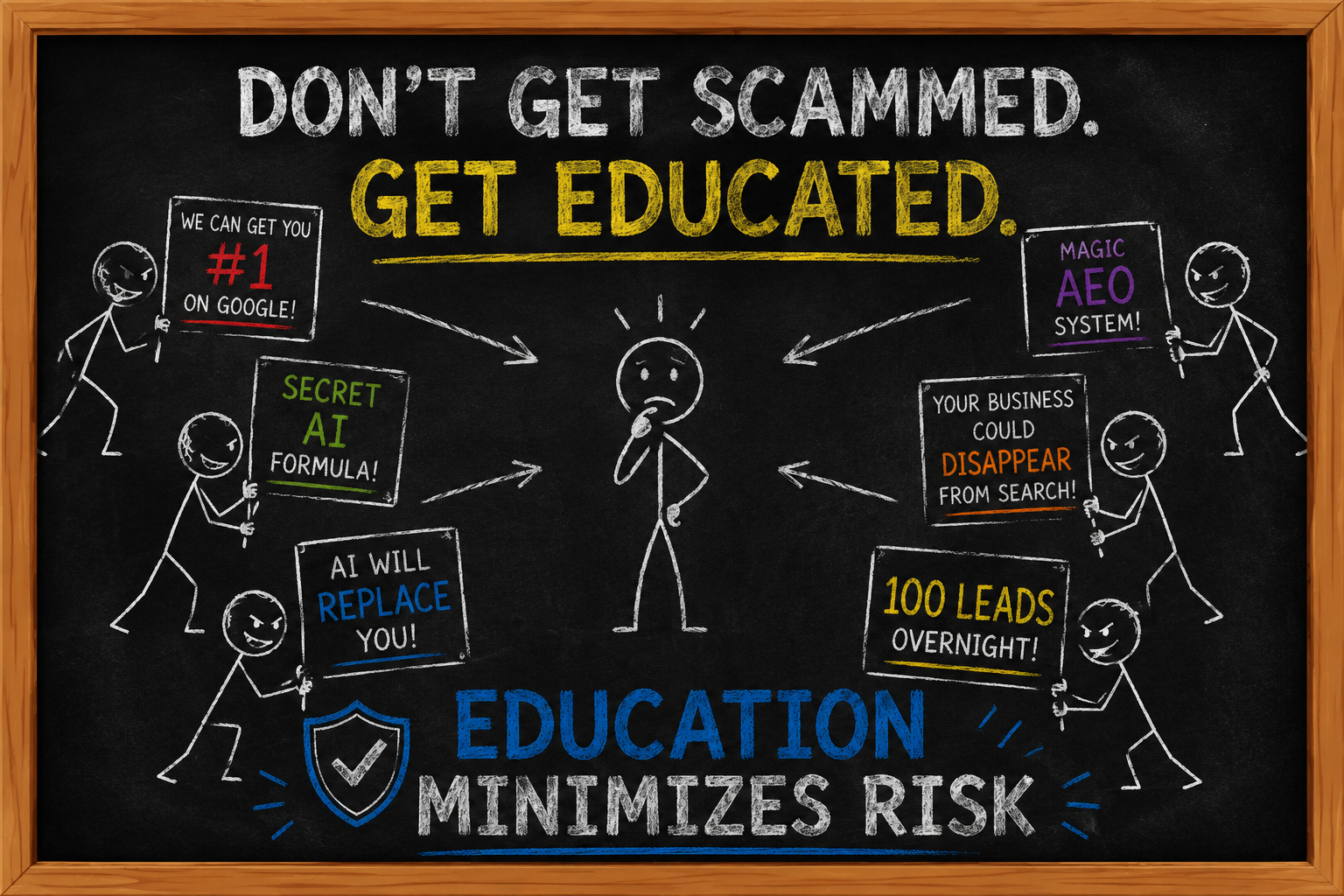
Beware the Sharks: The Scammers & Doomsday Sellers
With every major technological evolution, the sharks smell blood in the water.
Whenever a new technology emerges, there are always two groups of people waiting for it. The innovators who build real solutions... and the opportunists who build fear so they can sell.
Scammers know that hard-working business owners don't have time to keep up with every algorithm update, AI breakthrough, or new marketing buzzword. They count on that.
To exploit that uncertainty, they use fear-based marketing to bully business owners into buying products and services they don't understand and in some cases don't really need.
I'd be willing to bet you've already received some version of these phone calls or emails during the time you've been in busines:
- "We can guarantee your business lands on the first page of Google."
- "Your Google Business Profile has critical errors, and it's costing you leads right now."
- "Let us submit your business to a premium voice search network before your competitors do."
These buzzword bullies thrive on a business owner's lack of education. They overwhelm you with confusing terminology, flashy presentations, and promises that sound impressive but rarely deliver real results.
Minimizing that risk is the exact reason The Clueless Business Owner exists.
Education is your shield from scammers.
Now that AI is the latest marketing buzzword, the sales pitches are evolving right along with it.
Today, they sound more like this:
- "Your business is completely invisible to ChatGPT. Buy our AI optimization package."
- "AI is replacing businesses that aren't fully automated."
- "SEO is dead. You need our proprietary AEO system."
- "Your website is no longer relevant."
- "More than 50% of searches are happening with ZERO CLICKS."
The technology changes.
The sales tactics don't.
Half-Truths in My Book are the Same as Lying
One thing I've learned over the years is that scammers and fear-based marketers rarely make up statistics. They don't have to.
Instead, they take a real fact, leave out the important context, and hopes that fear leads you to clicking.
For example, recently, you've probably heard (or seen) someone say:
"More than half of all Google searches are now zero-click searches."
That statement is based on real research. But they are purposely taking that data and only giving you half the story - sorry but in my book that is the same as being misleading - or LYING.
What they conveniently leave out is what those searches actually look like for local service businesses.
For many plumbers, electricians, HVAC companies, roofers, landscapers, and other local service providers, a customer may find exactly what they need right inside Google.
They see your Google Business Profile, read your reviews, check your hours, request directions, or tap the Call button without ever visiting your website.
Google counts that as a zero-click search. That's not a failed search. That's often a new customer.
By the way this behavior is not representative of a change, in fact for more than a decade MOST service business searches end in Google Maps. That fact is still true today.
You'll also hear people confidently declare:
"Websites won't matter anymore."
That's another half-truth.
As search continues to evolve, people may interact with websites differently than they did ten years ago, but that doesn't make websites irrelevant.
Your website is still one of the primary ways Google understands your business.
It helps Google understand the services you provide, the areas you serve, your expertise, and the authority you've built over time.
Those signals help influence your visibility in traditional search, Google Maps, and AI-powered search experiences.
The lesson?
Always ask what's missing from the story.
Scammers and fear-based marketers don't always lie outright.
More often, they leave out the part that would make you feel a whole lot less afraid.
That's why education matters so do your own research.
If you were making a purchase for your home such as a new television or something along those lines you would do the research right? You would educate yourself on what you are buying.
Marketing services for your business are no exception.
Education minimizes risk.
Now let's drag their favorite tricks out into the light so you never fall prey to them.
1. The "Secret AI Code" Scam
Some agencies charge thousands of dollars claiming they need to "special format" your website with a secret AI code or proprietary schema formula so AI engines can finally recognize your business.
The AI Involvement
These marketers use the complex, mysterious nature of AI and Large Language Models (LLMs) to convince business owners that AI speaks some hidden programming language that only they understand.
The Reality
There is no secret AI code that unlocks visibility.
AI models primarily rely on clear, human-readable content to understand your business. Technical elements like schema markup can provide additional context, but they are not a hidden formula for getting recommended by AI.
Scammers are simply dressing up standard web best practices to make them look like wizardry.
Is there a chance your website DOES need to be rewritten so that it appears in AI Overviews? Perhaps.
BUT, this goes back to the "voice search dilemma". Marketers were trying to sell you voice search but the fact is your business never appeared in search in the first place.
Same now. Did you business appear in top results for searches before AI was an issue?
So perhaps your website could be done better, but the rise of AI search did not cause that problem.
2. The "ChatGPT Business Listing" Scam
Fly-by-night marketers love promising they can make your company the guaranteed "#1 recommended answer" inside ChatGPT, Perplexity, Gemini, or Google AI Overviews.
The AI Involvement
Shady agencies claim they have exclusive relationships, insider access, or backdoor methods that allow them to place your business directly into AI systems.
The Reality
There is no such thing as a "business directory" for ChatGPT.
You cannot buy a listing inside an AI model. There is no button to push.
AI systems draw information from a combination of training data, public websites, search indexes, trusted databases, reviews, and—depending on the platform—live web search.
No reputable company has a backdoor into these systems or can permanently place your business at the top of AI-generated answers.
If someone guarantees they can, walk away.
3. The "Guaranteed AI Recommendation" Scam
Some marketers promise they can guarantee your business will become ChatGPT's "#1 recommendation" or appear as the top answer in Google AI Overviews or other AI search tools.
The AI Involvement
These companies claim they have proprietary AI optimization methods, exclusive relationships, or secret systems that guarantee AI platforms will recommend your business above your competitors.
The Reality
No one—not Google, OpenAI, Anthropic, Microsoft, or Perplexity—offers a legitimate way to buy or guarantee AI recommendations.
Can you improve your visibility?
Absolutely.
Can anyone guarantee that AI will recommend your business over every competitor?
No.
The businesses that consistently appear in AI search earn that visibility by building authority, publishing genuinely helpful content, maintaining accurate business information, earning quality reviews, and establishing trust across the web.
Anyone promising guaranteed placement inside AI-generated answers is selling something they simply cannot control.
4. The "Schema on Every Single Page" Scam
Some agencies repackage standard website schema markup as a "revolutionary AI ranking breakthrough" and then charge thousands of dollars to add massive amounts of schema to every page of your website.
The AI Involvement
These marketers claim that loading your website with schema tells AI systems you're a superior local authority and is the secret to dominating AI search results.
The Reality
Schema markup is a helpful SEO best practice. It can make your content easier for search engines and AI-powered search experiences to interpret and may improve how your website appears in search results.
But schema alone won't make your business rank higher in AI search.
It certainly isn't a revolutionary AI breakthrough worth paying premium fees for.
Don't let someone convince you that adding more schema to every page is the magic key to AI visibility.
Good content, a well-structured website, and real authority will always matter far more than excessive markup.
Also, don't pay thousands of dollars for something a simple website plugin could accomplish.
5. The "LLMs.txt" Requirement Panic
You may start seeing urgent warnings claiming your business will be invisible to AI unless you immediately add an llms.txt file to your website.
Some agencies package this as a premium AI optimization service and make it sound like your future depends on it.
The AI Involvement
The sales pitch claims AI web crawlers require this file to understand your website and that you'll be blacklisted from AI search if it isn't installed.
The Reality
There is currently very little evidence that an llms.txt file has any measurable impact on local service business visibility in AI search.
Could that change someday?
Possibly.
Technology evolves.
But today, if you want to add one, it takes only a few minutes and costs virtually nothing.
Don't let an agency charge hundreds or thousands of dollars for what amounts to a tiny text file.
6. The "Automated AI Bot" Lead Promise
Scammers love promising that a custom AI chatbot or automated calling system will flood your calendar with hundreds of qualified appointments every month while you sit back and watch the leads roll in.
The AI Involvement
They present their software as a fully autonomous AI sales team that can replace your office staff, close sales, qualify every lead, and run your business without human involvement.
The Reality
Let's be fair.
There are some outstanding AI tools that can improve customer service, answer common questions, schedule appointments, and automate repetitive tasks.
I use AI every single day.
The problem isn't AI.
The problem is the unrealistic promises.
Many of the systems sold under flashy AI marketing are nothing more than automated robocallers, spam-texting platforms, or poorly configured chatbots.
Instead of creating a better customer experience, they frustrate potential customers, generate spam complaints, and in some cases can even violate telemarketing laws.
AI should enhance your customer experience.
It shouldn't become your customer experience.
The businesses win will use AI to make their teams more efficient—not to eliminate the human relationships that customers still value.
7. The "Proprietary AI Content" Trap
Some agencies charge massive monthly retainers for a "revolutionary AI content engine" that supposedly creates blogs, newsletters, emails, social media posts, and website content faster and better than anyone else.
The AI Involvement
These providers present their content system as proprietary technology that only they possess.
They make it sound like they've built an exclusive AI platform unavailable anywhere else.
The Reality
In many cases, they're simply using the same publicly available AI tools everyone else has access to.
They type in a prompt, make a few minor edits, and charge premium rates for work that took only minutes to produce.
That's not strategy.
That's markup.
More importantly, generic AI content often lacks original insights, real-world experience, and a unique brand voice.
Whether content is written by AI or a human, Google rewards content that is genuinely helpful and provides original value—not content that simply repeats what already exists online.
AI is an incredible assistant.
It is not a substitute for expertise, experience, or thoughtful strategy.
If an agency can't explain the strategy behind the content they're creating, you're probably paying for prompts—not marketing.
8. The "AI Google Maps Verification" Scam
Sooner or later, you'll probably receive an urgent phone call, text message, or email claiming that Google is using AI to audit business listings and that your Google Business Profile is at risk of being suspended or permanently removed.
The caller will tell you that you need to complete an "AI verification" immediately and, conveniently, they can handle it for you—for a fee.
The AI Involvement
These scammers often use AI-generated voices or automated calling systems to contact thousands of businesses every day. The voice sounds professional, confident, and sometimes surprisingly human.
They throw around terms like "AI audit," "AI verification," or "AI compliance" to make it sound as though Google has introduced an entirely new process that only they understand.
In reality, they're simply using AI to make their scam sound more convincing.
The Reality
Google does sometimes require businesses to complete a verification process, including video verification for certain businesses and situations.
However, Google never charges you to verify your business, and they don't hire third-party companies to call demanding payment on their behalf.
If your Google Business Profile requires verification, you'll see that information when you sign directly into your Google Business Profile dashboard.
Never trust an unsolicited phone call telling you that your listing is about to disappear unless you pull out your credit card and pay someone immediately. THIS IS A SCAM.
9. The "AI Directory Sync" Extortion
Another growing sales pitch starts with a flashy "AI Business Scan."
An agency emails you a colorful report showing your business listed across dozens—or even hundreds—of obscure online directories you've never heard of.
They'll explain that Google's new AI systems require your information to stay synchronized across all of these websites.
Then comes the solution.
For only $199 a month, they'll keep your business "AI synchronized."
The AI Involvement
The impressive-looking report is usually generated automatically by software.
The agency simply adds the words "AI Analysis" or "AI Directory Intelligence" to make it sound more sophisticated than it really is.
Likewise, the software they're selling is often nothing more than a bulk directory submission tool that's existed for years—now wearing a shiny new AI label.
The Reality
Consistent business information still matters.
Your name, address, phone number, website, and other core business information should absolutely be accurate across major platforms like Google Business Profile, Yelp, Angi, Apple Maps, Bing Places, Facebook, and other trusted business directories.
But Google places far more weight on authoritative, trusted sources than on hundreds of obscure directories that almost nobody uses.
Don't let someone convince you that syncing your business to dozens of random websites is suddenly an AI requirement.
In many cases, they're simply trying to lock you into another monthly subscription that provides very little real value.
10. The Fake "AI Negative Review Removal" Promise
Every business receives an occasional negative review.
Unfortunately, scammers know business owners are often willing to pay almost anything to make those reviews disappear.
That's where this scam begins.
A company offers to use a "proprietary AI legal bot" or "AI reputation engine" to automatically remove negative reviews from your Google Business Profile or Yelp account.
For a hefty upfront fee, they promise their AI has discovered secret loopholes that force review platforms to delete bad reviews.
The AI Involvement
In reality, they're usually just using AI to generate official-looking dispute letters or mass-produce review removal requests.
They make it sound like they've built sophisticated legal technology.
Most of the time, they're simply using the same AI writing tools available to everyone else.
The Reality
No software or agency can force Google or Yelp to remove a legitimate review that doesn't violate the platform's policies.
Reviews are only removed when they violate the Terms of Service—such as fake reviews, spam, harassment, hate speech, or other policy violations.
Many of these companies simply submit the same dispute form you could have completed yourself for free.
If the review doesn't violate Google's policies, it isn't coming down—no matter how much you paid.
The Bottom Line
AI is changing marketing.
That's true.
But it has also created an entirely new generation of fear-based sales tactics.
The technology may be new.
The scams aren't.
The best defense has never been buying the latest shiny object.
It's understanding enough to recognize when someone is trying to sell you fear instead of solutions.
Whenever someone tells you they have a secret system, exclusive AI relationship, proprietary technology, or a guaranteed shortcut, ask yourself one simple question:
"Is this solving a real business problem... or are they simply selling my fear?"
The more you understand how AI, search, and digital marketing actually work, the harder you become to manipulate.
And that's exactly why I wrote this guide.
Because the goal isn't to make you an AI expert.
The goal is to make sure you're never an easy target.
Education minimizes risk.
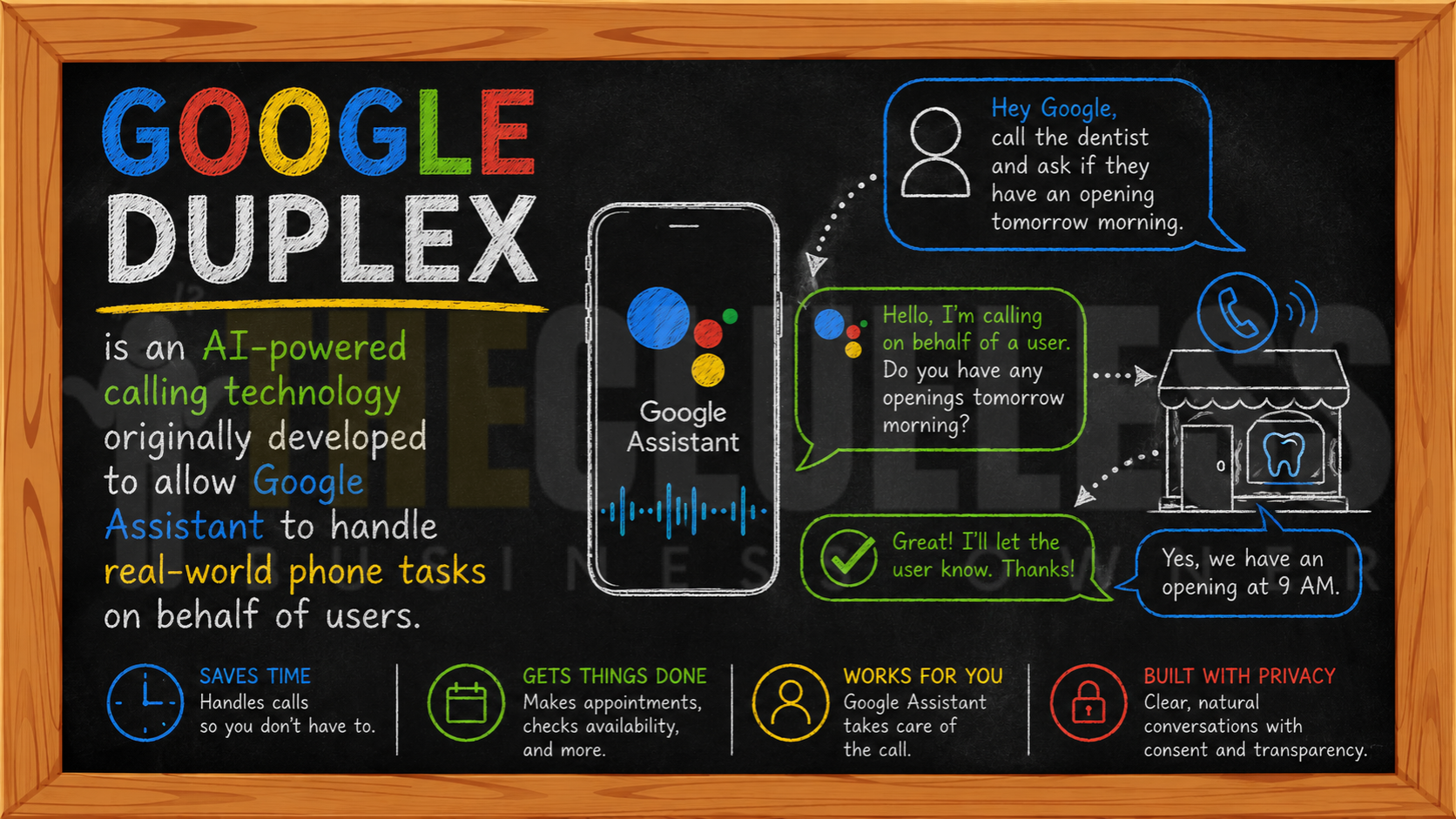
The Phone-Calling AI: Google Duplex
AI isn't just sitting inside text boxes on a computer screen. It is actively picking up the phone and making real-world calls.
Google developed a groundbreaking calling technology called Google Duplex.
It was originally built to allow Google Assistant to handle telephone tasks on behalf of consumers. Instead of a person making a call, Duplex speaks naturally with businesses to confirm hours, check availability, or complete simple requests.
What made Duplex so mind-blowing was how terrifyingly human it sounded. The system was designed to carry on realistic conversations, handle unexpected interruptions, understand context, and even use natural speech pauses like "um" and "ah."
It is often impossible to tell whether you are speaking to a robot or an actual person.
Over time, variations of this voice technology have been woven into everyday smartphone features, helping users:
- Screen incoming spam calls automatically
- Wait on hold during long customer service calls
- Confirm operational hours for local map data
- Streamline automated online booking tasks
The system operates completely behind the scenes. For example, a user might tell their smartphone: “Call the local hardware store and see if they are open on the holiday today.” The AI handles the entire interaction seamlessly while the user goes about their day.
For a local service business owner, this is a massive wake-up call. It means the "person" answering your phone might not be a person at all—and the "customer" calling your shop to check your availability might be an AI bot evaluating your response speed.
Listen to the audio file below to see how realistic Google Duplex is.
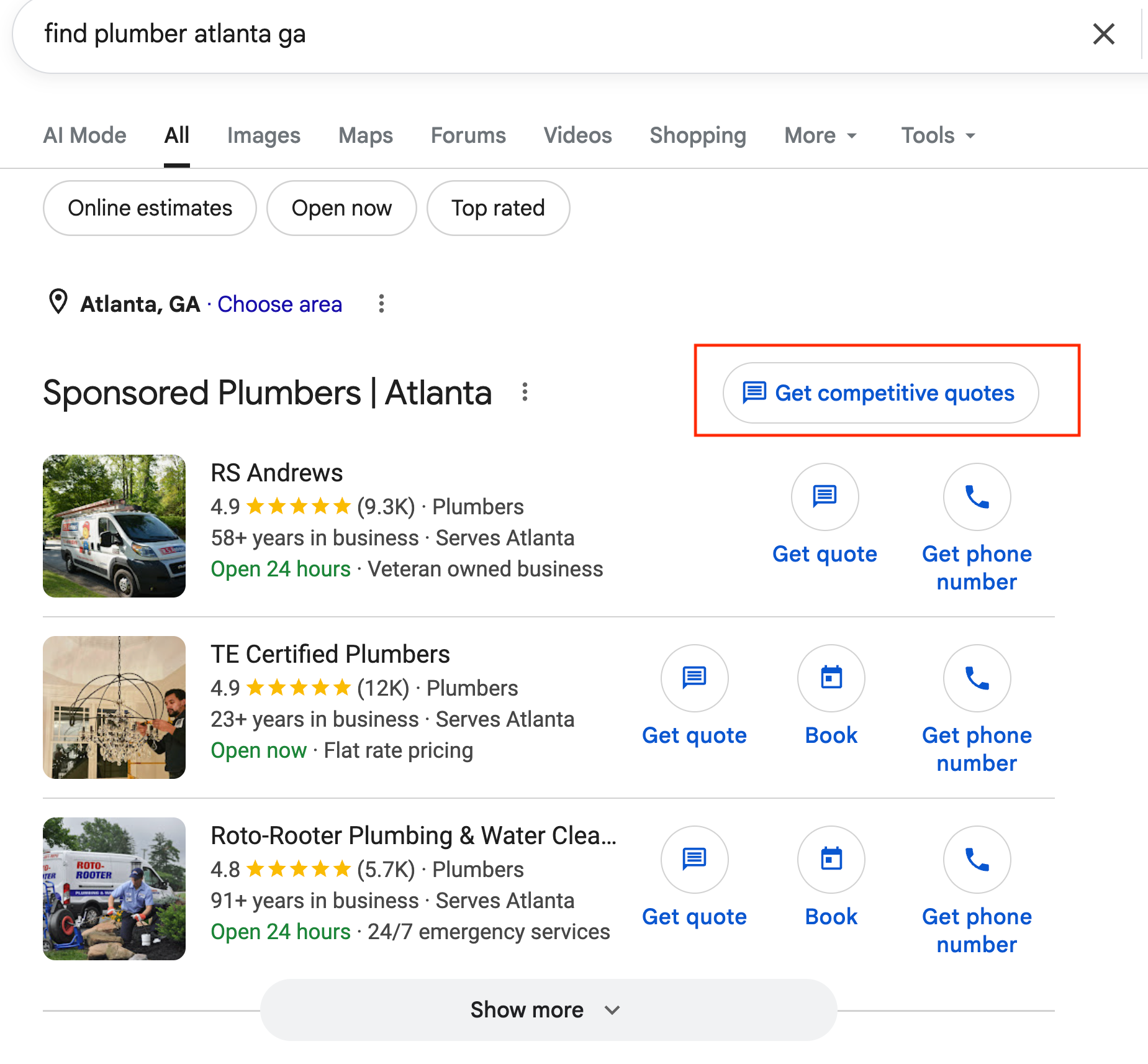
Additionally, lower down in Google Business Profiles, this is also what you could see:
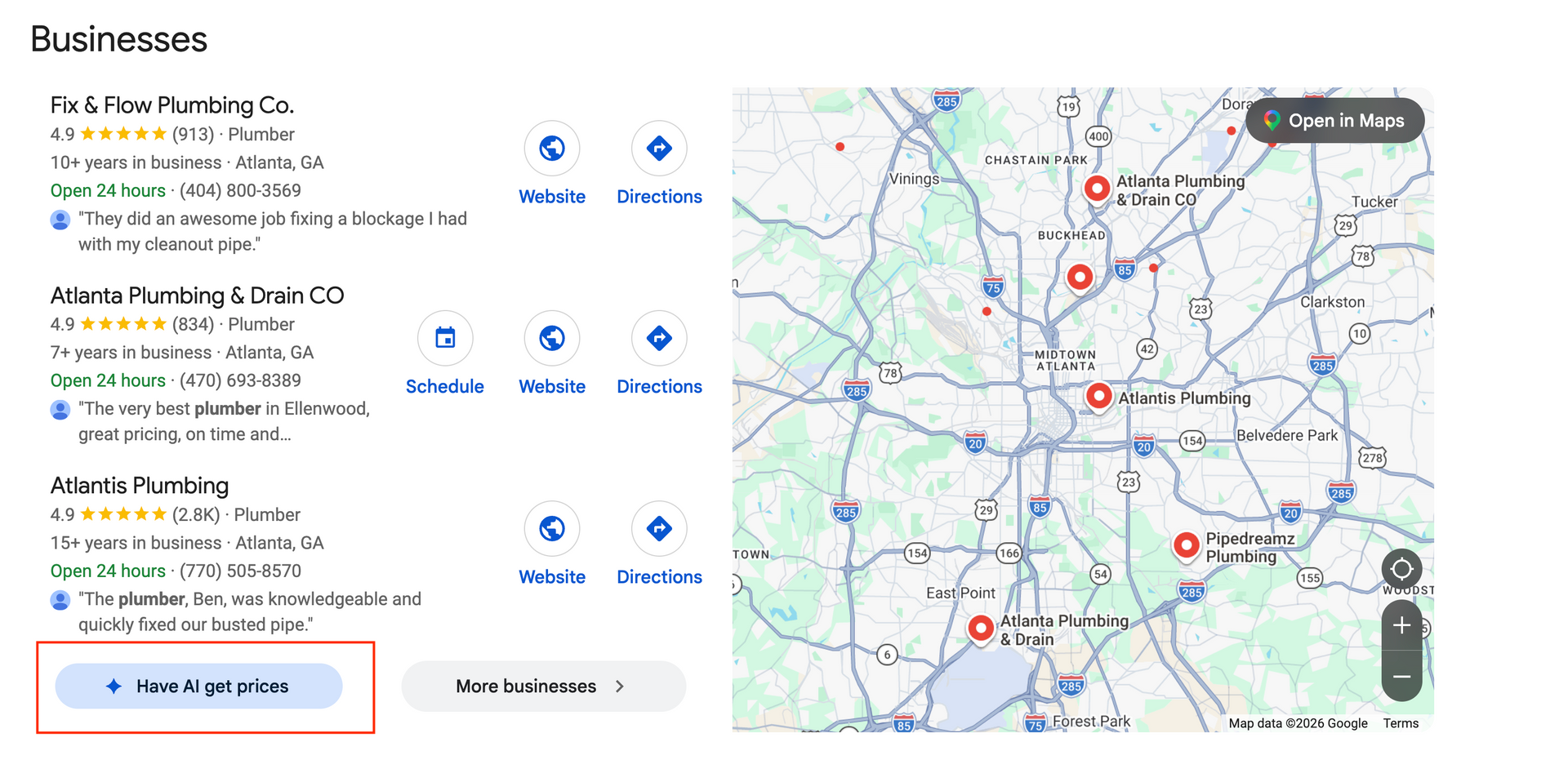
AI Can't See Inside Your Customer's Home
One of the newest trends in AI search is helping consumers request estimates and compare local service providers without leaving the search results.
Google has begun experimenting with AI-powered features that can help users gather pricing information more quickly, while its paid Local Services Ads continue to offer quote and lead-generation tools for participating businesses.
On the surface, that sounds incredibly convenient.
But here's where I believe AI runs into a very real limitation.
Home service work isn't like ordering a pizza.
It's not even like buying a television.
Most repair work cannot be accurately priced until someone with real experience physically evaluates the problem.
A leaking pipe might be nothing more than a loose fitting.
Or it might require opening walls and replacing damaged plumbing. A roof leak might need a simple repair.
Or it might reveal hidden structural damage that no one could have predicted from a few photos or a short description.
An electrical problem might be a faulty outlet. Or it might require replacing an entire circuit.
The point is simple:
AI cannot inspect what it cannot see.
Experience Still Matters
Over the years, I've personally listened to hundreds of recorded service calls through platforms like CallRail.
One thing became obvious. Customers usually describe symptoms. They rarely diagnose the actual problem.
And that's perfectly understandable.
They're homeowners—not licensed plumbers, electricians, or HVAC technicians.
The same limitation applies to AI.
- It can ask intelligent questions.
- It can organize information.
- It can recognize patterns.
But it cannot crawl into an attic.
- It cannot test electrical voltage.
- It cannot inspect a cracked sewer line.
- And it certainly can't replace decades of real-world experience standing in someone's home solving problems.
That's why I believe AI should help start the conversation—not finish it.
Set the Right Expectations
Could AI help homeowners understand general price ranges? Absolutely.
Could it help determine whether a problem is urgent? Probably.
Could it help answer common questions before a technician arrives? Without question.
But when it comes to providing an accurate price for a complex home service problem, there are simply too many unknown variables.
That's why the best contractors are careful about making promises before they've had a chance to inspect the job.
Sometimes the problem is smaller than expected.
Sometimes it's much larger.
No artificial intelligence can't reliably know the difference without enough accurate information.
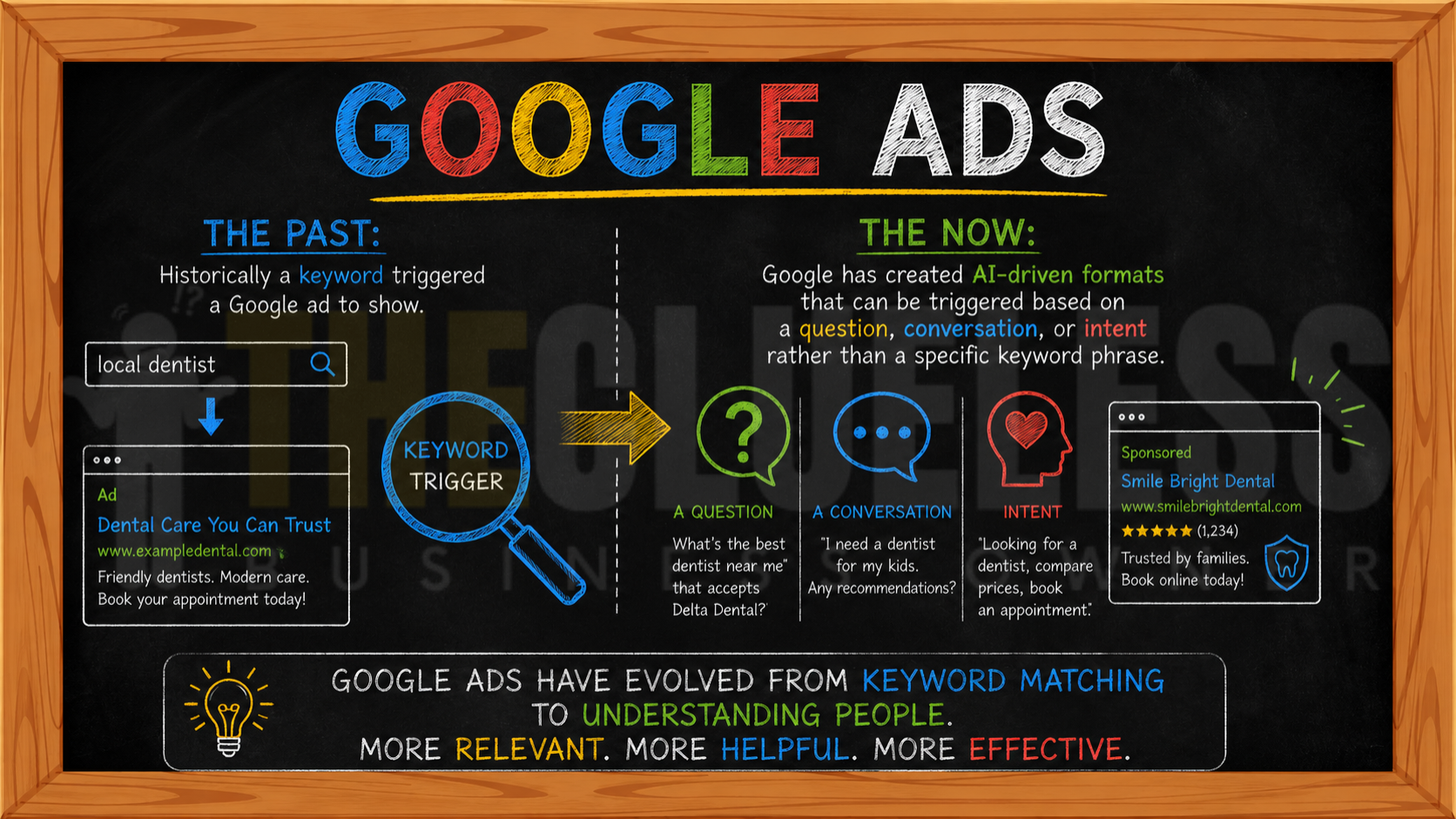
Google Ads - No, Google Search Ads Aren't Going Away
If you've heard people say that AI is replacing traditional Google Search Ads or that Google is forcing everyone to use AI-generated advertising, you can relax.
That's simply not true.
Google Search Ads are still one of the most effective ways for service businesses to generate qualified leads and appear in the Call Pool. They are not going away anytime soon.
Why?
Because advertising is Google's primary source of revenue. While Google continues to invest heavily in AI, it also continues to invest heavily in its advertising platform. AI isn't replacing Google Ads—it's being integrated into them.
What has changed is that Google is increasingly offering AI-powered tools to help advertisers create ads, write headlines, suggest keywords, optimize campaigns, and improve performance.
Those tools can be incredibly helpful.
But they are tools—not requirements.
You still have significant control over your campaigns.
You can choose your keywords (depending on the campaign type), write your own ad copy, control your budget, and decide how much of Google's AI assistance you want to use.
AI is becoming an increasingly important assistant inside Google Ads.
It hasn't replaced Google Ads.
If your goal is to appear in the Call Pool, Google Search Ads remain one of the fastest ways to put your business in front of people who are actively searching for the services you offer.
Think of it this way:
- Google Search Ads help you BUY visibility.
- SEO, your website, your Google Business Profile, reviews, and helpful content help you EARN visibility.
The strongest businesses understand that both strategies have a place.
AI may continue to change how campaigns are managed over time, but it hasn't changed the fundamental purpose of Google Search Ads: connecting businesses with customers who are actively searching for the products and services they need.
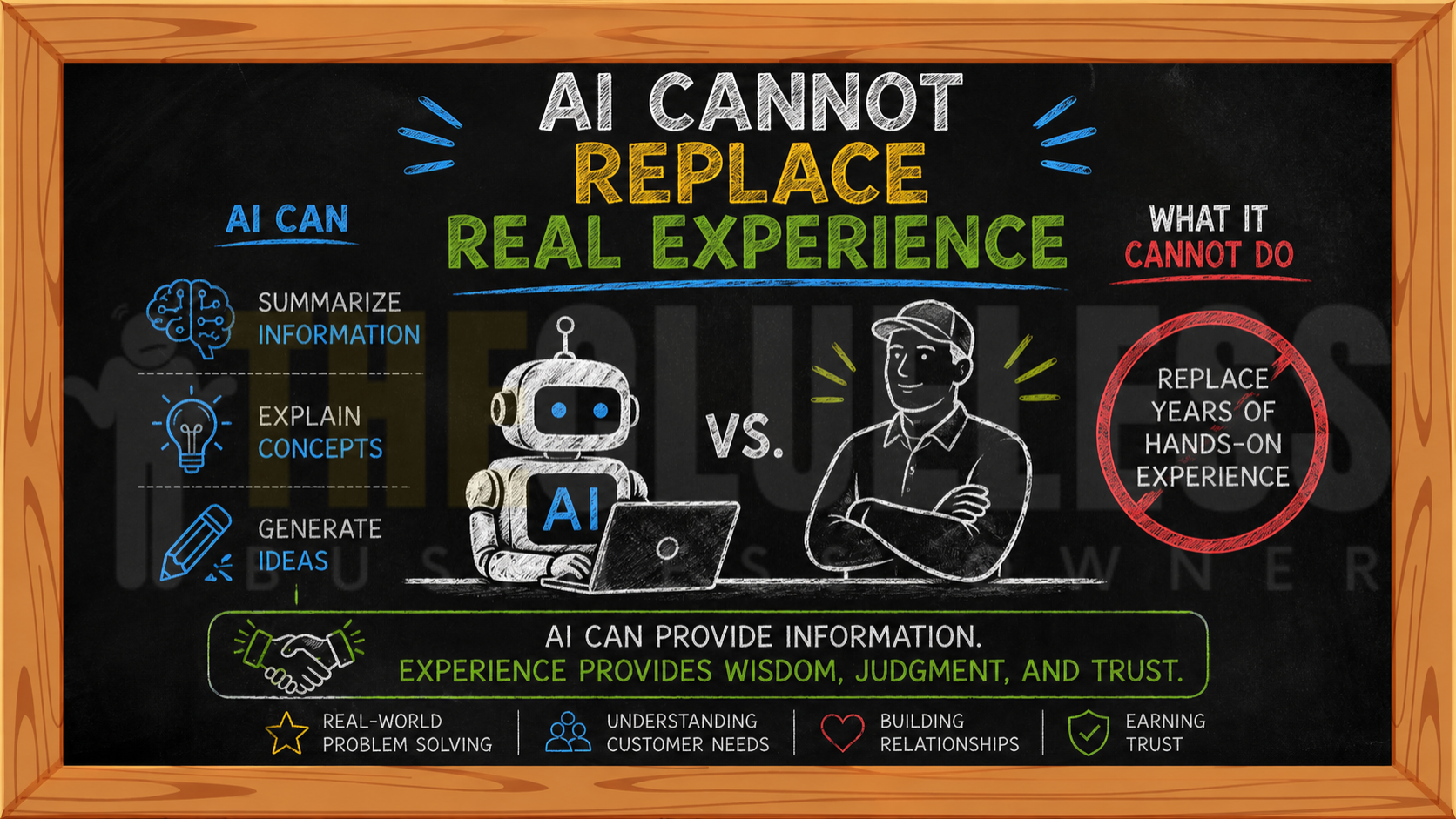
What AI STILL Can't Do
With all the media hype surrounding artificial intelligence, it's easy to start believing this technology can do absolutely everything.
It can't.
AI is an incredibly powerful assistant, but it also has significant limitations. If you rely on it blindly, it can damage your credibility, confuse your customers, and hurt your reputation.
Here are the hard boundaries of what AI still cannot do for your business.
AI Cannot Replace Real-World Experience
AI can summarize information, explain concepts, and brainstorm creative ideas. What it cannot do is replace years of muddy, hands-on experience serving actual customers.
A plumber who has physically repaired thousands of water heaters knows things that an algorithm simply cannot comprehend.
A contractor who has worked with homeowners for twenty years understands nuanced local situations that no software can replicate.
Your real-world experience is still your highest-value business asset.
Take my own workflow as an example.
I frequently use ChatGPT to help me with Facebook ads. It's fantastic at brainstorming ideas, organizing campaigns, drafting ad copy, and even helping me think through different approaches.
But here's what it can't do.
It can't replace judgment.
It hasn't managed hundreds of advertising campaigns. It hasn't watched thousands of dollars succeed—or fail—in the real world.
Experience teaches lessons that no language model can truly possess. The same principle applies to your website.
AI Can't Build an AI-Ready Website
Today, AI can build a professional-looking website in minutes. It can generate service pages, write basic copy, organize navigation, and even suggest SEO improvements.
But an AI-built website is not automatically an AI-ready website. AI doesn't know what makes your company different.
It only knows what you tell it—and if you don't tell it, it has to guess.
It doesn't know the questions your customers ask every day. It doesn't know which services are the most profitable, why customers choose you over a competitor, or the years of experience you've gained solving real problems.
A website becomes valuable because it reflects your expertise, your reputation, and your experience—not simply because it was created with artificial intelligence.
Think of AI as the builder, not the architect.
AI can help construct the house, but only you can provide the blueprint.
AI Cannot Build Trust for You
AI can help you write a nice paragraph, but it cannot earn a customer's trust.
Genuine trust only comes from:
- Real, unedited customer reviews
- Authentic video testimonials
- World-class customer service
- Consistent, honest communication
- Delivering exactly what you promise
Trust isn't generated by software. It's earned one customer at a time.
AI can help you communicate your value, but your business still has to roll up its sleeves and create that value in the real world.
AI Cannot Guarantee Accuracy
AI makes mistakes. (A lot of mistakes!!!)
It hallucinates, gets facts wrong, and sometimes attaches incorrect information to real businesses and real people.
I have experienced this firsthand.
Not long ago, I looked up my husband's business in Google's AI Overview just out of curiosity. He has been in business for over fifteen years and has nothing but 5-star reviews.
The AI Overview incorrectly attached unrelated website links to his business and falsely stated that his company was "often accused of doing shoddy work."
I was absolutely mortified!
After clicking the links, I realized they pointed to an entirely different business. I reported the mistake through Google Gemini, and it was corrected.
The experience reminded me of something important.
AI can misunderstand context or confidently present incorrect information.
That's exactly why you should always review, verify, and double-check any AI-generated information before publishing it or acting on it.
AI Cannot Replace Human Relationships
When a homeowner's house is flooding or their air conditioner stops working in the middle of summer, they're stressed, frustrated, and often overwhelmed.
They don't want to connect with a sterile algorithm.
They want to talk to someone they trust.
AI can answer common questions, but it cannot provide genuine empathy, human connection, or real relationships.
Local business has always been built on people serving people.
That hasn't changed.
As a matter of fact, in the future I believe one of the largest weapons a business can have against their competition is going to be a real human answering the phone.
AI Cannot Fix a Broken Business
AI can improve efficiency, but it is not a magic eraser for structural problems.
It cannot fix:
- Poor customer service
- A string of bad reviews
- Slow dispatch and response times
- Weak back-office operations
- A lack of technical expertise
Technology amplifies what's already there.
If your processes are excellent, AI can help you move faster.
If your processes are broken, AI simply helps you make mistakes faster.
AI Cannot Create Something from Nothing
One of the biggest misconceptions today is that AI can magically make an invisible business appear online.
It can't.
AI needs information to work with.
It draws from the digital footprint your business has already created.
If your website contains only a few generic service pages, your Google Business Profile is incomplete, your review count is low, and your online presence lacks depth, AI has very little evidence that your business is an authority worth recommending.
This is why relying solely on an AI website builder is a mistake.
AI can create pages.
- It cannot create years of customer trust.
- It cannot create genuine expertise.
- It cannot create positive reviews.
- It cannot create a strong local reputation.
- It cannot create the experience that separates your business from every other company in your market.
If you want AI to recommend your business, you must first give it something worth recommending.
AI doesn't invent your reputation.
It reflects the reputation you've already earned.
AI doesn't create authority.
It recognizes authority that already exists.
AI doesn't manufacture trust.
It discovers the trust you've built over time.
Artificial intelligence is an amplifier.
It can recognize patterns, summarize information, and connect people with trustworthy businesses—but it cannot manufacture credibility that doesn't already exist.
If you've built a trustworthy business with helpful content, satisfied customers, genuine expertise, and a strong online presence, AI can help more people discover you.
If those things don't exist, no amount of artificial intelligence can manufacture them for you.
The Bottom Line
Treat AI as a powerful assistant—not a replacement for your own knowledge and judgment.
The businesses that will benefit the most from the AI revolution are not the ones that hand the keys over to a machine.
They're the businesses that combine AI's efficiency with human experience, sound judgment, and real-world expertise.
Use AI as your tool.
Use your experience as the guide.
AI will continue to evolve.
New tools will emerge.
New platforms will appear.
New headlines will claim that everything has changed.
But one thing hasn't changed.
People still want to do business with companies they trust.
Use AI to become more efficient.
Never let it replace the experience, judgment, integrity, and relationships that made your business successful in the first place.
Because at the end of the day...
People don't hire artificial intelligence.
They hire people they trust.
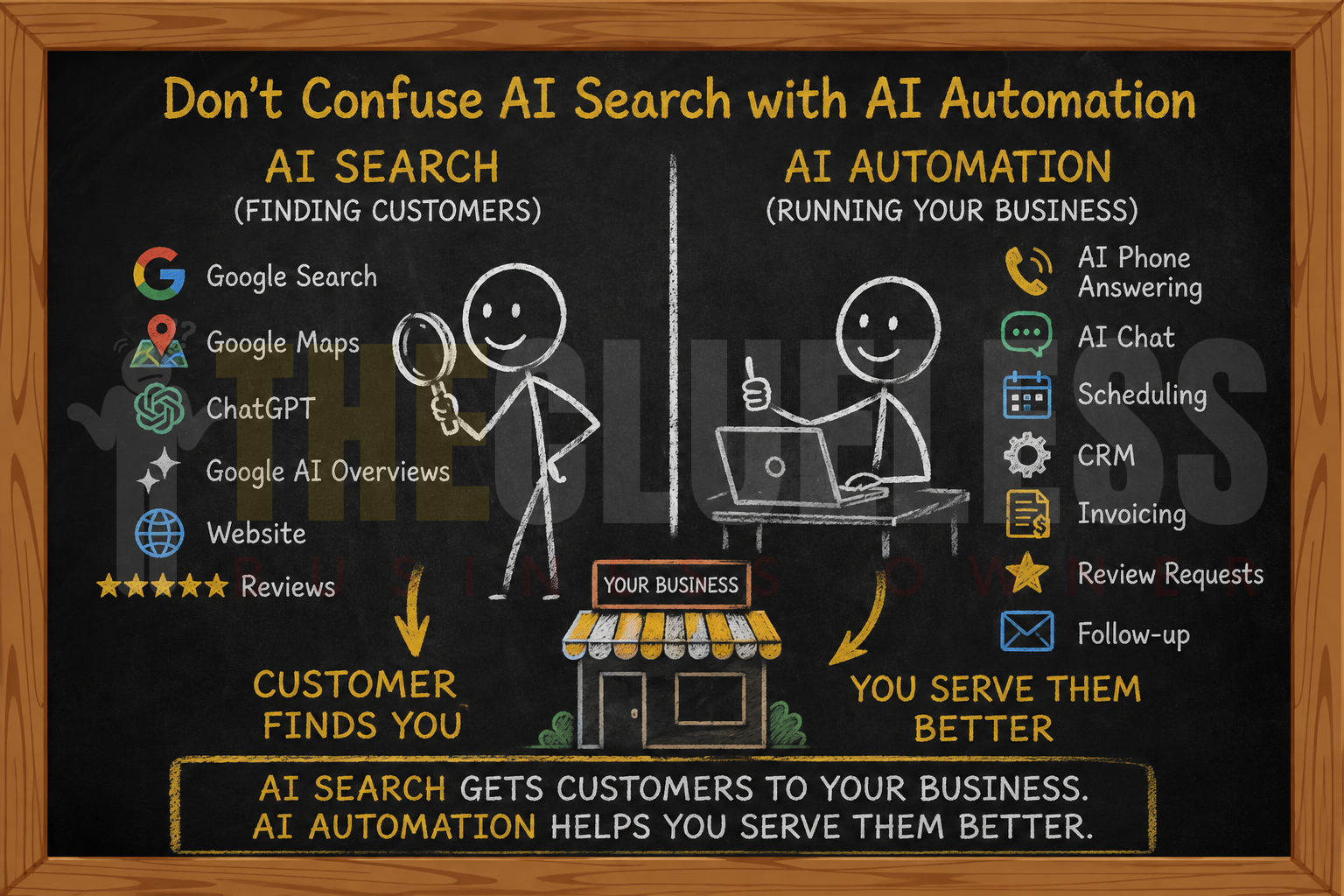
Don't Confuse AI Search with AI Automation
One of the biggest misconceptions surrounding artificial intelligence today is that using AI software automatically makes your business more visible online.
It doesn't.
There is an important difference between AI search and AI automation.
AI search is how customers discover your business. This includes platforms like ChatGPT, Google AI Overviews, Google Search, Google Maps, and other AI-powered search experiences that recommend businesses based on the information they find across the web.
AI automation is what happens after a customer finds you.
Today's software can use AI to answer your phone 24/7, schedule appointments, send invoices, request Google reviews, respond to customer messages, follow up with leads, dispatch technicians, and even help write marketing emails.
These are fantastic tools that can save time, improve customer service, and help you convert more of the leads you already receive.
But don't confuse those operational improvements with increased online visibility.
Installing an AI receptionist will not suddenly cause ChatGPT to recommend your business.
Using AI to automate review responses will not automatically move you to the top of Google.
Adding an AI chatbot to your website will not, by itself, improve your rankings in AI search.
Those tools make your business run more efficiently. They do not replace the work required to become a business that AI trusts enough to recommend.
If you want your business to appear in AI search results, you still need to build the digital signals that AI relies on.
That means:
- A trustworthy, well-organized website.
- Helpful, original content that answers real customer questions.
- A complete and active Google Business Profile.
- Genuine customer reviews.
- Consistent business information across the web.
- Mentions from reputable websites and local organizations.
- Clear evidence of your experience and expertise.
Think of it this way:
AI Search helps people find your business.
AI Automation helps your business serve those people more efficiently.
The most successful companies understand that these two work together. First, you earn the visibility. Then, you use AI to maximize every opportunity that visibility creates.
Don't fall into the trap of believing AI automation will replace the fundamentals of marketing.
AI can help you answer the phone faster. It can help you respond to customers more quickly.
It can help you generate more reviews.
But before any of that matters, customers still have to find you.
And becoming the business that AI confidently recommends still requires the same things it always has: expertise, trust, authority, and a strong digital presence.
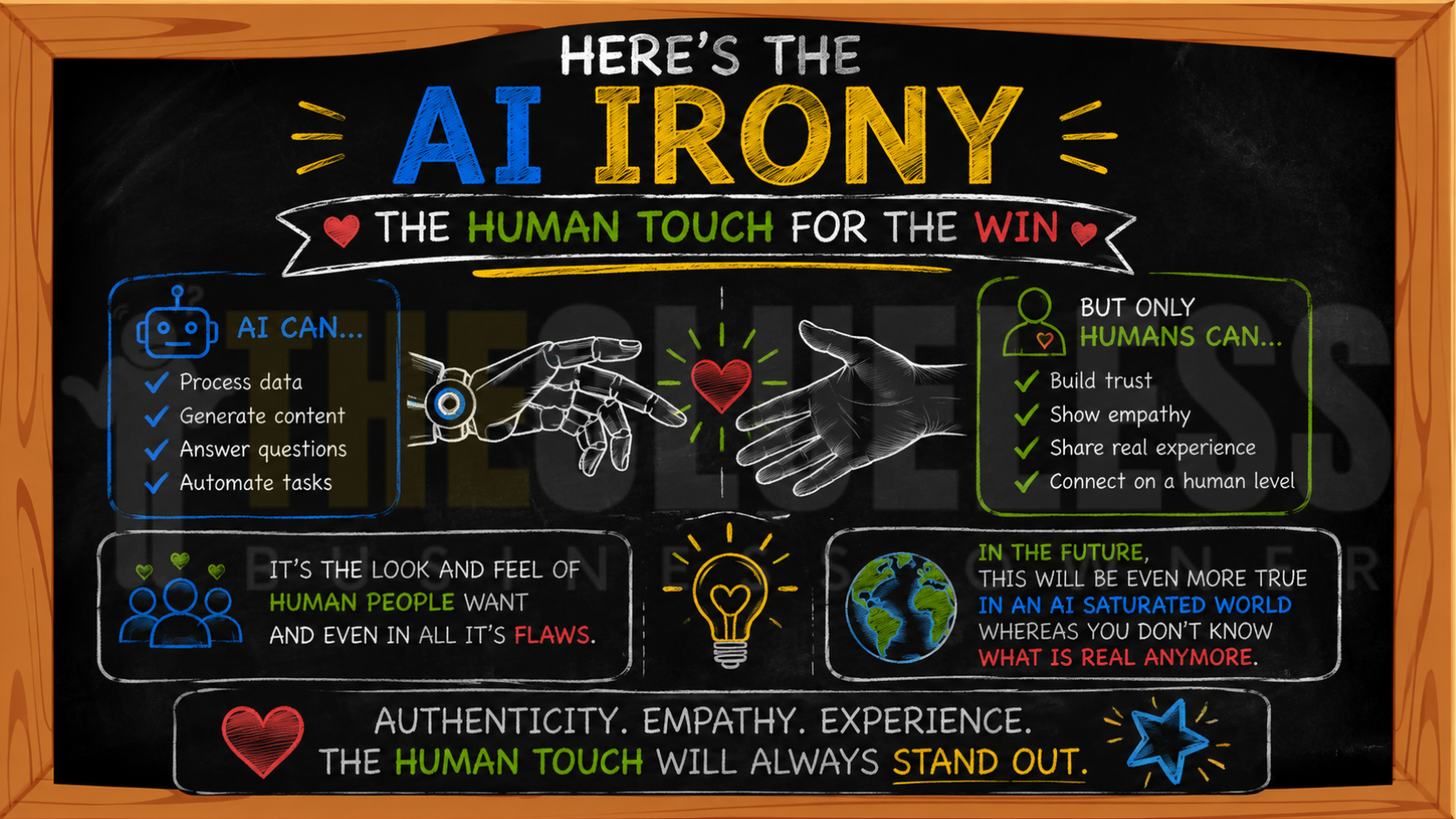
The Ultimate AI Irony: The Human Touch Wins
At the end of the day, it’s the raw look and feel of a real human being that people actually want—even with all of our natural flaws.
In the future, this is going to be even more true. As the internet becomes completely saturated with AI, consumers will reach a point where they don’t know what is real anymore.
When that happens,
authenticity becomes your highest-value currency.
There is tons of data to support the fact that raw, unpolished images and smartphone videos heavily outperform stock photos or highly designed agency advertisements.
I manage Facebook ads for several retail clients, and I can tell you right now: I can design the most beautiful, polished ad in the world using flawless product stock images, and a raw, poorly edited smartphone photo of a real product will out-perform it every single time.
It’s crazy, but it’s true.
People connect far more with real, authentic everyday visuals than with generic stock photography.
Most consumers can instantly recognize a staged, fake, or overused stock photo from a mile away, and they subconsciously scroll right past them.
Humans are hardwired to crave a human experience. That will never change.
Showcasing your actual team, your messy workspace, your real trucks, and your actual local customers creates instant credibility.
It builds real-world trust and gives your brand a relatable feel that completely separates you from the automated competition.
The "Unfakeable" Checklist
As AI floods the internet with millions of pages of cheap, generic content, the local businesses that stand out will be the ones that lean heavily into their humanity.
To win the game, you must:
- Show your real personality
- Show your natural flaws and raw operations
- Show vulnerability and tell your authentic story
- Demonstrate real-world, hands-on trade expertise
- Collect authentic reviews from real, local customers
- Use genuine, unedited smartphone photos and videos
- Show the real human beings standing behind the business
Ironically, the AI revolution is actually going to increase the financial value of humanity online. The deep human connection is what will give small businesses a massive competitive edge.
Say goodbye to generic blog content written by an outsourced writer who lives in a different country and is totally out of touch with your trade! Say goodbye to fake stock images!
Local customers want to see something REAL, now more than ever before.

Your AI Readiness To-Do List
At this point, you are probably thinking: “Okay... so what do I actually DO with all of this information?”
The good news is that preparing for this digital transformation is not as complicated as the tech gurus make it sound. You do not need to become an AI engineer, a software programmer, a technology wizard, or even a corporate marketing strategist to protect your business.
You don’t even need a marketing agency—as long as you are willing to roll up your sleeves and do the work yourself.
Now, if you can easily afford an agency or a marketing professional to handle this for you, great! But if you can't, I promise you this is not rocket science.
It will require real work and consistent effort on your part, but the payoff is massive: more local visibility, more opportunities, a steady stream of leads, and a dominant position inside the Call Pool.
In fact, local marketing has never been less complicated. At its core, winning the AI game is simply about building a helpful informational resource on the internet centered around the exact way your customers search for your services.
Foundations Never Fail
Don't get me wrong: it isn't complicated, but it is work.
Most of what helps a local business succeed in the AI era are the exact same foundational things that have always built strong companies online:
- Unshakeable trust
- Dominant visibility
- Crystal clarity
- Obsessive consistency
- A rock-solid reputation
- Helpful, problem-solving information
The businesses that become the most visible tomorrow will not necessarily be the ones with the largest budgets.
They will simply be the businesses willing to adapt, stand in the spotlight, and evolve alongside changing consumer behaviors.
Below is your ultimate checklist to help your business adapt and gain an unfair edge in the AI information age.
These are the exact, practical strategies I have personally tested in my own marketing practice to make my clients highly visible in both traditional and AI-powered search.
1) Research
Deep-Dive Customer Research
Get out your notebook. It's time to do some real market research and take a lot of notes.
Start by brain-dumping a list of every single question you know your potential and existing customers ask you.
- What are their common daily concerns?
- What specific objections do they have before pulling out a credit card?
- What questions do they ask your team over the phone?
If you have employees out in the field, pull them into a room and get their feedback too. Your service technicians and dispatchers are on the frontlines every single day—they will think of common customer pain points, worries, and questions that you might completely overlook.
Once you have built your initial baseline list, it’s time to expand it using a powerful, free online research weapon.
The Secret Weapon: AlsoAsked
To get inside the mind of your local buyers, use a free online research tool called AlsoAsked.
Open up the tool and enter your primary service keyword—like “water heater replacement” or “AC repair.”
Instead of showing you a confusing spreadsheet of robotic keywords, this tool automatically generates a live, visual map of the exact questions real people are typing into Google.
It shows you exactly how one question naturally leads to the next in a normal human conversation.
This visual data is an absolute goldmine for your business. It tells you exactly what content you need to create to capture local attention.
You can use these questions to build:
- High-converting local blog topics
- Detailed FAQ sections on your main pages
- Problem-solving videos for YouTube
- Authentic, helpful social media posts
At the time of writing, you can use the basic version of this tool completely for free up to three times every 24 hours. Use it to audit your market, see exactly what your customers are struggling with, and start building your informational arsenal
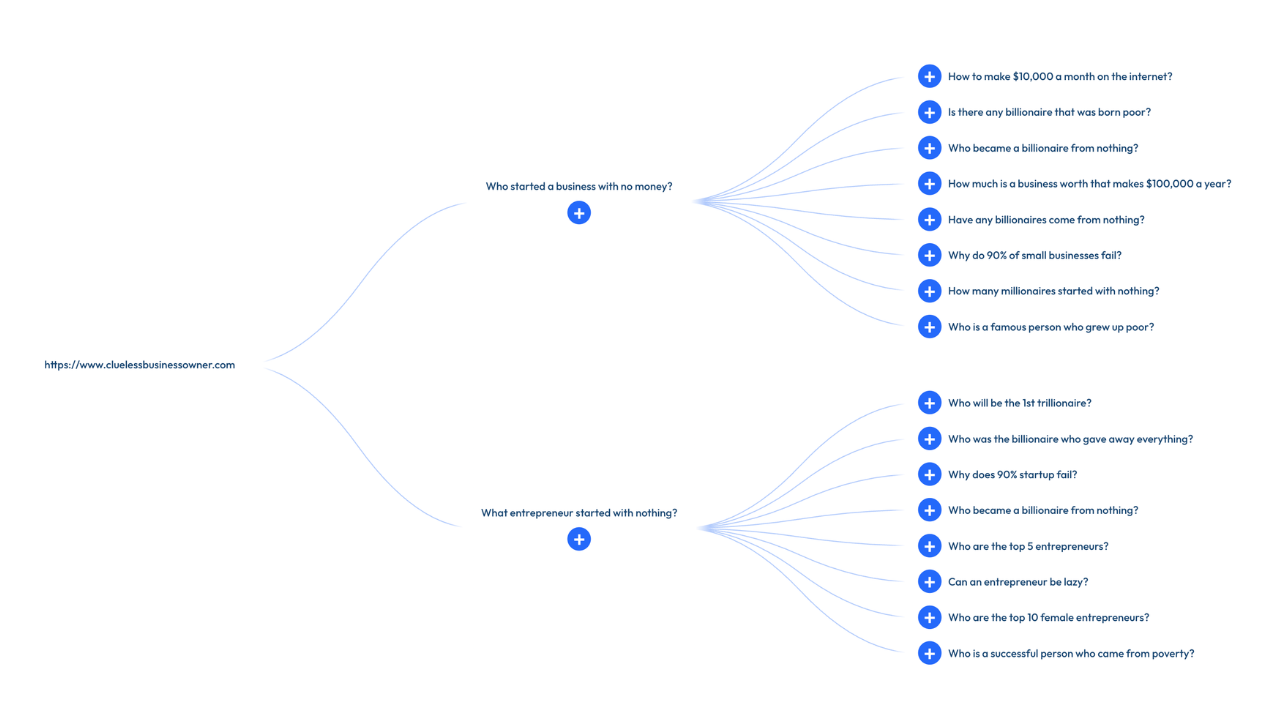
Use these ideas to come up with some great search-worthy content.
Also, a completely free tool to use is Google.
Type in a common keyword for what people use when they search for your products and services and you will see this area:
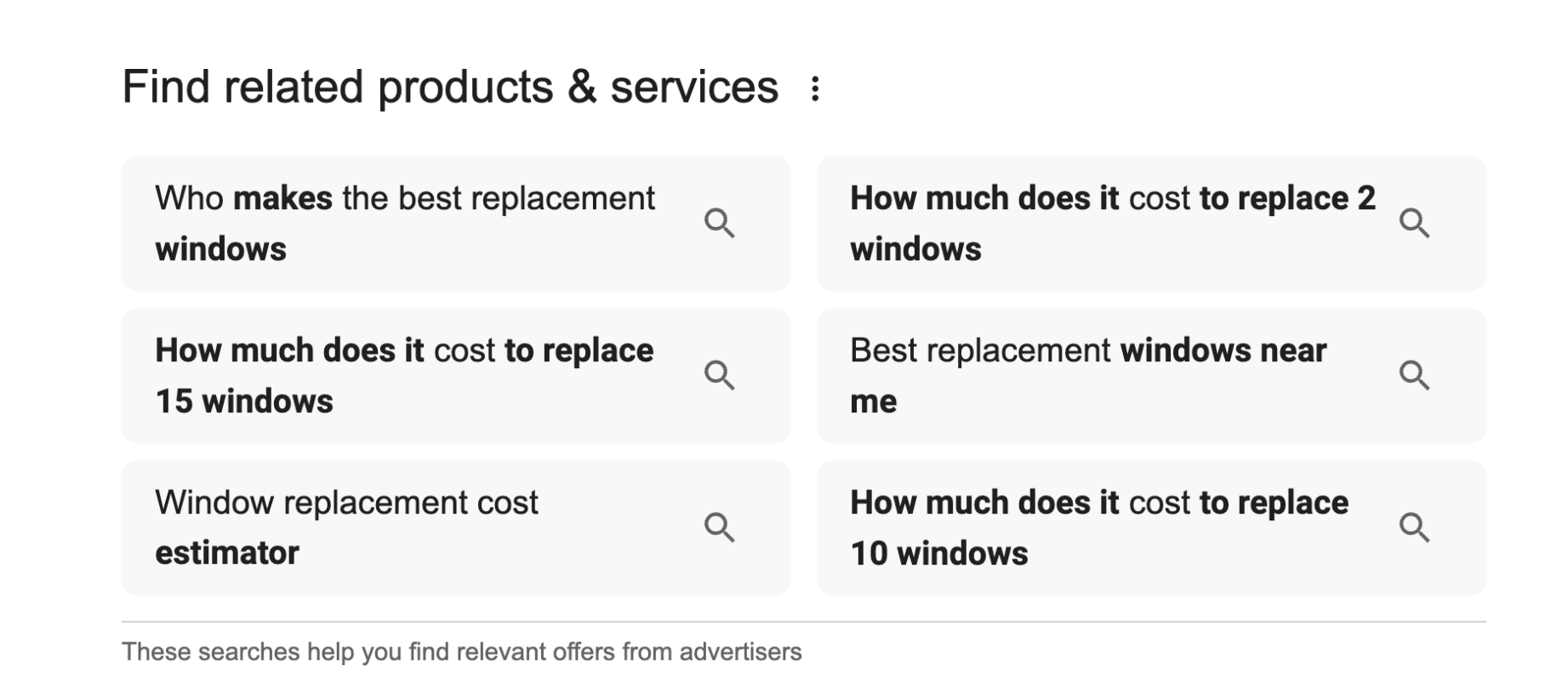
And also look for sections like this one below.
These are the questions people ask and if your website answers the questions people ask, AI will use your content to answer searcher questions.
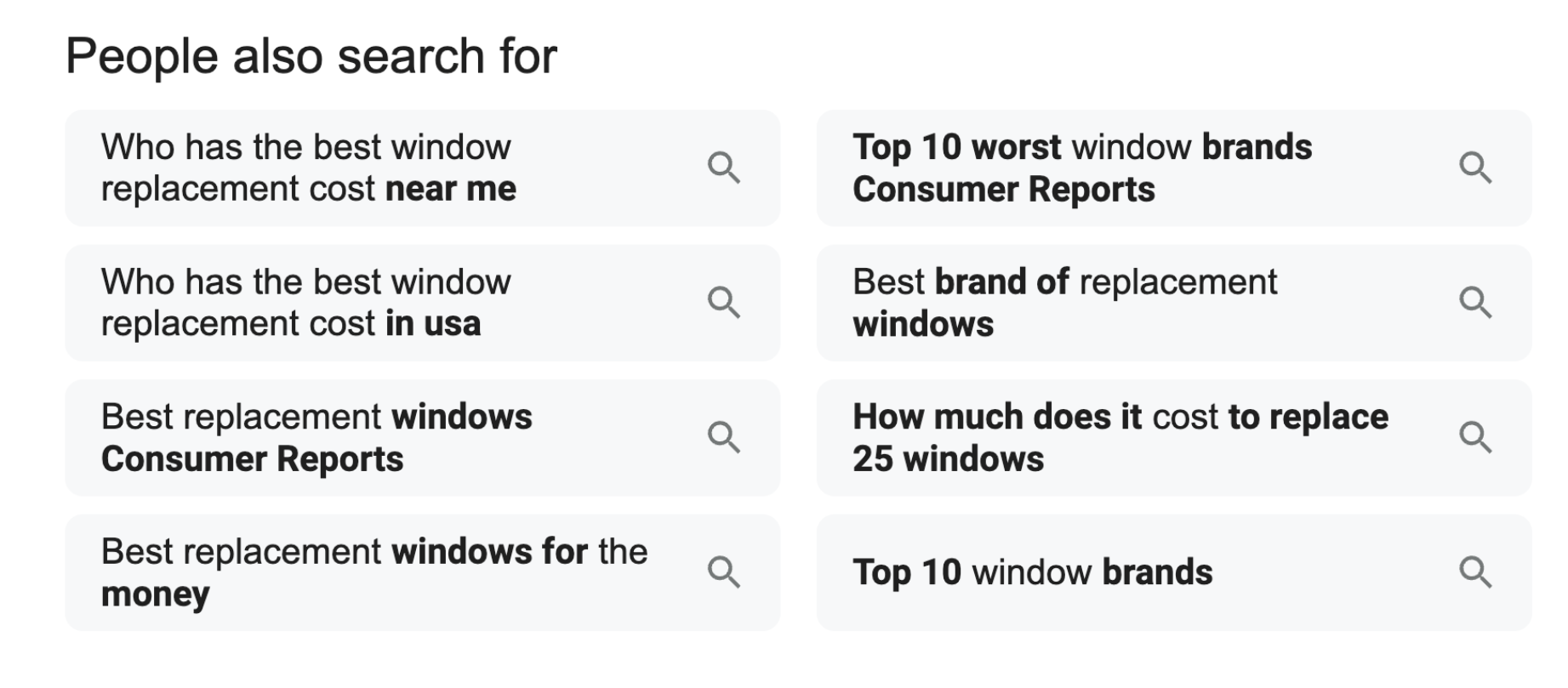
So now that you know what people search for and what questions they ask, what to do with this information? This is information you will use to enrich your entire website. Create blog posts and Q & A's using these ideas and also incorporate these ideas into your services pages.
Your website has to mirror what people search for and the language they use.
2) Check Your Ranking
Check Your Real Local Ranking
Before you touch a single page on your website, you must understand exactly how much visibility your business actually has right now.
Take out your phone or computer, open a private or Incognito window in your browser, and begin searching for your services.
(Note: Using Incognito Mode is mandatory here. It strips away your personal search history and gives you an honest, objective view of what a brand-new local customer actually sees.)
Run the exact types of searches a desperate homeowner would use.
Try multiple generic keywords, service phrases, and urgent questions.
As you look at the screen, ask yourself:
- Where are you inside the Call Pool? Does your company name even populate on the screen?
- Do you appear inside any AI Overviews at the very top of the scroll?
- Are you dominating the Google Business Profile map section?
- Are your local competitors showing up way more often than you are?
Take detailed notes for every single search where your business actually makes the cut.
Audit The Competition
Next, turn into a detective and look closely at the businesses that are currently beating you.
- Which specific companies appear most frequently inside the Call Pool?
- Who is being cited and recommended inside the AI Overview boxes?
- Which competitors are locked into the top of the map listings?
Create a physical list of the top two or three companies that seem to completely dominate your local search results.
This simple exercise will show you exactly who currently owns the digital real estate in your market. It gives you a realistic benchmark to measure your progress against as you start executing the rest of this checklist.
3) Reputation Check
Conduct an AI Reputation Check
Remember the nightmare scenario I shared earlier about the AI completely crossing its wires and falsely claiming my husband's business did shoddy work?
That scare was a HUGE lesson for me. It proved to me that AI doesn't just make mistakes—it can actively damage a pristine reputation if nobody is watching the screen.
As a result we run a mandatory AI reputation audit for every single one of our clients once per month. You need to put a recurring note on your calendar and do the exact same thing.
Once a month, open up an incognito window and run these specific searches:
- Search your company name directly to see exactly what the AI text says about you.
- Search your major services (e.g., “drain cleaning,” “roof leak repair”).
- Search your city + your service (e.g., “electrician Birmingham”).
- Search your top competitors' names to see how the AI describes them.
Take a close look at the AI Overviews for every single one of those results. Note exactly who appears, what links are being cited, and what kind of feedback is being broadcast to the public.
If you see an error, an incorrect link, or a false statement, use the chat box or feedback buttons to correct it immediately. Protecting the name you spent years building is no longer a set-it-and-forget-it job.
Monitor your footprint regularly.
4) Your Website
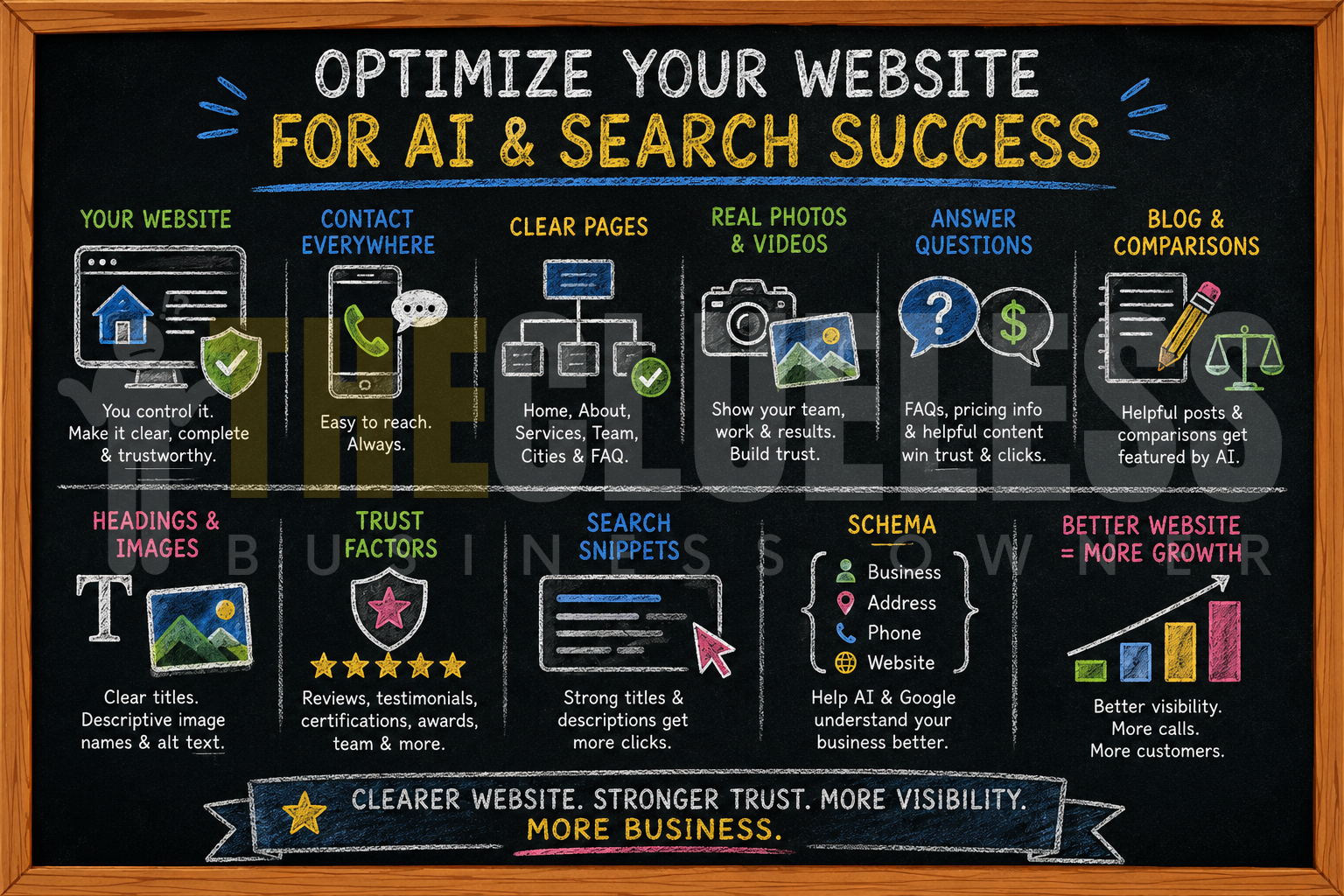
The AI-Friendly Website Checklist
1) Contact Information & Callouts
Every single page on your site must make it incredibly easy for a panicked customer to reach you.
- Place clear, click-to-call phone numbers at the top of every screen.
- Embed fast contact forms and clear, actionable "Get a Quote" buttons throughout your pages so visitors can take action immediately.
2) The Homepage Roadmap
Your homepage should function like a visual directory to your entire business operation.
It must:
- Link directly to all of your major individual service pages.
- Proudly display real customer reviews, ratings, and testimonials.
- Clearly explain exactly what you do and what geographic areas you serve.
- Highlight the specific things that make your business different from your competitors.
3) A Trustworthy "About" Page
Stop writing vague, generic summaries. Your About page needs to be a strong, informative document that builds immediate trust.
Explicitly state who you are, the history of your company, the exact communities you serve, the common problems you solve, and why a local family should choose you over anyone else.
4) Real Team & Employee Pages
If you have a crew, consider creating a page that introduces your key technicians, managers, and dispatchers.
AI search engines love verifying the actual humans behind a company logo, and local customers feel significantly more comfortable booking a service call when they can see the real faces of the people walking into their homes. Never lose that human touch.
5) Isolated, Detailed Service Pages
Far too often, I see local contractors place all of their services onto a single, lazy page. They list “Drain Cleaning, Water Heaters, Leak Repair” in one big paragraph.
This completely destroys your visibility.
AI models and search engines cannot index a single paragraph effectively. Every major service you offer needs its own dedicated webpage written in extreme detail.
Explain the process, list the equipment you use, and answer common client questions about that specific job.
6) Centralized and On-Page FAQ Content
I highly recommend building a dedicated, localized FAQ section directly onto the bottom of every individual service page. In addition to those, create a massive, centralized Frequently Asked Questions master page for your overall business.
- The Formatting Rule: Do not hide your text inside drop-down "accordion" tabs just to make the design look pretty. While search engines can read accordion text if it sits cleanly in the page code, it creates unnecessary roadblocks for AI readability and user experience.
Write the questions and answers out completely in plain, open text: - Q: How much does professional drain cleaning cost?
- A: Standard drain cleaning typically ranges from $150 to $350 depending on...
7) Descriptive, Named Website Images
Whenever possible, throw away your generic stock photos and use real images of your wrapped trucks, branded uniforms, and completed jobs. AI systems are becoming incredibly effective at identifying authentic business imagery and punishing sites that use stolen or generic stock assets.
When you upload your photos,
never leave the file name as a generic smartphone code like
IMG_483920.jpg
.
Rename the files using descriptive, localized text that tells the AI exactly what is inside the photo:
emergency-drain-cleaning-atlanta.jpg
.
Always fill out the backend Alt Text box with a clear description as well.
8) Optimize Your "Sizzle Snips" (Meta Tags)
Your search snippets—your page title and meta description—are the most underutilized marketing opportunities on the internet.
I like to call these your Sizzle Snips. They represent the literal text billboard that potential clients see on a search page before they decide to click your link.
Most business owners completely ignore this text, causing their search listings to look messy, cut off, or missing a call-to-action.
To ensure your entire message is beautifully displayed on mobile phones, stick to these strict guidelines:
- Meta Titles: Must stay under 60 characters long.
- Meta Descriptions: Must stay under approximately
155 to 160 characters long.
When writing your Sizzle Snips, always include your primary service, your city, and a high-converting hook.
If someone is frantically shopping for replacement windows or a broken pipe fix, seeing phrases like “Best Value,” “Competitive Pricing,” or “Call for a Free Estimate Today!” is exactly what forces them to click your link instead of your competitor's.
9) The Trust Factor
Trust is the single most valuable currency in both traditional search and AI visibility. The more proof you scatter across your digital headquarters, the easier it is for local consumers and AI recommendation engines to verify that you are a legitimate, high-quality operation.
Show Tangible Proof Throughout Your Website:
- Recent, unedited customer reviews and video testimonials
- Real-world case studies detailing complex jobs
- Before-and-after photos of your actual field work
- Trade certifications, licensing numbers, and insurance verifications
- Local community awards and your total years in business
- Group photos of your actual team and branded service vans
10) Answer the Taboo Pricing Questions
The absolute number one question every single customer has when they discover your business is: “How much is this going to cost me?”
Most local businesses completely avoid discussing pricing on their websites because they are afraid of scaring people away.
This is a massive mistake.
Modern consumers and AI search engines are actively hunting for pricing clarity. Creating helpful pricing content doesn’t mean you have to give away a rigid, binding estimate online. It simply means you openly educate the buyer on the financial reality of their project.
By addressing costs, you instantly build trust, dismantle customer objections, and make your business highly visible to high-intent searches inside the Call Pool.
Create Dedicated Content Around:
- Average local costs: State realistic baseline price brackets for standard jobs.
- Pricing factors: Explain exactly why prices fluctuate (e.g., pipe material, accessibility, emergency hours).
- Cost ranges: Provide low-end vs. high-end scenarios so the customer knows what to expect.
- Budget considerations: Offer financing details or explain how ignoring a minor fix now can lead to a catastrophic bill later.
11) Create Problem-Solving Blog Content
If your main website pages represent the heart of your local information ecosystem, your blog section acts as the veins.
AI recommendation engines are constantly hunting for deep, trustworthy information to fuel their quick answer boxes. The more useful, educational content you publish around your core services, the more likely the AI is to cite your business at the very top of the scroll.
Stop writing generic news updates. Write detailed articles that explicitly answer common customer questions and combat objections:
- What to Expect During a Full Water Heater Replacement
- How Much Does Professional Drain Clearing Actually Cost?
- 5 Warning Signs Your Home Desperately Needs a New Roof
- Is Hiring a Professional Pest Control Company Worth the Money?
AI Loves Comparison Content
AI search engines are heavily biased toward structured comparison data because humans constantly ask comparison questions.
You can gain a massive edge by writing comparison articles like:
- Tankless vs. Traditional Water Heaters: Which Is Best for a Family of Four?
- DIY Pest Control vs. Professional Service: The Real Cost Breakdown
- Asphalt Shingles vs. Metal Roofing: Longevity and Return on Investment
12) Book-Style Headings (H1 and H2 Tags)
Every individual page on your website must have a single, crystal-clear main title that tells both humans and AI crawlers exactly what the page is about. Think of your page titles like the chapters of a book.
If a page is about drain clearing, make the main title say exactly that: "Drain Cleaning Services." If it’s about water heaters, say "Water Heater Replacement."
Do not try to be artsy or clever with your headings. Clear, blunt headings make your architecture seamless to understand and help search engines confidently connect your pages to the right local searches.
13) The Answer Zone(s)
The Answer Zone is a short, direct answer placed near the top of a webpage, typically just below the title.
I recommend including an Answer Zone on every blog post and every important core or service page on your website.
In roughly 40–80 words, clearly address the page's primary question or search intent before expanding with more detailed information below.
The goal is to make the most important information easy for people, search engines, and AI systems to find and understand.
It doesn't guarantee that your content will be used in an AI-generated answer, but it structures your content in a way that makes the answer clear and easy to extract.
14) Schema Data Markup
Schema is simply behind-the-scenes code embedded in your website that acts like a set of digital name tags for search engines. It labels specific pieces of plain text so algorithms don't have to guess what they mean.
For example, if your website states: “John’s Plumbing Service has proudly served the Atlanta, GA area since 1991.”
The hidden backend Schema code tells the search engine:
- Business Name = John’s Plumbing Service
- Business Type = Plumbing Contractor
- Year Founded = 1991
- Service Location = Atlanta, GA
- Phone Number = xxx-xxx-xxxx
Is Schema Still Critical in the Age of AI?
Years ago, search engines were fairly primitive. They had to work incredibly hard to interpret what a local website was trying to communicate.
Schema markup was mandatory because it forced the information into a rigid format the computer could read.
Today, the landscape is completely different.
AI and modern search engines have developed advanced semantic understanding. They can read your web pages almost exactly like a human being does.
If your website layout is clean, and your text clearly explains who you are, what you do, where you are located, and how a customer can contact you—the AI will easily figure it out on its own.
My Advice on Schema Implementation
I still use schema markup for my marketing clients, but for one simple reason: the web platform I build on makes it incredibly easy to turn on with the click of a button.
It takes almost zero extra effort, so there's no reason to skip it. If implementing it required paying a developer thousands of dollars for custom coding, I would feel differently about it.
If you manage your own site using WordPress, you don't need a tech degree to set this up. You can easily deploy clean schema tags for free using standard SEO plugins like Yoast SEO, Rank Math, or All in One SEO.
5) Google Business Profile
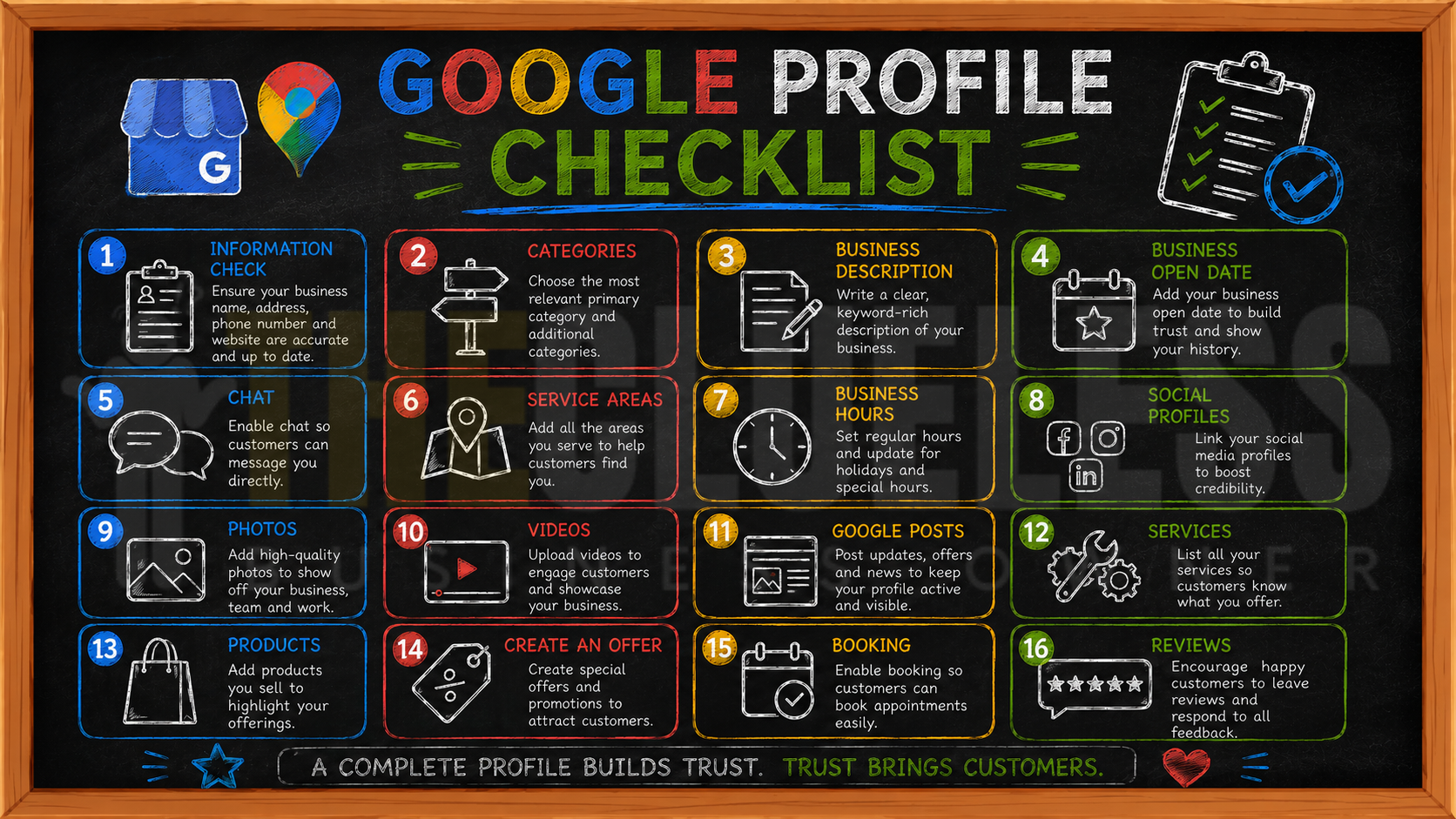
The Ultimate "Beachfront Property": Optimizing Google Business Profile for AI
After your own website, your Google Business Profile (GBP) is the most valuable digital asset your business can have.
In my marketing philosophy, I teach business owners to view the internet as digital real estate. If the web is a map, your GBP is beachfront property.
It sits on some of the most lucrative real estate on the internet, capturing the highest-value clicks within the Call Pool™.
Securing a spot in the "Local 3-Pack" (the top three map listings before someone has to click to see more) fundamentally changes your growth trajectory.
Businesses in these spots generate more calls, website visits, and revenue simply because they are the easiest to find.
Furthermore, modern AI search engines and Large Language Models (LLMs) pull heavily from GBP data to answer geographic queries and summarize recommendations.
Here is your 16-step checklist to ensure your Google Business Profile is fully optimized for both human customers and AI discovery systems.
1) Essential Core Information
- Action:
Verify that your legal business name, address, and phone number (NAP) are 100% accurate and match your website exactly.
- 💡Pro-Tip: AI systems prioritize data consistency. Discrepancies between your GBP, website, and directories create algorithmic friction, lowering your trust score and confusing AI search bots.
2) Primary & Secondary Categories
- Action:
Choose your primary category with precision (it carries the most weight). Add relevant secondary categories if there is one available but it isn't necessary.
- 💡Pro-Tip: Categories act as the foundational semantic tags AI uses to map your business to user intent.
3) Fully-Utilized Business Description
- Action: Use all 750 available characters. Craft a compelling narrative that incorporates your primary services and the natural language phrases people use when searching.
- ⚠️ Warning: Do not keyword stuff. Google strictly prohibits it, and modern AI algorithms easily detect unnatural phrasing, which can result in profile suspension.
4) Opening Date
- Action:
Populate the exact month and year your business opened.
- 💡Pro-Tip: Google uses longevity as a core trust signal. Leaving this blank is a missed opportunity to establish immediate algorithmic authority.
5) Chat & Messaging
- Action:
Turn on the Chat feature only if you have the operational capacity to manage it.
- 💡Pro-Tip:
Because slow response times trigger negative signals, consider connecting your GBP chat to an AI-powered auto-responder or CRM.
When replying, use complete, helpful sentences that naturally mention your specific services.
6) Hyper-Specific Service Areas
- Action:
Don't just list major cities (e.g., "Atlanta"). Drill down into specific neighborhoods, suburbs, and districts (e.g., "Buckhead, Dunwoody, Sandy Springs").
- 💡Pro-Tip: While proximity dictates real-time results, organize your service list by priority: Headquarters first, major markets second, and surrounding communities last.
7) Synced Business Hours
- Action: Keep your regular hours accurate and meticulously update your holiday or seasonal closures.
- 💡Pro-Tip: Discrepancies between your GBP hours and your website hours trigger red flags for AI engines trying to provide accurate "open now" answers to users.
8) Connected Social Profiles
- Action:
Link your active social media channels (Facebook, Instagram, LinkedIn) directly to your profile dashboard.
- 💡Pro-Tip: Google displays social media content carousels directly on your profile. Connecting them helps AI engines draw connections between your diverse brand assets across the web.
9) Vision-Optimized Photos
- Action: Regularly upload real photos of your team, office, fleet, and completed projects. Avoid stock photography entirely.
- 💡Pro-Tip: You cannot manually add "alt text" to photos on GBP. Instead, give your image files descriptive names before uploading (e.g.,
commercial-roofing-repair-atlanta.jpg).
Google uses advanced Cloud Vision AI to automatically "read" and object-recognize what is inside your images, matching real visual proof to user searches.
10) Google Posts
- Action: Treat Google Posts like a mini-blog. Share updates, promotions, events, and educational content regularly.
- 💡Pro-Tip: While posts don't directly boost traditional map coordinates, they increase conversions, maximize your visual real estate, and feed fresh contextual data to search engines looking for active businesses. (It makes your Google Profile look much fancier than your competitors.)
11) Complete Services Menu
- Action:
Populate the Services section with every core and sub-service you offer.
- 💡Pro-Tip: This section acts as a data engine for AI search tools. When a user asks an LLM or AI assistant a specific question about a niche offering, the AI scans this metadata to see if you fit the bill.
12) Authentic Video Content
- Action: Upload short, raw, behind-the-scenes video clips taken on a smartphone.
- 💡Pro-Tip: Algorithms love format diversity, but Google also uses advanced video intelligence models. AI automatically transcribes what is said in a video, recognizes the location, and identifies tools or actions shown. Pro-tip: Speak your services and city clearly out loud while filming so the AI indexes the audio track.
13) The "Product" Hack for Service Businesses
- Action: Don't skip this section just because you don't sell retail items. Use the Products section to visually showcase your core service packages.
- 💡Pro-Tip: This gives you massive, highly visual real estate at the top of your profile that immediately captures user attention while feeding additional structured data to the algorithm.
14) Create An Offer
- Action:
Create seasonal promotions or introductory offers directly within the GBP dashboard.
- 💡Pro-Tip: Offer a specific call-to-action (CTA), giving hesitant searchers an immediate reason to click and contact you. By the way NO ONE uses this great tool so you can bet your competitors aren't. This is just another way for you to stand out in the Call Pool.
15) Bookings
- Action: Link your profile's booking button directly to your website’s scheduling page or contact form.
- 💡Pro Tip: Link this to your contact form on your website.
16) Reviews: The Ultimate Rocket Fuel
- Action: This is the single most critical step. Consistently ask for reviews, and reply to every single one of them.
- 💡Pro Tip: If your profile is a rocket, reviews are the fuel. This is the one area where a nimble local business can outrank a massive corporate competitor.
Here are 2 Ninja Moves:
1. When replying, naturally weave in service names and locations—AI actively reads your review text and responses to determine your business reliability and expertise.
2. Everyone knows that the more reviews you have - the more you stand out in the 3-pack. BUT did you know about velocity? Getting great reviews at a fast pace (maybe getting 5 in one week versus getting 5 in a month) can make your Google Profile outrank a competitor with less reviews!
6) Directory Listings & Forums (Backlinks)
Beyond Your Website: AI Looks Across the Internet to Validate Your Business
AI doesn't rely solely on your website for information. It behaves like a detective, looking across the entire internet for additional sources to confirm who you are, what you do, and whether your business is actually trustworthy.
Directory listings, industry websites, reviews, and online mentions all serve as a
Trust Validation Loop. When an AI engine sees the exact same data points about your company repeated across independent, authoritative sites, its algorithmic confidence in your business skyrockets.
Discussion Forums: The AI Trust Multiplier
Discussion forums like
Reddit and
Quora have become incredibly valuable for AI systems. Because modern search engines lease and scrape data directly from these platforms, AI places massive value on them.
Why? Because they contain real, unvarnished conversations between real humans. If local users on Reddit are recommending your business for a specific service, AI engines index that sentiment and use it to validate your real-world reputation.
The Backlinks and Profiles That Matter Most
It's critical to have a solid foundation of high quality backlinks to digital real estate where AI bots regularly feed.
Prioritize these backlinks:
- Your Google Business Profile (The absolute gold standard)
- Bing Places for Business (Crucial for feeding Microsoft’s Copilot and Bing ecosystem)
- Yelp (Claim your free listing.)
- Your Local Chamber of Commerce (High local trust signal for AI)
- The Better Business Bureau (BBB) (High trust signal for AI unless you have bad reviews)
- Dun & Bradstreet (Verifies your business entity status)
- Industry-Specific Associations (e.g., ACCA for HVAC, NRCA for Roofing)
- Local News Websites (Mentions in local press carry massive algorithmic weight)
- Manufacturer and Supplier Websites (Being listed as an authorized dealer)
- Local Sponsorships & Community Organizations
- Trusted Niche Directories (e.g., Houzz, Nextdoor, Yellow Pages)
7) Social Media Profiles
Social Media Is No Longer Optional: It’s an AI Context Engine
As AI models and search platforms continue to evolve, social media has transformed into something much bigger than just a marketing channel.
It is now a massive dataset that Google and AI systems use to understand your business, verify your real-world activity, and showcase your expertise.
The Google Business Profile Social Carousel
Google automatically pulls recent posts from your connected social media profiles (like Facebook, Instagram, LinkedIn, and YouTube) and displays them in a prominent Social Media Updates carousel right on your Google Business Profile.
Your latest social media post is now competing with your reviews and photos as the very first thing a prospect sees when they look up your business name.
AI Overviews are Quoting Social Media
Google’s AI Overviews are actively pulling direct quotes, perspectives, and first-hand experiences from social media posts and online communities when generating answers for users.
This makes it more important than ever to review your social media presence regularly and keep it active.
What to Post to Feed the AI and Win Customers
You do not need to post constantly. You simply need to post strategically. A consistent stream of helpful, authentic content is far more valuable to an AI engine than a high volume of generic filler posts.
Focus your limited time on creating these types of posts:
- Real Proof: Share posts featuring your team members, real office or field work, completed projects, and customer success stories.
- Ditch the Stock Images: Whenever possible, use authentic smartphone photos rather than stock photography. Real visual content builds human trust instantly and provides distinct data points that AI vision models use to verify your business.
- Answer the FAQ: Create posts that answer the exact questions your customers ask most often. Explain common industry problems, highlight your core services, and share practical tips.
By building a social feed rooted in real-world answers and authentic visuals, you feed the AI exactly what it needs to trust you, while showing human searchers that your business is active, reliable, and open for business.
08) NAP
NAP Consistency: Building Your Digital "Entity" for AI Trust
NAP stands for Name, Address, and Phone Number. One of the absolute simplest ways to help search engines and AI systems trust your business is to make sure this core information is 100% identical everywhere it appears online.
Your business name, address, phone number, website URL, and hours should match exactly across your website, Google Business Profile, social media accounts, directory listings, and business databases.
The Technical Truth: AI "Entity Resolution"
When human searchers find conflicting business data, it creates annoyance. When AI systems find conflicting information, it creates algorithmic distrust.
Modern AI platforms use a process called Entity Resolution. They scan the web to see if your business is a real, legitimate entity. When the exact same NAP data appears consistently across multiple trusted sources, the AI successfully maps everything to a single profile, validating that your business is legitimate and trustworthy.
However, if your website says
"Jack's Electrical Repair" but the Better Business Bureau lists you as "Jack's Electrical," that minor conflict creates an algorithmic split. Old phone numbers, outdated street abbreviations, and mismatched website URLs (like
http
vs
https
) tell the AI that your data is unreliable.
The bottom line is simple: when your information conflicts, AI systems lose confidence in your business and are far less likely to display it in conversational search results or AI Overviews.
Your NAP Optimization Checklist
Meticulously audit the following data points:
- Business Name: Match your legal or registered DBA name exactly (no variations).
- Physical Address: Ensure suite numbers, street spellings, and zip codes match perfectly.
- Phone Number: Use your primary local business line consistently.
- Hours of Operation: Sync your regular and seasonal availability.
- Website URL: Use the exact same formatting (e.g., watch out for
www.vs non-www.).
Make Sure It Matches Across These Pillars:
- Google Business Profile & Bing Places
- Your Website Header/Footer
- Facebook & LinkedIn Company Pages
- Industry-Specific Directories (e.g., Houzz, Nextdoor)
- Local Chamber of Commerce Listings
- The Better Business Bureau (BBB) & Dun & Bradstreet
09) Video Content
Video Content: Feeding the Multimodal AI Engine
Video content has become one of the most powerful ways to help customers, search engines, and AI systems understand your business. A single video can showcase your real-world expertise, explain complex services, and demonstrate your quality of work in ways that flat text and photos simply cannot duplicate.
The AI Shift: Multimodal Video Intelligence
Many business owners assume search engines only index the text written in the video's title and description. That is ancient history.
Modern search engines use Multimodal AI. This means AI algorithms can "watch" the frames of your video to recognize objects or actions, "read" any text overlays or slides on screen, and "listen" to the audio track.
The AI automatically transcribes your spoken words, analyzes your vocal tone, and indexes the entire video for search.
Why Simple Smartphone Content Wins the AI Era
The absolute best news for busy business owners is that your videos do not need to be fancy. You do not need expensive equipment or professional production.
In fact, raw, authentic smartphone videos recorded right from the field or office are often more effective. They build immediate trust with human viewers who are tired of polished, corporate-feeling marketing.
Your AI Video Content Framework
Think of video as an open opportunity to teach both AI and potential customers exactly what your business does.
Create short, simple videos answering:
- Frequently Asked Questions: Address the top 5 questions your sales team fields every week.
- Common Misconceptions: Debunk industry myths or mistakes customers make when buying your service.
- Detailed Service Explanations: Walk through exactly what happens during a standard service call.
- Pricing Questions: Be transparent about how costs are calculated in your industry. (This builds massive trust and ranks incredibly well).
Pro-Tip for the Mic: Because AI listens to and indexes your audio track, make sure to clearly say your primary services and your city out loud while filming (e.g., "We're out here in Dunwoody today replacing a tankless water heater...").
Where to Distribute Your Video Assets
Once you record a short video on your phone, maximize its digital real estate by uploading it to these four core pillars:
- YouTube: The world’s second-largest search engine and a direct feeder into main Google search results.
- Your Website: Embed the YouTube video directly onto your 6 foundational pages to skyrocket visitor dwell time.
- Google Business Profile: Upload short clips directly to your photos/videos dashboard to catch local map searchers.
- Social Media Profiles: Share them on Facebook, Instagram, or LinkedIn to keep your active social carousels fresh.
The Golden Rule: Simple and helpful always beats polished and complicated.
A 90-second smartphone video that genuinely answers a customer's question provides infinitely more value than a $5,000 corporate video that says nothing at all.
10) Become the Source
Wrap Up: Securing Your Digital Beachfront Property
Optimizing your business for the AI era doesn't require a computer science degree or an endless marketing budget. It requires clarity, consistency, and authenticity.
By ensuring your NAP information is consistent, treating your social media as an active asset, feeding the algorithm with simple smartphone videos, and locking down your Google Business Profile, you are doing something 95% of your competitors are completely ignoring.
You are staking your claim on the most valuable digital real estate on the internet.
Stepping Into the Call Pool
Remember, your Google Business Profile is beachfront property! It's probably the most valuable online asset you have.
When you align all your most valuable online assets to give AI engines the structured, honest, and multi-format data they crave, you position your business directly in front of the highest-value clicks happening inside the Call Pool.
The algorithms, search platforms, acronyms, and AI models will continue to change, but the core fundamentals of human trust and data clarity never will.
Don't worrying about creating an overwhelming volume of content.
Just focus on creating strategic, helpful, and high-quality assets that prove who you are and what you do the best!
Do it consistently, protect your real estate, and watch your business grow over time.
(P.S. It's VERY likely you're competitors are not doing this, if they are, they are not doing the job as well as they could. Seize the opportunity!)
Keep Learning

Growth Mindset
Give a group of people the same business to run and access to all the same resources. Some will succeed and some will fail. What is the deciding factor? Their mindset. This is what divides.

Marketing Strategy
Want to blow your competitors out of the water? It really isn't that complicated. Just HAVING a strategy can do the trick! (Pssst they don't usually have one.)